In science fiction, technology problems are solved with the stroke of a writer’s pen. In reality, science and technology research takes time, and a lot of effort.
“If you’ve seen the movie Predator, you’ve seen a perfect illustration of the process of lethality,” said Dr. Don Reago, director of the Night Vision Electronics Sensors Directorate, or NVESD, of the U.S. Army Communications-Electronics Research, Development and Engineering Center at Fort Belvoir, Va. “First, you must identify your target and if in fact it is a target, then you can move in and eliminate the threat.”
In the movie, the predator identifies targets using thermal technology and deducing whether or not they are carrying weapons.
“If potential targets were unarmed they went unharmed, much like how our warfighters operate at present,” Reago said. “Today, the Army’s goal is to improve situational awareness for Soldiers, resulting in increased survivability, decreased civilian casualties and accurate lethality when necessary.”
At NVESD, Army researchers are developing sensors, like the thermal sensors from Predator, as well as image intensification.
“With every advancement, we’re able to refine our work, build upon it and make it better,” Reago said. “We use every opportunity we can to make our sensors smarter, lighter and smaller.”
Sensors increase the odds of survivability by limiting unnecessary casualties and targeting threats. One such development is a consolidated control platform for multi-sensor systems. This fully integrated approach improves Soldier efficiency and allows the user to accurately detect, locate and then target threats.
The Multi-Function Video Display, or MVD, provides a touch screen interface for viewing and controlling all attached subsystems by combining all of the disparate control and display hardware into one universal interface.
“Having all sensor outputs controlled by one integrated system allows for improved target detection performance through the statistical combination of algorithmic processing results,” Reago said. “At NVESD, we’re able to understand the problem and create an effective, cogent and straightforward solution to overcoming that problem.”
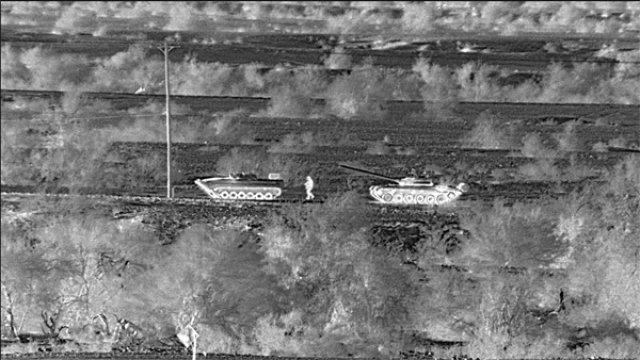
The Army’s premier scout sensor is the Long Range Advanced Scout Surveillance System, or LRAS3, also a science and technology effort from CERDEC NVESD. This long-wave infrared thermal imager, Day TV camera and a differential GPS-based far-target location system gives Soldiers the ability to detect and locate threats long before engaging targets with any direct action.
“By imaging scenes in the infrared, our warfighters are afforded additional capabilities to detect threats through smoke and fog with imagery stability over day, night and temperature extremes,” Reago said. “After identifying the threats, Soldiers have the capability to target these threats using CERDEC NVESD-developed micro-laser technology.”
Multiple athermal laser designs were developed over the last 10-12 years and have resulted in a significantly lighter weight and more compact man-portable laser designator/marker. Athermal means a process that does not involve either heat or a change in temperature. These NSVESD athermal laser designs are based on minimal electronics, Reago said.
The Army continues to look for advances in waveguide technology to provide advanced displays that improve ergonomics and Soldier situational awareness. These new displays can provide Soldiers with a wearable display, which is coupled with advanced algorithms and symbology to improve overall lethality.
“CERDEC NVESD is at the cutting edge of these types of displays for both Soldier-borne and vehicle-based platforms, slowly giving our Soldiers capabilities much like the predator from the future,” Reago said. “The work conducted at NVESD really matters to our Soldiers; the technology helps accomplish the mission while saving lives.”