Soldiers deployed to remote locations around the world need a lightweight charger for electronic devices that are critical to successful missions in the 21st century.
A team of U.S. Army engineers are developing new battery chargers for smartphones, tablet computers and laptops to use when there is no access to a traditional electrical grid. The team has engineered and built prototypes for 8-port, 4-port, and 2-port USB chargers, as well as an AC/USB adaptor, all of which use a military standard battery such as the BB-2590 as the main power source.
Electronics engineer Yuk Chan and electronics technician Ron Thompson are leading the effort for the U.S. Army Research, Development and Engineering Command. They develop solutions for Soldiers as part of the Command, Power and Integration Directorate at RDECOM’s Communications-Electronics Research, Development and Engineering Center, or CERDEC.
The key innovation is to design units that are able to charge multiple devices simultaneously from different military standard batteries, Chan said.
Having an on-site prototype integration facility, or PIF, at CERDEC reduces the time and cost of developing products for testing by Soldiers, Chan and Thompson explained.
“[The PIF] helps us with quick turn-arounds. Otherwise, we would have to wait months for a company to build the box. Having a prototyping facility in our own lab has been an asset in providing [rapid] support to the Soldier in the field,” Chan said. “It is a unique value added.”
Thompson said the PIF has a three-dimensional printer and circuit-board milling machine to design and build prototypes in days instead of months. The group also assembles and tests its products internally.
CERDEC’s first prototype was an 8-port battery charger designed for smartphones, Chan said. It weighs 2.5 ounces; can recharge up to eight phones simultaneously; and is compatible with the BB-2590, BA-5590, BA-5390, or BB-2557 military batteries. One fully charged BB-2590 can recharge a smartphone battery 37 times.
After producing the 8-port charger, CERDEC expanded the capability to include charging for tablet computers. The third-generation was a personal 2-port battery charger, weighing 1.8 ounces, for phones and tablets.
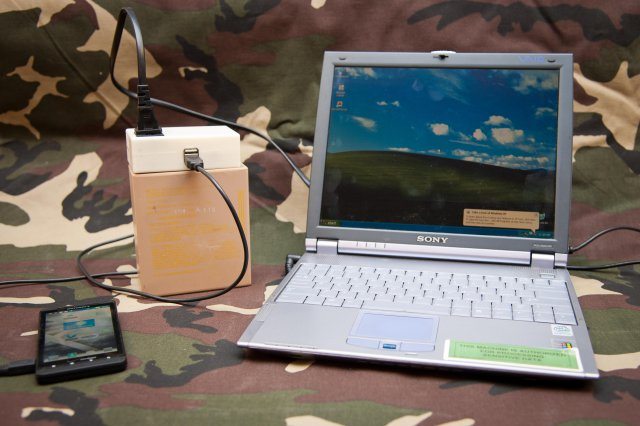
Late in 2011, Maj. Mark Owens of Project Manager Soldier Warrior at Fort Belvoir, Va., asked for eight 8-port chargers and eight 4-port chargers for field evaluation. In June 2012, he asked for additional 2-port chargers for field evaluation. At Owens’ request, Chan and Thompson then built a prototype with an AC adapter, weighing 5.9 ounces, to enable charging for a laptop and two smartphones.
Lt. Col. Margo Sosinski initiated a request to CERDEC in April 2012 for a USB charger to support Soldiers’ smartphones in the field. Sosinski is a uniformed science adviser at the National Training Center in Fort Irwin, Calif., as part of RDECOM’s Field Assistance in Science and Technology program, known as FAST.
RDECOM’s uniformed science advisers are assigned to major Army operational commands and training centers throughout the world to provide on-site technical advice and quick-reaction solutions to technical problems.
Chan said CERDEC’s reputation for delivering timely solutions and capabilities enabled by the PIF led to the initial and subsequent inquiries.
“We have a history of developing prototypes to be used in the field. That’s why NTC came to us,” Chan said. “We got a request, we placed an order for parts, and within five days, we had a working prototype. Within a week and a half, we were able to ship the working prototype to NTC.”
Four-port and 2-port chargers were issued to U.S. Africa Command in July. CERDEC also sent 20 2-port chargers to Soldiers in Afghanistan.
Another important consideration for Soldiers is the reliability of a power source, Chan said. In developing countries such as Afghanistan, U.S. forces cannot rely on the local grid for dependable energy because of the wide fluctuations in voltages in AC power. The solutions from CERDEC help to fill that gap with portable power.
The CERDEC team is now developing a 150-watt charger with AC adapter to power all commercially available laptops.