Sunday, March 29, 2026
  • About us
    • Write for us
    • Disclaimer
    • Terms of use
    • Privacy Policy
  • RSS Feeds
  • Advertise with us
  • Contact us
DefenceTalk
  • Home
  • Defense News
    • Defense & Geopolitics News
    • War Conflicts News
    • Army News
    • Air Force News
    • Navy News
    • Missiles Systems News
    • Nuclear Weapons
    • Defense Technology
    • Cybersecurity News
  • Military Photos
  • Defense Forum
  • Military Videos
  • Military Weapon Systems
    • Weapon Systems
    • Reports
No Result
View All Result
  • Home
  • Defense News
    • Defense & Geopolitics News
    • War Conflicts News
    • Army News
    • Air Force News
    • Navy News
    • Missiles Systems News
    • Nuclear Weapons
    • Defense Technology
    • Cybersecurity News
  • Military Photos
  • Defense Forum
  • Military Videos
  • Military Weapon Systems
    • Weapon Systems
    • Reports
No Result
View All Result
DefenceTalk
No Result
View All Result
Home Defence & Military News Army News

Virtual reality dome impact of real-life scenarios on cognitive abilities

by Army News Service
February 26, 2016
in Army News
2 min read
0
virtual reality dome

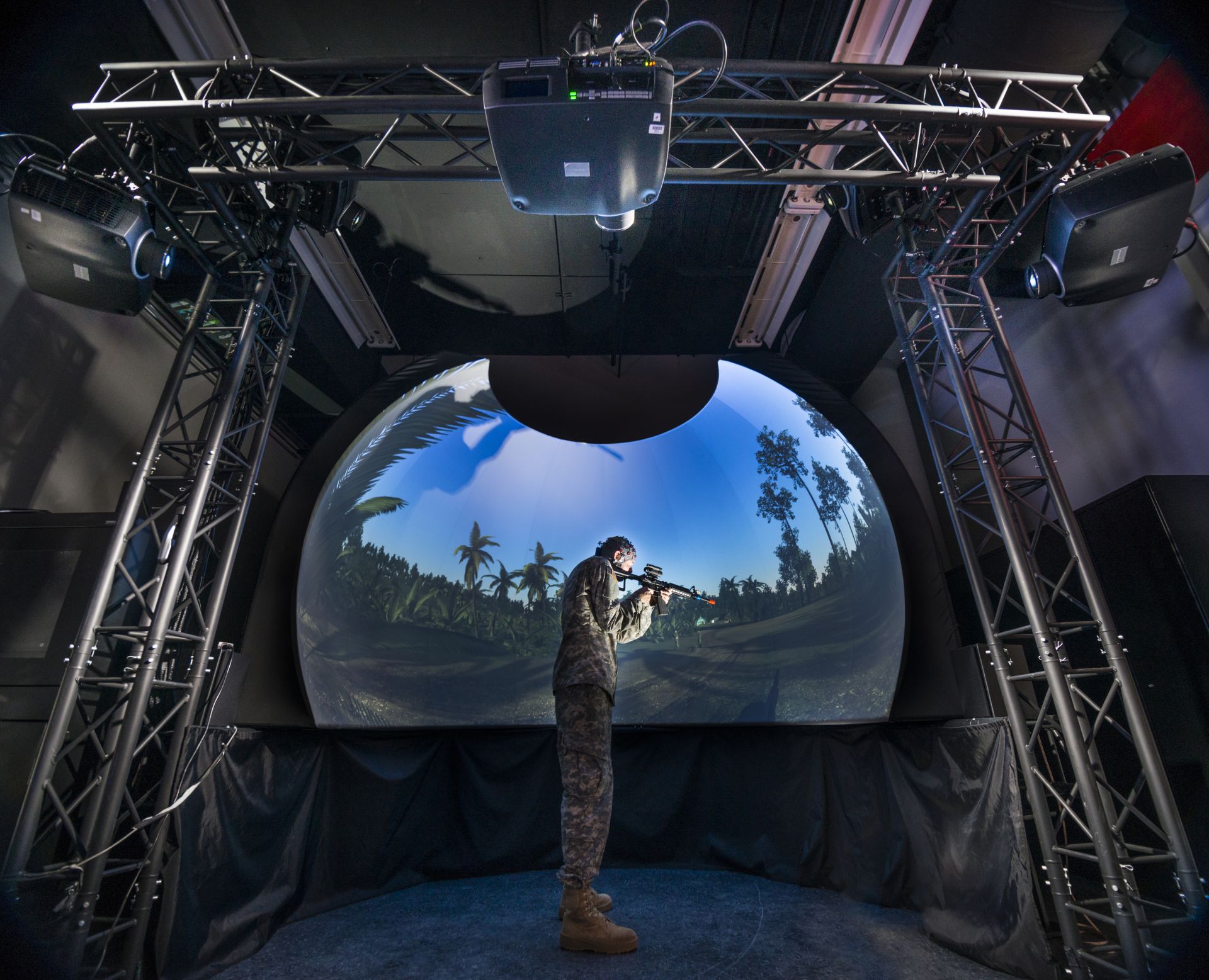
Natick's new virtual reality dome will enable researchers to assess the impact of the environment on Soldier cognition, including decision-making, spatial memory or wayfinding. Researchers will also be able to assess the impact of new equipment on cognitive abilities.

14
VIEWS

For researchers at the U.S. Army Natick Soldier Research, Development and Engineering Center (NSRDEC), there just may be no place like dome.

Thanks to its new virtual-reality dome, NSRDEC’s Cognitive Science and Applications Team will be better able to study the impact of real-world operational situations on a Soldier’s cognitive abilities and performance.

“The new VR laboratory will provide the Cognitive Science and Applications Team the ability to conduct research using more operationally relevant scenarios while still maintaining experimental control in our studies,” said Dr. Caroline Mahoney, team leader for NSRDEC’s Cognitive Science and Applications Team. “This capability brings our tightly controlled laboratory work one step closer to the field/operationally relevant environment.”

The concave virtual-reality system provides a full 180-degree horizontal field and uses high-density, front-projection to create a high-resolution, visual world. The system enables participants to have immersive experiences in seamless virtual environments, which are modeled after real-world locations.

“This NSRDEC virtual reality capability affords novel applied, interdisciplinary science and technology activities that close traditional translational gaps between laboratory and field,” Mahoney said. “The integration of multiple input modalities, along with multisensory feedback, increases the realism, immersion and engagement on behalf of users subjected to prolonged, workload-intensive activities.

“These novel integrations provide unprecedented opportunities to monitor and optimize human behavior during real-world task execution, and to evaluate and predict the impact of innovative human-systems technologies on operational performance.”

In the virtual dome, users can interact and alter the environment through hand-held and weapon-based devices, which control movement, orientation and weapon aiming.

“Individual-level behavior can be elicited through immersive, scripted scenarios, and measured through location and orientation tracking, eye tracking, physiology and neurophysiology,” Mahoney said.

The virtual dome will enable researchers to assess the impact of the environment on Soldier cognition, including decision-making, spatial memory or wayfinding. NSRDEC researchers will also be able to assess the impact of new equipment on cognitive abilities.

“For example, the Cognitive Science and Applications Team is currently working with Dr. Dave Darkow and the Mission Information Team to develop metrics for measuring cognitive workload during mission tasks and will use these tasks to measure the impact of new technology on Soldier cognition in operationally relevant environments,” Mahoney said.

NSRDEC and outside equipment developers will eventually use the Cognitive Science Team’s virtual dome data to aid in the design and development of Soldier technology and equipment.

In the future, additional and improved capabilities will be incorporated into the virtual dome. The future additions will include whole-body motion tracking, low-frequency vibration and directional wind. Vibro-tactile collision feedback — which combines vibration and touch to help give participants a physical sense of constraints in a virtual environment — will also be included.

“In the coming years, additional input modalities and multisensory feedback will be developed and integrated into the system to increase immersion,” said Mahoney.

Overall, the dome will provide extensive new insights into the thinking processes of Soldiers in the field.

“Our new, virtual-reality capability provides unprecedented translational value to basic and applied cognitive sciences, allowing us to bridge the gap between highly controlled laboratory research and the inherent richness, dynamics and complexity of real-world Soldier experiences,” said Dr. Tad Brunyé, a member of NSRDEC’s Cognitive Science Team.
Tags: Army & Security Forces NewshealthresearchtrainingVirtual RealityVR
Previous Post

Underwater robots can be programmed to make independent decisions

Next Post

Increased manpower must come with funding: US Army

Related Posts

Indonesia Orders Additional CAESAR Artillery Systems

France to send more mobile artillery to Ukraine

February 1, 2023

France will ship 12 more Caesar truck-mounted howitzers and fresh air defence equipment to Ukraine to bolster the fight against...

Leopard tanks to arrive in Ukraine around late March: Germany

Leopard tanks to arrive in Ukraine around late March: Germany

January 27, 2023

Leopard tanks pledged by Germany to help Ukraine repel Russia's invasion will arrive in "late March, early April", Defence Minister...

Next Post
Increased manpower must come with funding: US Army

Increased manpower must come with funding: US Army

Latest Defense News

US needs top cyber coordinator, better hacker ‘deterrence’

‘Digital fog of war’ around Iranian cyberattacks

March 13, 2026
US military says aircraft crash in Iraq killed 4 crew members

US military says aircraft crash in Iraq killed 4 crew members

March 13, 2026
Northrop Grumman moves to boost B-21 Raider output

Northrop Grumman moves to boost B-21 Raider output

March 13, 2026
US Navy evacuates virus-struck aircraft carrier Roosevelt

US military ‘not ready’ to escort tankers through Hormuz Strait

March 12, 2026
Israel cancels leave for combat units after Iran consulate strike

US says Iran campaign cost $11 billion in six days

March 12, 2026
US moves closer to retaliation over hacking as cyber woes grow

Cyberattack Disrupts Operations at MedTech Giant Stryker

March 11, 2026

Defense Forum Discussions

  • Royal Australian Navy Discussions and Updates 2.0
  • The Russian-Ukrainian War Thread
  • ADF General discussion thread
  • Indonesian Aero News
  • AUKUS
  • Middle East Defence & Security
  • Russia - General Discussion.
  • NZDF General discussion thread
  • Australian Army Discussions and Updates
  • Royal Australian Air Force [RAAF] News, Discussions and Updates
DefenceTalk

© 2003-2020 DefenceTalk.com

Navigate Site

  • Defence Forum
  • Military Photos
  • RSS Feeds
  • About us
  • Advertise with us
  • Contact us

Follow Us

No Result
View All Result
  • Home
  • Defense News
    • Defense & Geopolitics News
    • War Conflicts News
    • Army News
    • Air Force News
    • Navy News
    • Missiles Systems News
    • Nuclear Weapons
    • Defense Technology
    • Cybersecurity News
  • Military Photos
  • Defense Forum
  • Military Videos
  • Military Weapon Systems
    • Weapon Systems
    • Reports

© 2003-2020 DefenceTalk.com