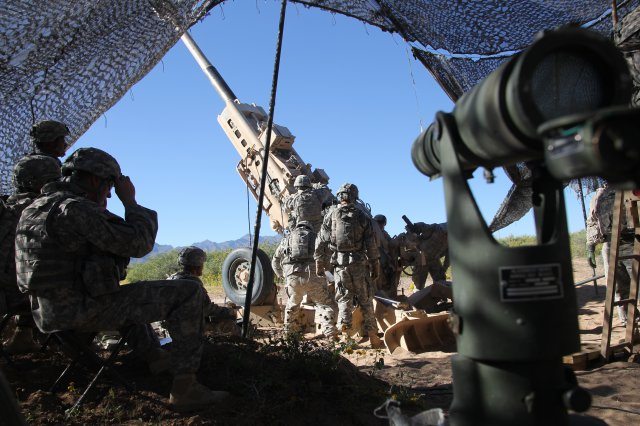
During the latest test of the Army’s mobile tactical communications network, Warfighter Information Network-Tactical Increment 2, a field artillery battalion used the Soldier Network Extension to extend the range of their fire support operations to the tactical edge and significantly cut the length of time it takes to process their fires missions.
The satellite-based Warfighter Information Network-Tactical, or WIN-T, Increment 2 SNE provides network communication and extension capabilities down to the company level.
“WIN-T Increment 2 allows us to operate as a lethal battery with the platoons much farther out than we normally would be able to operate,” said Capt. Sean Williams, A Battery commander, 4th Battalion, 27 Field Artillery Regiment, 2nd Brigade Combat Team, 1st Armored Division. “Before we were constrained by terrestrial location systems; since this is a satellite-based system, there is a much greater range now to digitally call for fire and process fires missions on the battlefield.”
During the WIN-T Increment 2 Follow-on Operational Test and Evaluation 2, Soldiers used the WIN-T Increment 2 SNE to retransmit fire and counter fire support information between upper and lower echelons during realistic operational missions. Forward observers and fire support officers once restricted by the line-of-sight distances of their radios to exchange fires information between maneuver platoons and brigade, can now execute these critical operations from any location within the brigade area of operations. For several missions, the kill chain timeline was ten times faster when using the WIN-T Increment 2 satellite network compared to previous times when using the line-of-sight Single Channel Ground and Airborne Radio System data and voice network.
Just as Soldiers in Operation Enduring Freedom utilized their organic WIN-T Increment 2 equipment in new ways, such as mobile hotspots, to support their unique operational requirements, Soldiers at both NIE 14.2 and NIE 15.1 utilized their organic WIN-T Increment 2 equipment to support their unique fires missions. The Army configured the network to support the traffic flow for these fires operations.
The WIN-T Increment 2 Follow-on Operational Test and Evaluation 2, aimed at evaluating the recent upgrades that make the system easier to operate and maintain, was held in conjunction with the Army’s Network Integration Evaluation, or NIE, 15.1, in October and early November, at Fort Bliss and White Sands Missile Range, New Mexico. Over 5,000 Soldiers, including 2/1AD and supporting units, conducted the test, which lasted over 19 days and covered over 3,000 square miles. This was the first time the Army utilized field artillery AN/TPQ36 and AN/TPQ37 radars connected into the WIN-T Increment 2 network, during an official test.
During their mission threads, field artillery units utilized the AN/TPQ36 radar, which locates indirect fire weapons such as mortars and shorter-range artillery, and the AN/TPQ37, used to locate longer-range artillery and rockets. The radars enable the units to see and track the point of origin of enemy fire so that fire can be returned if needed, “so instead of finding out as the mortar impacts, we find out as soon as it is fired,” said Sgt. Loveland Craig, 4-27 S6, radio retransmission team chief.
When units push out to the front lines, whether it’s for fires missions or counter-fire missions utilizing AN/TPQ36 and AN/TPQ37 radars, they are currently limited by the extension of their line-of-sight radio networks. During the NIE, Soldiers used the SNE to transmit that fire information from remote strategic locations on the battlefield, eliminating the need to set up, monitor and secure multiple retransmission sites.
“Because this WIN-T asset allows us to push farther away, we can push our radars out now, we can push our guns out, we can give immediate suppressive fire back,” Craig said. “And, it also allows us to have situational awareness across the entire battlefield.”
These new fires tactics, techniques and procedures utilizing WIN-T Increment 2 enabled radar sections to rapidly move and relocate anywhere on the battlefield to support the mission with faster setup times and dramatically improved target message transmission times. It enabled units far forward in the fight to deliver target acquisition information all the way back to headquarters, adding to the full-fires operational picture. That critical information could then be shared across the battlespace, including with aircraft and air defense systems, enabling more accurate and timely fires decisions.
“It allows us a lot more freedom as to where we can put the defensive and offensive pieces out there and still be able to track them across the battlefield,” said Maj. Stephen Dail, brigade communications officer for 2/1 AD.
Digital fires data is exchanged from the front line to battalion, brigade and higher, depending upon the criticality or location of the target, and the mission. To do this, the Army utilizes the Advanced Field Artillery Targeting and Direction System, or AFATDS, which aides in producing, analyzing and exchanging fires information among the U.S. Army, U.S. Marine Corps and other Joint architectures.
During the NIE scenarios, field artillery units used the SNE to push AFATDS data via satellite communications out to fires batteries in places where line-of-sight radios simply could not operate, such as on mountains or in low valleys. It also enabled fires and radar units to exchange larger files and critical situational awareness information, such as map updates, which wouldn’t easily be transmitted over line-of-sight radios, enabling more accurate and up to date target information and situational awareness.
Leveraging the WIN-T satellite network to improve fires and other missions, is aiding the Army in its modernization efforts in preparation for future contingencies. Army priorities are currently geared at improving force agility, the common operational picture and the ability to operate from any environment, terrain, or distance. The more the Army uses WIN-T Increment 2 in different environments and scenarios, the more Soldiers are levering its versatility to support these new and evolving requirements.
“We did an air assault a few days ago and it was too far out for FM communications, but with the WIN-T assets, we were able to communicate efficiently,” Craig said. “With WIN-T Increment 2, we can go farther, fight faster.”