The Army is on the cusp of revolutionizing materials that go into armament construction, making for stronger, lighter and more durable weapons, Dr. Andrew Littlefield said.
The key to this revolution is composite materials, said Littlefield, who is a mechanical engineer at the U.S. Army Armament Research, Development and Engineering Center at Picatinny Arsenal, New Jersey.
Littlefield’s topic, “Lightweighting of Large Caliber Weapons – Present and Future,” was presented during the National Defense Industrial Association-sponsored 2015 Armament Systems Forum here, April 21.
Most armaments are still constructed almost entirely of steel, as they have been for more than a century, he said.
The Army’s work with composite materials includes metal matrix, ceramic matrix and carbon-carbon composites in addition to polymer matrix, Littlefield said. For instance, carbon-carbon is used on space vehicles to withstand heat upon reentry. Heat resistance has real applicability to Army weapons systems because excessive heat is what often causes those systems to fail.
Besides the ability of some composites to withstand a lot of heat, another advantage is that they’re much lighter than steel, Littlefield said.
CHALLANGES
One of the biggest problems with composites is getting them to stick to the portions of a gun that must continue to be manufactured of steel, such as the barrel, Littlefield said.
In one of the early days of testing, composite material was wrapped around the steel tube of a howitzer, like a jacket. During the first test firing, “the gun recoiled, but the jacket didn’t,” he said.
A gun must also exhibit “stiffening” properties, he said. This stiffening is necessary to lessen vibration and ensure targeting accuracy. Some composites are two to three times stiffer than steel.
Another factor that needs to be controlled is “dynamic strain,” he said, meaning the possibility of the material breaking apart. Dynamic strain failure during testing has actually resulted in the muzzle end of the gun shearing off and flying downrange.
Composites also allow “tailorability” in design, he said. Different composite formulations can be used for different parts of a gun. In critical areas, stiffer, more expensive composites can be used. In other areas, less expensive, more flexible composites can be used.
For instance, certain layerings of composites can induce a desirable effect known as “coupling/extension-twist coupling,” he said. This design has been successfully used on experimental helicopters to change the rotors’ attack angle during flight. These composites would allow portions of a gun to twist slightly during recoil, like a rubber band, so the parts don’t shear or crack.
WEAPONS UPDATES
Littlefield touched lightly on composites developments for weapons systems.
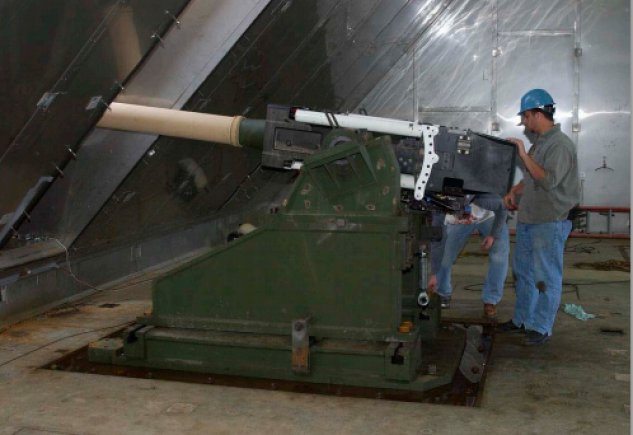
The XM360 120mm cannon, part of the now-cancelled Future Combat Systems, remains one of the most mature examples of composites development.
To ensure that the composite jacket fits securely over the barrel of the XM360, the steel core was first contracted by chilling it with frozen carbon dioxide, Littlefield said. Then, thermal plastic was wrapped tightly around it. Finally, as the frozen barrel warmed up, it expanded into the composite jacket.
Fourteen barrels were produced in this manner and each was tested. Some of them fired as many as 250 rounds. Tests were a complete success, he said, and this “technology is sitting on the shelf, ready for use.”
Among crew-served weapons, the 81mm mortar tube and baseplate are now being researched for composites integration, Littlefield said. Testing should begin in about another year.
Littlefield said that metal and ceramics composites are being tested to help with excessive overheating in mortar tubes. Composites could also help reduce the weight of mortar tubes, placing less of a burden on the teams that use them. Composites could reduce the entire weapon from 90 pounds down to 50 pounds, he said. The base plate alone would go from 25 to 15 pounds.
Work is also being done to lighten the M284 bore evacuator, used on the M256 cannon of the Abrams tank. Composites should lighten the M284 from 200 to 78 pounds. The new composites should be ready for use in about five years and will also be used for the 155mm howitzer.