WASHINGTON, D.C.: The Air Force’s top civilian addressed Air, Space and Cyberspace Power in the 21st Century during his portion of the 38th Institute for Foreign Policy Analysis-Fletcher Conference on National Security Strategy and Policy Jan. 20, here.
Air Force Secretary Michael Donley noted the service’s challenge to “plan for uncertainty in a complex security environment,” with a multi-faceted approach to supporting combatant commanders and national leadership.
The secretary also discussed strategies to allow the service to plan for uncertainty and ambiguity, mitigate the possibility of surprise, and both shape and recover from what Secretary of Defense Robert Gates described as likely “imperfect assessments” about the future.
Strategies include “engaging with partners and shaping the environment, making careful decisions in posturing U.S. forces abroad, developing balanced forces, promoting operational innovation, and developing the institutional capacity for change,” the secretary said.
He underscored the significance of joint initiatives, increased capabilities and reduced vulnerabilities in a 21st century security environment.
“The complex, hybrid nature of future conflict will continue to challenge us and will demand coalition, whole-of-government and joint applications of power,” Secretary Donley said.
The secretary added that national and international security will continue to be a “team sport” as the service confronts a wide range of strategic challenges such as global terror networks, nuclear deterrence, space, cyber and “rising economic and regional powers whose intentions may be unclear.”
“The Air Force needs to remain vigilant in tying our work to the National Security Strategy, the (Quadrennial Defense Review) and other authoritative guidance that sets the direction for DoD and the larger national security community,” he said.
Secretary Donley cited that Air Force presence in regions of interest is critical to building partnerships and partner capacity along the way. “Engagement provides early warning and helps us understand the direction and pace of change through the eyes of potential adversaries and partners in the region.”
He added that continuous engagement also creates avenues for sharing perspectives of the strategic environment and opportunities to shape that environment in ways favorable to the U.S.
“Well-developed air forces often seek partnership with us in the most advanced weapon systems, like the Joint Strike Fighter and intelligence, surveillance and reconnaissance or space-based capabilities,” Secretary Donley said.
The secretary continued that building partner capacity as an Air Force core function must be “sufficiently robust and flexible to address a broad range of engagement needs.”
Secretary Donley described basing access as “the lifeblood” of a globally oriented Air Force as the service seeks the right balance between the forward stationing of U.S. forces in key regions and periodic rotations and deployments. He explained sending the right message of long-term interest and commitment while preserving greater flexibility in the service’s global posture.
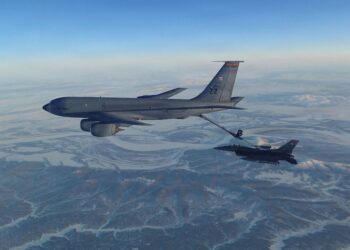
He said that the identification and exercise of contingency basing remains important to the force, particularly the mobility and tanker forces that facilitate joint movement and logistics.
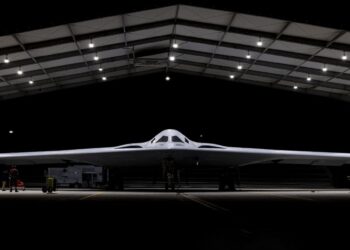
“This is why we also sustain periodic deployments of long-range strike aircraft in the Pacific,” he said, “and why, as we eventually field the (F-35) Joint Strike Fighter, we will consider the need for early beddowns outside the continental U.S.”
“(The service) must build in the flexibility that enables our forces to operate effectively across the spectrum of conflict,” he said.
This flexibility includes enabling such capabilities as C4, mobility, air refueling and ISR, on which the entire joint force depends at any level of conflict.
According to the secretary, the balance also reflects the need for a broad range of capabilities. “While reinforcing our counter-insurgency capabilities, we’re also building the Joint Strike Fighter. While working on command and control for missile defense, we’re building light attack armed reconnaissance and light air support aircraft. While planning for the recapitalization of the tanker fleet, we’re strengthening space situational awareness and cyber defense. And, while building up language and cultural competency, we continue research on directed weapons,” Secretary Donley said.
With contingency operations and humanitarian missions in Haiti in full swing, the secretary noted that the conference was occurring “at a most important time.”
“We are challenged to meet today’s requirements while preparing for tomorrow’s and doing both with fewer resources than we’d like,” he said.
Noting such pitfalls as planning too far ahead, getting mired in processes or locking into a single approach for success, Secretary Donley emphasized the institutional competence for change as the most important capability the service can foster.
“We need the capacity and culture to anticipate and recognize change early and respond quickly and effectively to new facts and circumstances,” he said. “Developing new joint initiatives, capabilities and closing vulnerability gaps will be important as we move into the future.”