SOUTHWEST ASIA: Being in a fight is easy; it is having the ability to stay in the fight until you win that is the hard part. This is especially true in the new type of war being fought by the coalition forces in Afghanistan where the enemy’s strategy is to outlast the resolve and sustainment capability of U.S. and coalition forces.
In Afghanistan today, the ability of both ground and air forces to engage the enemy is enabled in large part by the processes and systems executed by the Combined Air and Space Operation Center’s Air Mobility Division. Through their innovative approach and flexibility, they are able to coordinate and synchronize movement of supplies to those in need in a safe, efficient manner.
The conditions faced by military planners are extremely difficult and take an extraordinary effort to coordinate. The great distances to cover, poor weather conditions, as well as a very unfriendly terrain to navigate makes getting needed supplies where they need to go extremely difficult.
Because of these challenges, the Air Mobility Division staff working out of the Combined Air and Space Operations Center in Southwest Asia is able to provide valuable direction and oversight for the air mobility mission.
“We provide materials needed by those that are in the fight, whether it is fuel or bombs for close-air-support aircraft, or bullets for troops on the ground,” said Lt. Col. John Roscoe, the chief of the Air Mobility Division at the CAOC. “This has been even more important in Afghanistan where a lack of infrastructure limits both overland supply activity as well as capacity for logistics to flow through existing operating locations.”
In coordination with other service and coalition partners, the Air Mobility Division staff is responsible for integrating requirements for airlift, airdrop, refueling and aeromedical evacuation. The coordination and synchronization of this effort is done through the air tasking order cycle, which is the mechanism for providing transparency to logistics requirements and assigning available coalition assets to support each requirement.
The airlift operation has come a long way over the last seven years in Afghanistan.
“There have been several innovative approaches that have enabled us to be more proactive versus reactive,” Colonel Roscoe said. “We have been able to continuously monitor the force structure to right size available assets needed given changing requirement levels. In some cases we were able to send aircraft home to save resources and reduce the cost of operations.”
Experiences in operations Iraqi Freedom and Enduring Freedom have enabled air mobility aircraft to significantly improve their effectiveness and efficiency.
“Being able to anticipate requirements through the use of historical data have enabled us to effectively posture the force,” Colonel Roscoe said. “We are always looking ahead. Since there are never enough aircraft to fully support requirements, we plan in a joint environment and work to use available assets judiciously.”
Another innovation that has been particularly effective is the theater express program. Colonel Roscoe said, “Through this program we are able to offer up cargo to commercial air couriers for “tender” where these contract carriers essentially bid to move “non-military cargo” (general replenishment supplies). This allows us to focus military cargo airlift on moving combat systems and passengers while reducing overall cost to the taxpayer.”
He said the goal is to move up to 50 percent of the cargo commercially and use the available military aircraft for high-priority missions. “We are moving toward a point where the commercialization of airlift in Iraq is possible as we reduce our presence there in accordance with the Status of Forces Agreement.”
While it is much more efficient to land to offload cargo, sometimes troops on the ground need more immediate resupply. For these needs, coalition aircraft have become very proficient at airdropping materials.
“While airdrops are not as efficient as unloading cargo on a ramp, they do give the capability to provide supplies directly to the user on the ground increasing the effectiveness of resupply efforts,” Colonel Roscoe said. “The new technology we employ and the precision of our aircrews forged over years of training and operational missions has enabled coalition units to achieve unparalleled accuracy and success with our airdrop missions.”
The improved efficiency has been extremely valuable. In 2008 alone, nearly 15 million pounds of supplies were airdropped in Iraq and Afghanistan.
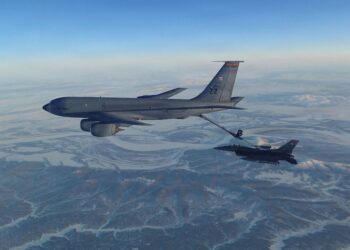
In another example of innovation in the air refueling mission, also in 2008, more than1 billion pounds of fuel were passed to coalition aircraft.
“If you take what we offload in one day alone, equal to energy, this is enough power to light Las Vegas for two days,” Colonel Roscoe said.
This tremendous requirement for fuel takes precise planning and innovative approaches to complete. Tankers are now much more efficient in supporting combat aircraft.
“We are finding new, innovative ways to reduce the time it takes to refuel our aircraft,” Colonel Roscoe added. “This allows aircraft that are responding to support ground operations to reduce their response time significantly and consequently vastly improving their effectiveness. Simply put, the faster we get our strike aircraft to the fight the more lives of friendly forces we save.”
“We are also doing a lot to support Afghan and coalition forces through aeromedical evacuations,” the colonel said. “We are able to treat in-route and have a 98 percent survival rate once we get them to the theater hospitals.”
He explained they then coordinate for the transport of patients through inter-theater airlift to strategic hospitals, “the safety of how we move people and patients is one of the most important missions we have.”
The success of Air Mobility Division’s coordination efforts enabled the evacuation of more than 9,800 patients in 2008 by in-theater aeromedical flights.
Colonel Roscoe said the air logistics teams are not resting on their successes.
“We are working toward improved in-transit visibility between various coalition aircraft which will enable us to maximize utilization of available space on our various aircraft,” he said. “This will enable us, across all of our missions, to better address the great distances and complexity that we are facing within Afghanistan. This will be enabled by a common scheduling system across the combined/joint forces world.”