Wednesday, April 8, 2026
  • About us
    • Write for us
    • Disclaimer
    • Terms of use
    • Privacy Policy
  • RSS Feeds
  • Advertise with us
  • Contact us
DefenceTalk
  • Home
  • Defense News
    • Defense & Geopolitics News
    • War Conflicts News
    • Army News
    • Air Force News
    • Navy News
    • Missiles Systems News
    • Nuclear Weapons
    • Defense Technology
    • Cybersecurity News
  • Military Photos
  • Defense Forum
  • Military Videos
  • Military Weapon Systems
    • Weapon Systems
    • Reports
No Result
View All Result
  • Home
  • Defense News
    • Defense & Geopolitics News
    • War Conflicts News
    • Army News
    • Air Force News
    • Navy News
    • Missiles Systems News
    • Nuclear Weapons
    • Defense Technology
    • Cybersecurity News
  • Military Photos
  • Defense Forum
  • Military Videos
  • Military Weapon Systems
    • Weapon Systems
    • Reports
No Result
View All Result
DefenceTalk
No Result
View All Result
Home Defence & Military News Technology News

US Air Force’s Space Plane Has Been in Orbit for 500 Days, But Why?

by Sputnik
October 14, 2016
in Technology News
3 min read
0
Boeing Orbital Test Vehicle X-37B Begins 1st Flight
14
VIEWS

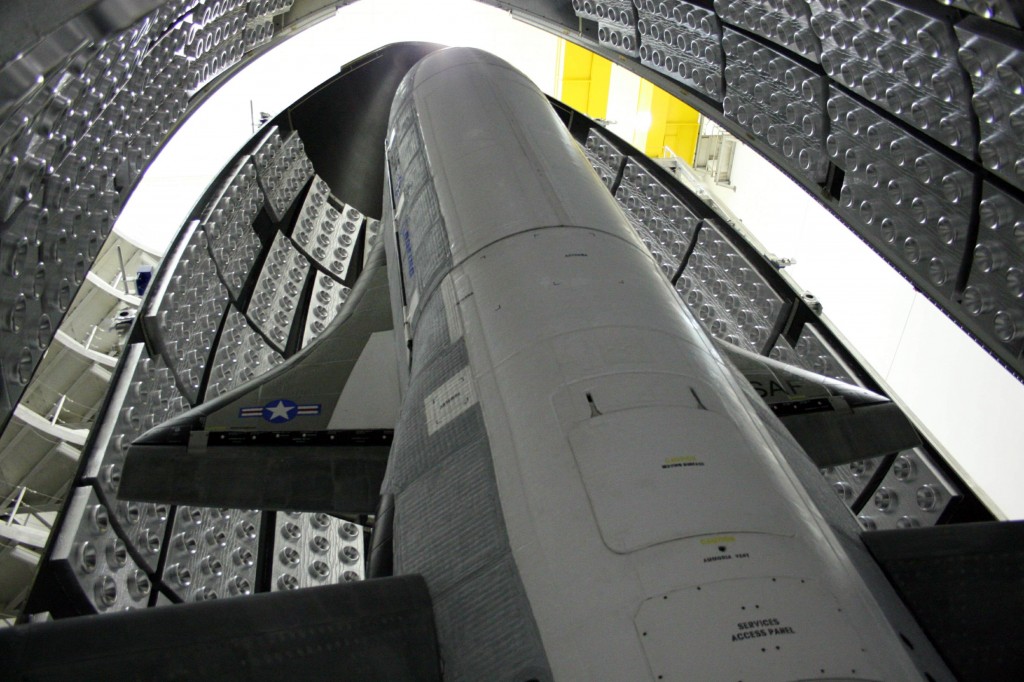
The US Air Force’s unmanned X-37B space plane has now spent more than 500 days orbiting the Earth, without statement or explanation.The 29-foot unmanned plane is part of the Air Force’s orbital program. Launched May 20, 2015, it is the program’s fourth flight (hence its other name, OTV-4 for Orbital Test Vehicle-4). The first OTV took flight in 2010 and spent 224 days in orbit; two others brought the total number of OTV days in orbit before 2015 to 1,367, according to the Air Force.

The full purpose or intent of the program? The US Air Force remains mum.

The Air Force will only say in its program factsheet that the initiative is to “demonstrate technologies for a reliable, reusable, unmanned space test platform for the US Air Force. The primary objectives of the X-37B are twofold: reusable spacecraft technologies for America’s future in space and operating experiments which can be returned to, and examined, on Earth.”

The Secure World Foundation, a Colorado-based private foundation dedicated to the peaceful, sustainable use of space, found in its 2010 fact sheet on the X-37B program that “none of the potential missions posited by the US military appear to justify the program’s existence, especially on a cost basis …”

This has led to speculation that the spaceplanes are intended to be used to capture satellites, as was mused in a 2014 Guardian article, or even that the American military is testing space-to-earth weapons.

Secure World found suggested that it is most likely that the plane is an on-orbit sensor platform, containing “various sensors used for intelligence collection of the Earth from space, potentially including radar, optical, infrared, and signals/electronic intelligence (SIGINT/ELINT) suites to flight-test and evaluate new sensors and hardware.” Brian Weedon, a consultant with Secure World and former Air Force officer who wrote the fact sheet, put it more bluntly in an interview with ABC in 2014.

“What I think is more practical [than other theories] is that it’s setting up technology for surveillance,” he said.

Experts speaking with Air and Space Magazine in 2015 generally concurred. Any technology the Air Force is testing on its spaceplane must have military applications, the magazine noted, possibly for communications, navigation, surveillance or anti-satellite and counter-anti-satellite operations.

Most likely among these are advanced surveillance sensors, the magazine suggests. “I think that’s probably what they’re not telling you, that there are payloads in there that might be part of the design for future reconnaissance satellites,” said Director and Senior Fellow in the Strategic Technologies Program at the Center for Strategic and International Studies James Andrew Lewis in the article.

“The idea of being able to launch an unmanned research platform that can stay up there for months on end provides you with all kinds of capability, both military and civilian,” said Chris Hellman, a policy analyst with the National Priorities Project, an American budget watchdog group, to the Christian Science Monitor in 2010. The idea of American eyes being able to hover at low orbits over any part of the planet has security experts and arms control advocates concerned, the story noted.

NASA has revealed that on this particular mission, it is carrying a materials experiment as well as facilitating a solar sail demo by the Planetary Society and giving nine CubeSat nanosatellites a lift, according to the Daily Mail.

Space.com reports that Aerojet Rocketdyne claims that it tested a new thruster onboard the plane, and that the Air Force is also testing a new propulsion system. NASA began the X-37B program in 1999, then transferred it to Defense Advanced Research Projects Agency (DARPA) in 2004 to test an Approach and Landing Test Vehicle. The Air Force took over after 2006.


Tags: sensorsspaceUS air forceX-37B
Previous Post

Tech giants race for edge in artificial intelligence

Next Post

ISIS drone kills Kurdish fighters, hurts French troops

Related Posts

US needs top cyber coordinator, better hacker ‘deterrence’

‘Digital fog of war’ around Iranian cyberattacks

March 13, 2026

Hostilities on the digital front have intensified since the outbreak of war between the US, Israel and Iran, with many...

US moves closer to retaliation over hacking as cyber woes grow

Cyberattack Disrupts Operations at MedTech Giant Stryker

March 11, 2026

A cybersecurity incident affecting Stryker Corporation—one of the world’s largest manufacturers of medical devices—has drawn renewed attention to the growing...

Next Post
ISIS drone kills Kurdish fighters, hurts French troops

ISIS drone kills Kurdish fighters, hurts French troops

Latest Defense News

US needs top cyber coordinator, better hacker ‘deterrence’

‘Digital fog of war’ around Iranian cyberattacks

March 13, 2026
US military says aircraft crash in Iraq killed 4 crew members

US military says aircraft crash in Iraq killed 4 crew members

March 13, 2026
Northrop Grumman moves to boost B-21 Raider output

Northrop Grumman moves to boost B-21 Raider output

March 13, 2026
US Navy evacuates virus-struck aircraft carrier Roosevelt

US military ‘not ready’ to escort tankers through Hormuz Strait

March 12, 2026
Israel cancels leave for combat units after Iran consulate strike

US says Iran campaign cost $11 billion in six days

March 12, 2026
US moves closer to retaliation over hacking as cyber woes grow

Cyberattack Disrupts Operations at MedTech Giant Stryker

March 11, 2026

Defense Forum Discussions

  • Royal Australian Navy Discussions and Updates 2.0
  • Royal New Zealand Navy Discussions and Updates
  • Middle East Defence & Security
  • Royal Canadian Navy Discussions and updates
  • International Army News Thread
  • Indonesian Aero News
  • Croatian Air Force News and Discussion
  • Chinese J50
  • Air Based Offensive Against Iran- Possible?
  • Chinese Air Force (PLA-AF) News and Discussion
DefenceTalk

© 2003-2020 DefenceTalk.com

Navigate Site

  • Defence Forum
  • Military Photos
  • RSS Feeds
  • About us
  • Advertise with us
  • Contact us

Follow Us

No Result
View All Result
  • Home
  • Defense News
    • Defense & Geopolitics News
    • War Conflicts News
    • Army News
    • Air Force News
    • Navy News
    • Missiles Systems News
    • Nuclear Weapons
    • Defense Technology
    • Cybersecurity News
  • Military Photos
  • Defense Forum
  • Military Videos
  • Military Weapon Systems
    • Weapon Systems
    • Reports

© 2003-2020 DefenceTalk.com