Monday, March 30, 2026
  • About us
    • Write for us
    • Disclaimer
    • Terms of use
    • Privacy Policy
  • RSS Feeds
  • Advertise with us
  • Contact us
DefenceTalk
  • Home
  • Defense News
    • Defense & Geopolitics News
    • War Conflicts News
    • Army News
    • Air Force News
    • Navy News
    • Missiles Systems News
    • Nuclear Weapons
    • Defense Technology
    • Cybersecurity News
  • Military Photos
  • Defense Forum
  • Military Videos
  • Military Weapon Systems
    • Weapon Systems
    • Reports
No Result
View All Result
  • Home
  • Defense News
    • Defense & Geopolitics News
    • War Conflicts News
    • Army News
    • Air Force News
    • Navy News
    • Missiles Systems News
    • Nuclear Weapons
    • Defense Technology
    • Cybersecurity News
  • Military Photos
  • Defense Forum
  • Military Videos
  • Military Weapon Systems
    • Weapon Systems
    • Reports
No Result
View All Result
DefenceTalk
No Result
View All Result
Home Defence & Military News Air Force News

Dutch scientists flap to the future with ‘insect’ drone

by Agence France-Presse
February 24, 2014
in Air Force News
2 min read
0
Dutch scientists flap to the future with ‘insect’ drone
14
VIEWS

Dutch scientists have developed the world’s smallest autonomous flapping drone, a dragonfly-like beast with 3-D vision that could revolutionize our experience of everything from pop concerts to farming.

“This is the DelFly Explorer, the world’s smallest drone with flapping wings that’s able to fly around by itself and avoid obstacles,” its proud developer Guido de Croon of the Delft Technical University told AFP.

Weighing just 20 grams (less than an ounce), around the same as four sheets of printer paper, the robot dragonfly could be used in situations where much heavier quadcopters with spinning blades would be hazardous, such as flying over the audience to film a concert or sport event.

The Explorer looks like a large dragonfly or grasshopper as it flitters about the room, using two tiny low-resolution video cameras — reproducing the 3-D vision of human eyes — and an on-board computer to take in its surroundings and avoid crashing into things.

And like an insect, the drone which has a wingspan of 28 centimeters (11 inches), would feel at home flying around plants.

“It can for instance also be used to fly around and detect ripe fruit in greenhouses,” De Croon said, with an eye on the Netherlands’ vast indoor fruit-growing business.

“Or imagine, for the first time there could be an autonomous flying fairy in a theme park,” he said.

‘Real small insects’

Unlike other drones that use rotor blades and can weigh hundreds of times as much, the Explorer has two wings on each side that flap rapidly to create lift.

“We got our inspiration from real small insects,” De Croon said.

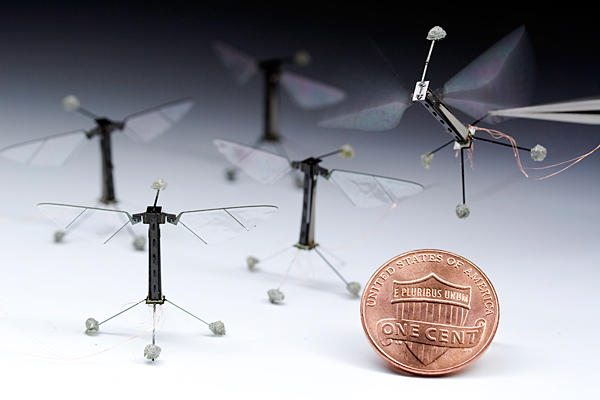
While smaller “flapping” drones exist, such as the RoboBee developed by students at Harvard University in the United States, they are tethered for power, control and processing, and thus far from autonomous.

The Explorer has its own small lithium polymer battery that allows it to fly for around nine minutes, while it “sees” with its onboard processor and a specially-developed algorithm to make instant decisions.

It has wireless analog video, gyroscopes and a barometer to calculate its height.

Different algorithms would allow it to perform different tasks, and because it is autonomous it could be sent into enclosed spaces such as concrete buildings or mine shafts, where radio control would be impossible, to search for casualties or hazards.

“The DelFly knows precisely where obstacles are located,” said De Croon as the aircraft, built from composite materials including carbon fibre, fluttered towards a wall during a demonstration flight before veering elegantly away in search of another route.

The idea of building a flapping-winged drone began around nine years ago when a group of students at Delft Technical University’s prestigious aerospace faculty first designed the DelFly I.

Over the next few years, research continued and the machine became smaller and smaller, said Sjoerd Tijmons, 28, who helped write the algorithm for the latest DelFly Explorer’s “brain”.

An earlier incarnation, the DelFly Micro with a wingspan of 10 centimetres, was in 2008 declared the “smallest camera equipped aircraft in the world” by the Guinness Book of Records.

But De Croon admits that humans are not quite able to produce swarms of autonomous robotic insects the size of bees or flies, mainly because of restrictions on battery life.

“Still there are some major challenges… and if I have to put a number on it, I think we are still a few decades away,” he laughed.
Tags: dronesinsect droneRoboBeeUnmanned Aerial Vehicle
Previous Post

Why is the US spending so much on the F-35 fighter?

Next Post

Turkey Formally Inducts First AEW&C Aircraft

Related Posts

US military says aircraft crash in Iraq killed 4 crew members

US military says aircraft crash in Iraq killed 4 crew members

March 13, 2026

A US KC?135 aerial refueling aircraft crashed in western Iraq killing four crew members, the military said Friday, adding that...

Northrop Grumman moves to boost B-21 Raider output

Northrop Grumman moves to boost B-21 Raider output

March 13, 2026

Northrop Grumman and the U.S. Air Force are ramping up production capacity for the B-21 Raider to field the new...

Next Post
NATO AWACS proves interoperability during test

Turkey Formally Inducts First AEW&C Aircraft

Latest Defense News

US needs top cyber coordinator, better hacker ‘deterrence’

‘Digital fog of war’ around Iranian cyberattacks

March 13, 2026
US military says aircraft crash in Iraq killed 4 crew members

US military says aircraft crash in Iraq killed 4 crew members

March 13, 2026
Northrop Grumman moves to boost B-21 Raider output

Northrop Grumman moves to boost B-21 Raider output

March 13, 2026
US Navy evacuates virus-struck aircraft carrier Roosevelt

US military ‘not ready’ to escort tankers through Hormuz Strait

March 12, 2026
Israel cancels leave for combat units after Iran consulate strike

US says Iran campaign cost $11 billion in six days

March 12, 2026
US moves closer to retaliation over hacking as cyber woes grow

Cyberattack Disrupts Operations at MedTech Giant Stryker

March 11, 2026

Defense Forum Discussions

  • Middle East Defence & Security
  • Royal Australian Navy Discussions and Updates 2.0
  • Russian Navy Discussions and Updates
  • ADF General discussion thread
  • Indonesian Aero News
  • Unmanned and Autonomous Air Vehicles
  • The Russian-Ukrainian War Thread
  • Indonesia: 'green water navy'
  • AUKUS
  • Russia - General Discussion.
DefenceTalk

© 2003-2020 DefenceTalk.com

Navigate Site

  • Defence Forum
  • Military Photos
  • RSS Feeds
  • About us
  • Advertise with us
  • Contact us

Follow Us

No Result
View All Result
  • Home
  • Defense News
    • Defense & Geopolitics News
    • War Conflicts News
    • Army News
    • Air Force News
    • Navy News
    • Missiles Systems News
    • Nuclear Weapons
    • Defense Technology
    • Cybersecurity News
  • Military Photos
  • Defense Forum
  • Military Videos
  • Military Weapon Systems
    • Weapon Systems
    • Reports

© 2003-2020 DefenceTalk.com