U.S. Army engineers will discuss the results of their efforts to enable a self-aware, decision-making network during the Military Communications Conference 2011, Nov. 8 at the Baltimore Convention Center.
The U.S. Army Research, Development and Engineering Command’s communications-electronics center, or CERDEC, has developed cognitive wireless networking capabilities that employ network-wide learning and reasoning algorithms that share information that enable nodes to make decisions.
CERDEC engineers hope that the results of their Cognitive Algorithm & Network Design Experiment, or CANDE, will enable easier network maintenance, reduce human decision-making requirements, increase network lifetime, transfer data with less delay, and reduce energy consumption — all of which result in a higher degree of network performance on the battlefield.
“It’s important that we apply learning and reasoning because currently, there’s no ‘intelligence’ in the network. Therefore, we’re developing capabilities that will aid the network in taking on this adaptive layer of learning and information sharing to reduce the complexity in managing the network,” said Sharon Mackey, chief for the Network Design and Cognitive Networking Sciences branch of CERDEC’s Space &Terrestrial Communications Directorate.
A more intelligent infrastructure reduces the need for Soldier intervention and aids in providing seamless information, noted Mitesh Patel, S&TCD technical lead for CANDE.
“A Soldier has to keep track of a lot of things to maintain the network such as network constraints, requirements and objectives. With cognitive algorithms, the network is more intelligent and self aware thus reducing resource management in the network,” Patel said.
One of the products within CANDE is the Cognitive Network Engineering Design Analytic Toolset, or CNEDAT, which can provide network design architectures for networks as they are being engineered, maintained, repaired or redesigned.
“The CNEDAT does not need a constructed network. Provide the constraints and objectives, and it will create a network for you: that is the power of this tool. It can optimize existing networks, and it can design a network from scratch while providing the most optimized way of maneuvering through the network,” Patel said.
One way it does this is by choosing a tactical radio signal’s “hopping pattern.” Radios typically “hop” to the closest radio; however, the closer radio may not always be the better choice if it is congested with traffic, explained Charles Graff, an electronics engineer with CERDEC S&TCD.
“The algorithm looks at the delay estimation to all source destination pairs and then determines which route has the best bandwidth or least traffic before transmitting data. The algorithm then updates itself on a periodic basis and learns from past experience not to take certain paths,” Graff said.
The algorithms can also enable a “dimmer-switch” capability to help reduce network energy consumption.
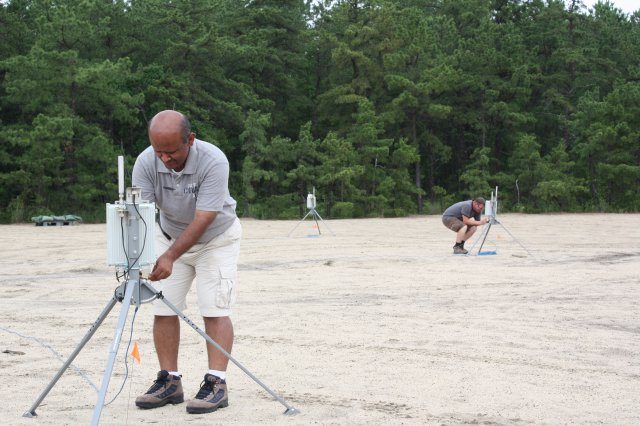
CERDEC S&TCD proved their concept in an operationally-relevant environment June 1- July 15 at Fort Dix, N.J., during Command, Control, Communications, Computers, Intelligence, Surveillance, and Reconnaissance & Network Modernization Event 2011.
Throughout CANDE, CERDEC S&TCD utilized commercial off-the-shelf radios to prove the operations of cognitive algorithms. The overall field network performance validated the predictions of CNEDAT based on prior work done in CERDEC laboratories, Mackey said.
“Anytime you try to put something on the network, it consumes network overhead, which in turn reduces bandwidth; the implementation of CANDE was achieved with minimal impact on the network overhead,” Mackey said.
CERDEC S&TCD is seeking to establish a follow-on program to conduct analysis on tactical radios in a testbed environment; currently, they are looking at the WIN-T and JTRS communities as targets of opportunity for transition, Graff said.