,
EDWARDS AIR FORCE BASE: The YAL-1A Airborne Laser, a modified Boeing 747-400F, successfully test fired its target illuminator laser March 15 during a five-hour test flight.
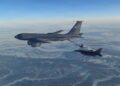
The mission and test firing represented the Airborne Laser's first in-flight external laser firing, and used the NC-135E “Big Crow” test aircraft to verify the ABL's ability to track an airborne target and measure atmospheric turbulence.
The Airborne Laser aircraft is undergoing a long-term test phase at the Air Force Flight Test Center here.
“This mission is a big milestone for our program,” said Lt. Col. Michel Zumwalt, the 417th Flight Test Squadron Airborne Laser Combined Test Force operations officer. “It's the first time we've actually had photons leaving the airplane in flight. In other words, we shot a kilowatt-class laser out of our aircraft and we were able to track a target, which is a big step towards meeting one of the mid-milestones (or knowledge points) for this program.”
The test firing was performed multiple times off the California coast, said Colonel Zumwalt, who is one of only three Air Force ABL pilots.
Current testing of the ABL is in preparation for the integration later this year of the chemical oxygen iodine laser, or COIL, a missile-killing, high-energy chemical laser.
The COIL is composed of six interconnected modules, each as large as a sport-utility vehicle turned on end. Each module weighs about 6,500 pounds and has 3,600 separate parts. When fired through a window in the aircraft's nose turret, it produces enough energy in a 5-second burst to power a typical household for more than one hour.
The COIL is a megawatt-class laser, as opposed to the less-powerful kilowatt-class targeting laser test fired on the March 15 mission, said Dr. Roc White, a contract test director and test conductor for the Airborne Laser Combined Test Force, who was aboard the aircraft during the test flight.
“We spent an intense four or five months of ground tests back at Wichita (Kansas), first installing and then thoroughly testing out the beam control system which involved two high-power illuminator lasers,” Dr. White said, talking about the different classes of lasers the Airborne Laser weapon system will have. ” We call it low-power system integration, but that is a relative term, relative to the ultimate weapon system, which is the COIL.
“These high-power illuminators are significant laser systems, hence all of the concentration on doing this safely (which was) initially proven out on the ground,” he said. “The ground testing enabled us to basically walk through the steps, but there is nothing like a live test. Since we got back here to Edwards in December, we've been working to make it to this point to do this first open-air laze. The mission couldn't have gone much better.”
Mitchell Ray, the Boeing air vehicle integration and test operations lead, also the test director for the March 15 mission, said, “I think it's probably pretty clear by now that this is a rather complex choreography, if you will, of assets. All kinds of things need to come together to enable us to do this. What we want to do is get all the external factors just right so we test the actual weapons system.
“On the 15th, everything came together and allowed us to do that,” Mr. Ray said. “(This was) our first attempt at doing it, and on our very first try, we got it right (on) the mark.”
The next major step for the test program is to combine what was started with the tracking of another aircraft with the Target Illuminator Laser, Dr. White said, thus being able to then project out the surrogate high-energy laser, called the SHEL.
“The surrogate high-energy laser will be representative of what the COIL is (and perform) in a manner that will prepare us for actually installing the COIL,” he said.
The Missile Defense Agency is testing and developing the Airborne Laser as part of the boost phase defense segment of the Ballistic Missile Defense System. The ABL, designed to identify, track and intercept enemy ballistic missiles shortly after missile launch, would operate at altitudes above the clouds to locate and track missiles in their boost flight phase, and then accurately point and fire the high-energy laser to intercept enemy missiles near their launch areas, MDA officials said.