Climate change is rapidly transforming the Arctic and the US Navy is falling behind as international powers jockey for power over vast oil resources, suggested a US study released on Thursday.
The report by the National Academy of Sciences (NAS) pointed to areas where the United States needs to bolster its forces as warming temperatures break up polar ice, raise sea levels, and potentially cause more international chaos.
A sea-level rise in the Arctic over the next two decades is “highly certain to occur and highly certain to come with economic costs” in a region thought to hold more than one-fifth of the world’s untapped hydrocarbons, it said.
The past three years have seen a surge of global interest in the Arctic, on a level not seen since the Cold War, but United States has not pursued this with the same vigor as Russia, Norway, Denmark and other countries.
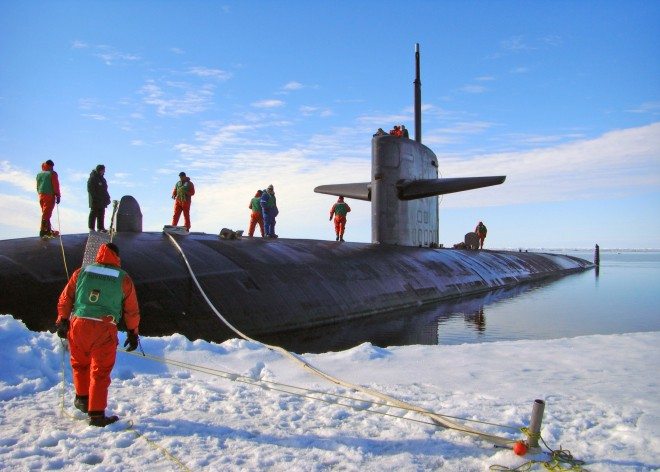
“The retreat of Arctic sea ice in summer is fundamentally altering the naval forces’ mission by allowing increasing access to the harsh and highly variable Arctic environment,” said the study by the NAS’s National Research Council (NRC).
“Surface and air operations have not been a priority for the Navy in the high latitudes for almost 25 years; so, today’s naval forces lack experience and procedures for the challenges of these northern environments,” it said.
Less ice near the North Pole means more boats will have access to the waters, leaving countries more prone to bickering over existing border disputes.
“It is anticipated that major international maritime passages in the Arctic will be accessible by the year 2030, at least during the summer months,” said the study.
Over the next 90 years, the global average sea level rise could range between 0.4 to two meters (1.3-6.5 feet), with a most likely value of about 0.8 meters (2.6 feet), it said citing recent peer-reviewed scientific literature.
“There are eight ‘frontline’ Arctic nations — Canada, Denmark, Finland, Iceland, Norway, Russia, Sweden, and the United States — many with unresolved claims in the region,” it said.
“Russia, Canada, Norway, and Denmark are all expanding their Arctic military capabilities,” the study added.
“There should be no assumption that the geostrategic situation will take care of itself or that US interests in the region are currently protected and promoted.”
Meanwhile the US Navy has no surface combatants hardened for ice operations, and the world’s sole superpower has only one working icebreaker ship.
Icebreaker operating budgets are controlled by the National Science Foundation, not the US military.
“US icebreaking resources are clearly inadequate to meet national needs,” it said.
“This deficiency is particularly significant given the recent and continuing investment in icebreaking resources by other countries, including China, Russia, Japan, South Korea, and the European Union.”
According to an earlier report by the NRC, Russia has 18 icebreakers — seven of which are nuclear-powered — while Finland and Sweden have seven each and Canada has six.
“China and (South) Korea, while not Arctic nations, have signaled their interest and intent to participate in the Arctic, including routine deployments of an icebreaking research vessel,” it added.
The research group said the fact that the United States has signed but not ratified the United Nations Convention on the Law of the Sea (UNCLOS) “will become even more problematic with time and as more states call for international recognition of their Arctic claims.”
Other areas of concern include how the US naval ships may be called to respond to more natural disasters around the world, and may need to stay deployed for longer periods.
The Navy also has no methods for long term forecasting of sea and climate shifts and must rely on civilian and international groups for those figures even though it has “billions of dollars in assets exposed to the threats of climate change.”
The researchers suggested that planning scenarios be revised to account for the effects of climate change, and urged new war gaming activities to test their response to new challenges.