Army researchers are finding they have much to learn from bees hovering near a picnic spread at a park.
Dr. Joseph Conroy, an electronics engineer at the U.S. Army Research Laboratory, known as ARL, part of the Research, Development and Engineering Command, works with robotic systems that can navigate by leveraging visual sensing inspired by insect neurophysiology.
A recently developed prototype that is capable of wide-field vision and high-update rate, hallmarks of insect vision, is something researchers hope to test at the manned and unmanned teaming, or MUM-T, exercise at the Maneuver Center of Excellence, Fort Benning, Georgia. This project will give us a chance to implement methods of perception such as 3-D mapping and motion estimation on a robotics platform, Conroy said.
The Maneuver Center of Excellence exercise will test whether ARL’s robotics platform is on track with the Army’s vision to team a robot with a Soldier. The tests will help to inform ARL researchers on how Soldiers might utilize information that can be provided by these platforms while attempting to clear a building from a safe distance in an urban environment, Conroy said.
The military’s goal of teaming autonomous systems with Soldiers requires collaboration among a variety of researchers from within ARL and outside, including Carnegie Mellon University researchers, who have been the primary collaborators for this project.
Carnegie Mellon is part of the Micro-Autonomous Systems Technology Collaborative Technology Alliance, or MAST CTA, of ARL’s robotics enterprise, which explores ways to enhance Soldiers’ situational awareness on the battlefield through basic research on micro-scale robotic systems.
The MAST CTA is led by BAE Systems, with principal members — the Jet Propulsion Laboratory, University of Maryland, University of Michigan and University of Pennsylvania, and 13 other university consortium members.
“The upcoming tests are a small example of a much larger effort,” said Brett Piekarski, Collaborative Alliance manager. “The university researchers across the consortium work with the Army researchers to come up with systems that can provide Soldier/robot teaming, and be transitioned to industry.”
The prototype is designed to help Soldiers have tactical awareness at the squad and personal level in urban and complex environments.
“If our prototype operates in the way it was designed to during these tests, it would be a technical win,” Conroy said. “But I would say the real goal of this exercise is to put the technology in the hands of Soldiers, gather their feedback, and gain understanding about what will make autonomous systems more useful.”
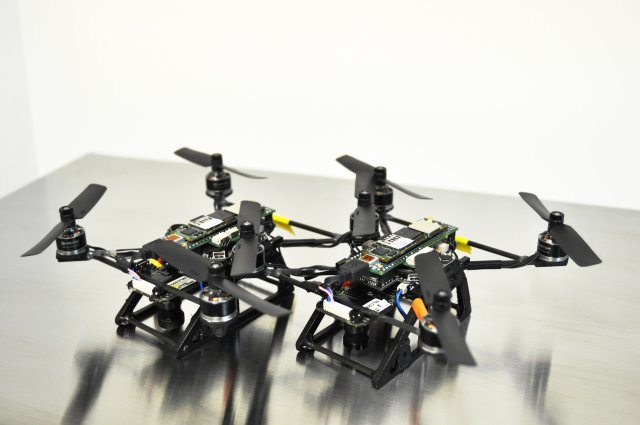
The components of the quad rotor are a mix of commercial and custom-designed parts to develop the navigation, exploration and mapping necessary for military applications, said Brendan Byrne, who manages the platform from the perspective of Computational and Information Sciences.
“Carnegie Mellon has previously demonstrated many of the capabilities that we will require for this project in a controlled environment, however, we are testing 3-D mapping and localization in a large, unstructured environment,” Byrne said.
ARL has been working with the Carnegie Mellon team for about two years, but only for the last nine months for the MUM-T exercise, Byrne said.
Issues can be uncovered when ARL engineers probe weaknesses in experimental setups that have been previously used to demonstrate capabilities in controlled environments. Further collaboration with university researchers can address these issues and produce a far more robust system.
The university researchers addressed the issues and came back with a far more robust algorithm, he added. “Just yesterday we were flying it through the building, zipping up and down stairwells.”
ARL is interested in stretching the boundaries of what will be feasible for Army unmanned system doctrine. The lab’s novel technology will be the least mature platform represented at MUM-T.
“We take a crack at unsolved problems,” Byrne said. “The technology may not completely work, but it directs where our attention should be focused.”
Today, human/robot teaming requires a lot of hands on participation from the Soldier but this platform is designed to navigate through a 3-D maze and avoid obstacles without help, he said.
MUM-T will be the first time ARL has demonstrated the technology in a more operational environment.
“It is exciting,” Byrne said. “On one hand, the technology offers the most cutting edge possibilities. On the other hand, the lack of maturity makes it the most prone to failure.”
Over the past few decades there has been much interest in this class of flying robotic platforms known as micro-air vehicles. The palm-sized vehicles operate relatively low to the ground, and are capable of navigating indoors or outdoors with stealth, low cost and low operator workload.
Engineers begin looking to insects because of the robust navigation in uncertain environments. In particular, Conroy became interested in the insect capability of detecting and tracking small targets and their capability for perceiving structure of the environment without stereo vision.
Conroy and his colleague J. Sean Humbert from the University of Maryland detailed their findings in “Structure from Motion in Computationally Constrained Systems.”
He said one of the things he is eager to test at MUM-T is the robotic mimicking of active vision in insects, which is their intentional use of motion to perceive structure.
The Research, Development and Engineering Command also has near-term focused organizations like the U.S. Army Communications-Electronics Research, Development and Engineering Center, Tank Automotive Research, Development and Engineering Center and Natick Soldier Systems Center, which will demonstrate state-of-the-art equipment at MUM-T the Army is developing.
The Maneuver Center of Excellence conducts research, development and experimentation to ensure the future maneuver force is prepared and equipped to fight and win in a complex future environment.