A new Army task force is trying to convince private industry to invest in solar energy, wind power and other renewable-energy projects on military installations.
The Energy Initiatives Task Force was officially stood up Sept. 15 and was discussed Tuesday during an energy-security panel at the 2011 Association of the United States Army Annual Meeting and Exposition.
“The focus of this task force is to bring $7 billion in alternative-energy resources to Army installations,” said Katherine Hammack, assistant secretary of the Army for Installations, Energy and the Environment.
The new task force is headed up by Richard Kidd, deputy assistant secretary of the Army for Energy and Sustainability. He said the Department of Energy and other agencies are represented on the task force.
“The Energy Initiatives Task Force recognizes that we, the Army, have to attract private capital if we’re going to develop large-scale renewable energy projects,” he said. “To do that, we must be an attractive investment option. We can’t order the private sector to do business with us. We have to attract it, through streamlined business processes, efforts to reduce risk, and efforts to improve the due diligence of our projects.”
Fort Bliss, Texas, is partnering with El Paso Electric on projects. The post has saved $2.7 million a year so far on energy programs, according to the installation commander. “And that’s just the tip of the iceberg,” said Maj. Gen. Dana J.H. Pittard, commanding general of 1st Armored Division and Fort Bliss.
“We will soon be announcing a 20-megawatt solar facility in tandem with a 20-megawatt gas turbine, which will help us with our standby power,” Pittard said. “In fact, between now and 2015, we hope to do three of those in tandem.”
Fort Bliss is also looking at proposals for wind generators that will produce 80 to 90 megawatts of power, Pittard said. And he said the installation is working with its Residential Communities Initiative partner to possibly construct rooftop solar arrays on post housing units.
Pittard said he plans for Fort Bliss to produce as much electricity as it consumes and be “net zero” by the end of 2015.
“We need a lot of advice on how to do alternative energy,” said Maj. Gen. Al Aycock, deputy commanding general of the Installation Management Command. He said the Army realizes that the private sector has the expertise in this field.
“We have to find the best ways for private industry and utilities to help us using models we haven’t thought about,” Aycock said.
Only about a third of the Army’s energy is used on installations, though, according to Hammack. She said two-thirds of the Army’s $4 billion in annual energy expenditure occurs in Afghanistan, Iraq and in other areas of the theater of operations.
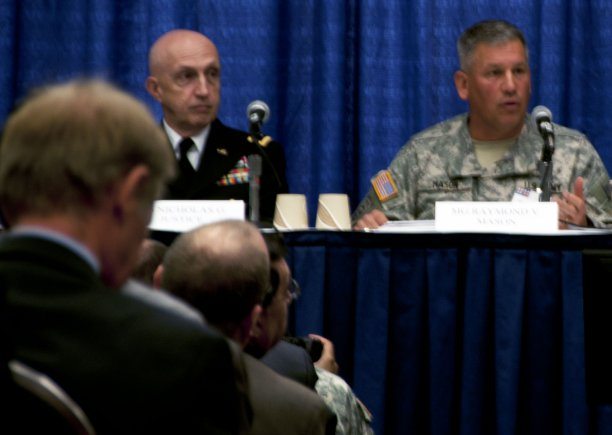
A new Operational Energy Office is also being set up by the Department of the Army as part of the G-4, announced Maj. Gen. Raymond Mason during the AUSA panel discussion. Mason has been confirmed for promotion and appointment as the next G-4 in November. He’s been serving for the past couple of months as the deputy G-4.
Before coming to the Pentagon, Mason said he “vaguely knew what operational energy was” and in the past two months, he has spent 80 percent of his time focusing on operational energy.
“I have a job — a mission — to educate the Army about operational energy,” Mason said.
The vast majority of coalition convoys in Afghanistan are moving fuel and water, Mason said. Reducing the amount of fuel needed will reduce the amount of convoys and save lives — because fewer Soldiers will be on the roads exposed to improvised explosive devices.
Micro-grid projects and mini-grids are saving about 4 million gallons of fuel every month in Afghanistan, Hammack said. That reduces the number of convoys on the roads, she said, “and we plan to install twice as many to ensure that we are able to continue the progress to reduce the amount of energy consumed in theater.”
The Army is working to standardize those batteries, hammock said, and to produce smaller, rechargeable ones. The effort is meant to reduce the load carried by Soldiers.
“Our Soldiers now carry 74 different types of batteries when they’re deployed (some of them) up to the size of a brick,” Hammack said.
Maj. Gen. Nickolas Justice, commander of the U.S. Army Research, Development and Engineering Command, talked about projects aimed at reducing Soldier loads and the logistics footprint. One of these is AMMPS, the Advanced Medium Mobile Power Sources, a new generation of fuel-efficient mobile generators.
The Army manages 80,000 vehicles daily, said Grace Bochenek, director of the U.S. Army Tank-Automotive Research, Development and Engineering Center. TARDEC has been working on a number of projects to make Army vehicles more energy efficient.
One of those projects is a of a fuel-efficient demonstrator vehicle, known as the “FED Alpha” which has been undergoing testing at Aberdeen Proving Ground, Md. RDECOM paused testing on the vehicle this week so that the “FED Alpha” could be displayed on the floor of the AUSA annual meeting and exposition in Washington, D.C.
The FED Alpha has a solar panel on its rear that can recharge the vehicle’s electrical system. It also has a special transmission and a score of other features that dramatically increase its mileage per gallon compared to other Humvees.
“There is a commitment from the Army’s senior-most leadership to make energy security a priority,” Kidd said. “We do this for three reasons: it’s fiscally responsible, operationally necessary, and mission critical.”