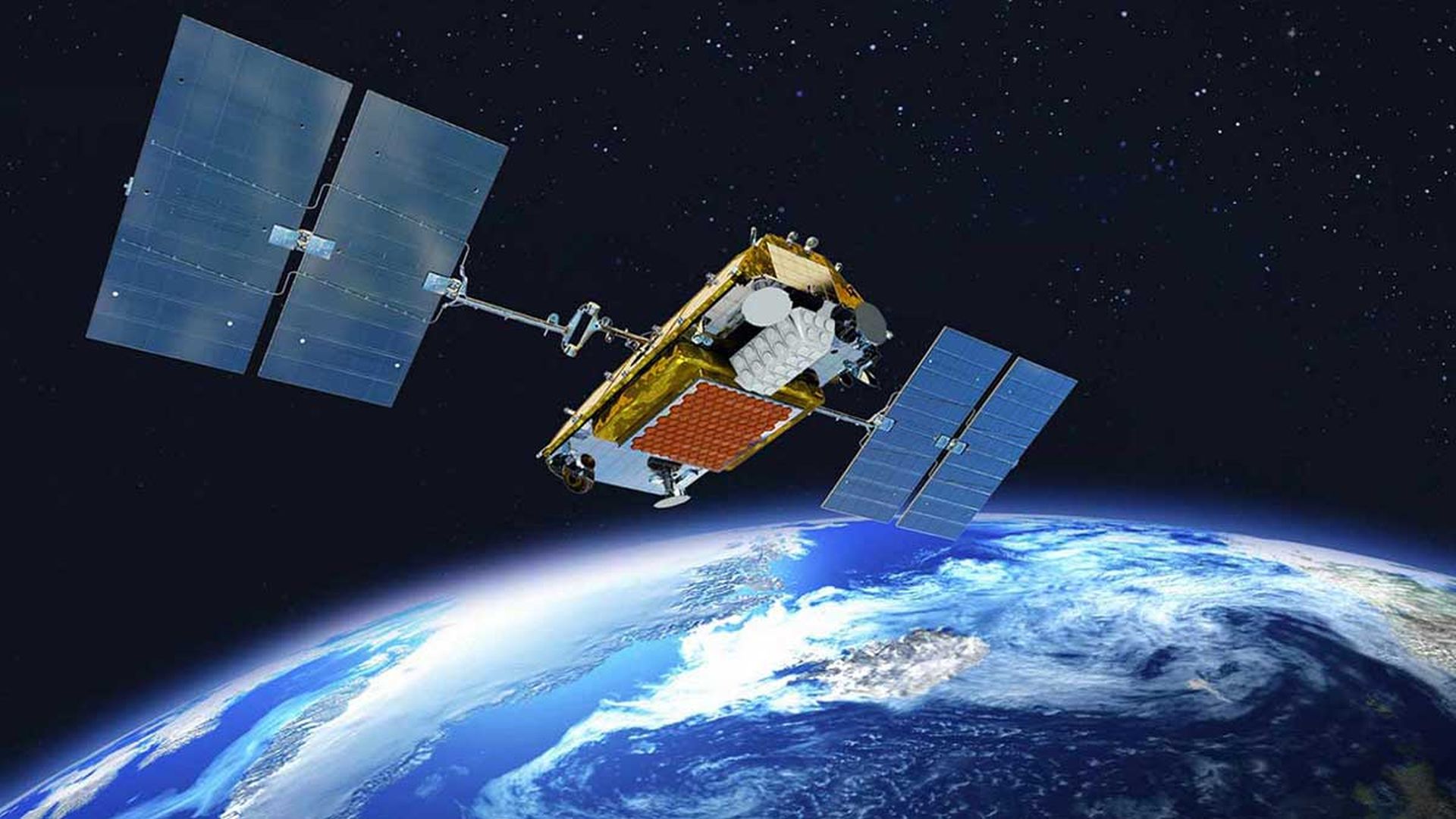
Think of it as a celestial parlor game: What is the minimum number of satellites needed to see every point on Earth? And how might those satellites stay in orbit and maintain continuous 24/7 coverage while contending with Earth’s gravity field, its lumpy mass, the pull of the sun and moon, and pressure from solar radiation?
In the mid-1980s, researcher John E. Draim proposed what is generally considered to be the ideal solution: a four-satellite constellation. However, the amount of propellant needed to keep the satellites in place, and the ensuing cost, made the configuration unfeasible.
Now, a National Science Foundation-sponsored collaboration led by Patrick Reed, the Joseph C. Ford Professor of Engineering at Cornell University, has discovered the right combination of factors to make a four-satellite constellation possible, which could drive advances in telecommunication, navigation and remote sensing. And in an ingenious twist, the researchers accomplished this by making the forces that ordinarily degrade satellites instead work in their favor.
“One of the interesting questions we had was, can we actually transform those forces? Instead of degrading the system, can we actually flip it such that the constellation is harvesting energy from those forces and using them to actively control itself?” Reed said.
Their paper, “Low Cost Satellite Constellations for Nearly Continuous Global Coverage,” published Jan. 10 in Nature Communications.
The AI-based evolutionary computing search tools that Reed has developed are ideally suited for navigating the numerous complications of satellite placement and management.
For this project, Reed collaborated with researchers from The Aerospace Corporation, combining his algorithmic know-how with the company’s expertise in cutting-edge astrophysics, operational logistics and simulations.
In order to sift through the hundreds of thousands of possible orbits and combinations of perturbations, the team used the Blue Waters supercomputer at University of Illinois, Urbana-Champaign. Blue Waters compressed 300 or 400 years’ worth of computational exploration into the equivalent of roughly a month of actual computing, Reed said.
They winnowed their constellation designs to two models that could orbit for either a 24- or 48-hour period and achieve continuous coverage over 86% and 95% of the globe, respectively. While 100% performance coverage would be ideal in theory, the researchers found that sacrificing only 5%-14% created greater gains in terms of harvesting energy from the same gravitational and solar radiation forces that would normally make a satellite constellation short lived and difficult to control.
The tradeoff is worth it, Reed said, especially since satellite operators could control where the gaps in coverage would occur. Outages in these low-priority regions would last approximately 80 minutes a day, at most, in the worst-case scenario.
“This is one of those things where the pursuit of perfection actually could stymie the innovation,” Reed said. “And you’re not really giving up a dramatic amount. There might be missions where you absolutely need coverage of everywhere on Earth, and in those cases, you would just have to use more satellites or networked sensors or hybrid platforms.”
Using this type of passive control could potentially extend a constellation’s lifespan from five years to 15 years. These satellites would require less propellant and would float at higher elevations, removing them from the risky high-traffic zone of low Earth orbit.
But perhaps the biggest selling point is the low cost. Commercial interests or countries without the financial resources to launch a large constellation of satellites could attain near-continuous global coverage very economically, with reduced long-term technical overhead.
“Even one satellite can cost hundreds of millions or billions of dollars, depending on what sensors are on it and what its purpose is. So having a new platform that you can use across the existing and emerging missions is pretty neat,” Reed said. “There’s a lot of potential for remote sensing, telecommunication, navigation, high-bandwidth sensing and feedback around the space, and that’s evolving very, very quickly. There’s likely all sorts of applications that might benefit from a long-lived, self-adapting satellite constellation with near global coverage.”
The paper’s lead author is Lake Singh with The Aerospace Corporation. Researchers from the University of California, Davis, also contributed.
“We leveraged Aerospace’s constellation design expertise with Cornell’s leadership in intelligent search analytics and discovered an operationally feasible alternative to the Draim constellation design,” said Singh, systems director for The Aerospace Corporation’s Future Architectures department. “These constellation designs may provide substantive advantages to mission planners for concepts out at geostationary orbits and beyond.”
Read Full Research Report