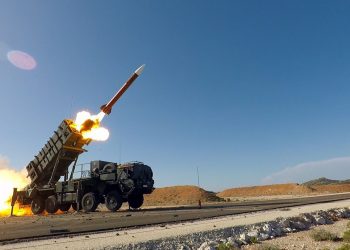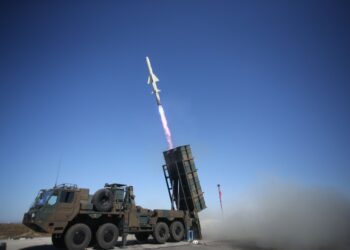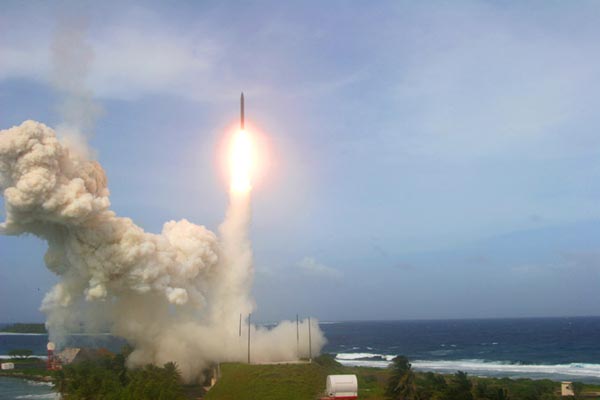
The United States will announce at next week’s NATO summit in Chicago that the new missile defense system in Europe has reached interim operational capability, the alliance’s supreme allied commander for Europe said.
“We will announce the interim operational capability of that system, which will begin to protect our European partners from the threat of ballistic missiles,” Navy Adm. James G. Stavridis said during an interview with the Pentagon Channel and American Forces Press Service. Stavridis also commands U.S. European Command.
That system — the first phase of the European Phased Adaptive Approach Missile Defense System that President Barack Obama proposed in 2009 — will integrate with the NATO command-and-control system to begin standing up the NATO missile defense system, he said.
The first phase, now completed, relies on existing missile defense systems to address short- and medium-range ballistic missile threats. Upcoming phases will introduce increasingly capable interceptors and missile defense command-and-control system upgrades.
Phase 1 consists of Aegis ships with ballistic missile defense capabilities and a command-and-control system in Ramstein, Germany.
USS Monterey, followed shortly by USS The Sullivans, last year became the first ships to rotate to the Mediterranean Sea in support of the initiative. Stavridis told Congress in March he considers these ships “the backbone of missile defense” with the added benefit of being able to support anti-submarine, anti-air and anti-surface operations.
Also as part of Phase 1, Turkey agreed to host a land-based early warning radar system in Kurecik, in the southeastern Malatya province. That, in turn, will be combined with the NATO command-and-control system, Stavridis said.
“Those three elements come together to provide us with an initial capability to provide some level of defense of Europe against a threat emanating from the Middle East,” Navy Rear Adm. Mark Montgomery, Eucom’s deputy director for plans, policy and strategy, told American Forces Press Service. “That was our most significant ballistic missile defense achievement in 2011.”
Meanwhile, “we are working hard on the Phase 2, 3 and 4 elements” of the plan, Stavridis told the Senate and House armed services committees in March. That includes negotiating agreements with partner countries, particularly Romania and Poland, regarding stationing of the Aegis ballistic missile defense system that will extend the missile shield during Phase 2 of the plan.
Montgomery also reported progress toward developing an AEGIS Ashore land-based interceptor system in Deveselu, Romania, to be completed by 2015. This is a critical element of the Phase 2 rollout, which Romania agreed late last year to host.
Meanwhile, Eucom is working closely with the Polish defense ministry to implement the U.S.-Poland ballistic missile defense agreement in support of important Phase 3 capabilities, Stavridis reported.
“We’ll upgrade the missiles at that point, and we’ll upgrade the command-and-control” with more and increasingly sophisticated overhead sensors, he told Congress. “And then the next step will be 2018, when we’ll add another set of ground interceptors in Poland.”
The final phase of the plan, slated for completion by 2020, will deploy more advanced interceptors designed to counter not only medium and intermediate range missiles, but also potential future intercontinental ballistic missile threats to the United States from the Middle East.
“It is a progression,” Stavridis said of the system. “It is adaptive to the threat, in that we can plug in at any step along the way to continue to improve it, to pace the threat that we see.”
In announcing the missile defense plan three years ago, Obama promised “stronger, smarter and swifter defenses of American forces and America’s allies.”
“It is more comprehensive than the previous program,” he said of the plan. “It deploys capabilities that are proven and cost effective. And it sustains and builds upon our commitment to protect the U.S. homeland against long-range ballistic missile threats, and it ensures and enhances the protection of all our NATO allies.”
NATO endorsed the concept at its November 2010 summit in Lisbon, Portugal, agreeing to expand its missile defense command, control and communications capabilities to protect Europe and encouraging allies to follow the U.S. lead in making voluntary national contributions to the effort.
Based on agreements at the Lisbon summit, Eucom fielded workstations throughout its headquarters and service component headquarters that use a NATO-compatible network able to support the NATO ballistic missile defense mission, officials explained.
The command plans to tie U.S. ships to that network, a step toward increasingly integrated theater sensors, shooters and platforms.
In addition, the Air Force is establishing a joint, combined European Integrated Air and Missile Defense Center in Eisiedlerhof, Germany. Its mission, Stavridis told Congress, will be to educate, develop and refine U.S., partner and allied missile defense capabilities and expertise.
With growing support within NATO to support the mission, Spain, the United Kingdom, Germany, the Netherlands, Denmark, Italy and France are exploring ways to complement it, Stavridis told Congress. He noted that the Dutch are buying ships capable of plugging into the ballistic missile defense architecture, and that all NATO nations now contribute command and control capabilities.
Getting additional commitments for the system is expected to be an agenda topic at next week’s NATO summit. Stavridis told Congress in March he’ll continue to press the Europeans to shoulder a growing role in missile defense.
NATO Secretary General Anders Fogh Rasmussen is expected to join in that effort, with the goal of making the system as comprehensive as possible.
“Step by step, NATO’s territorial missile defense is becoming a reality,” he reported in October just before a NATO defense ministers conference in Brussels.