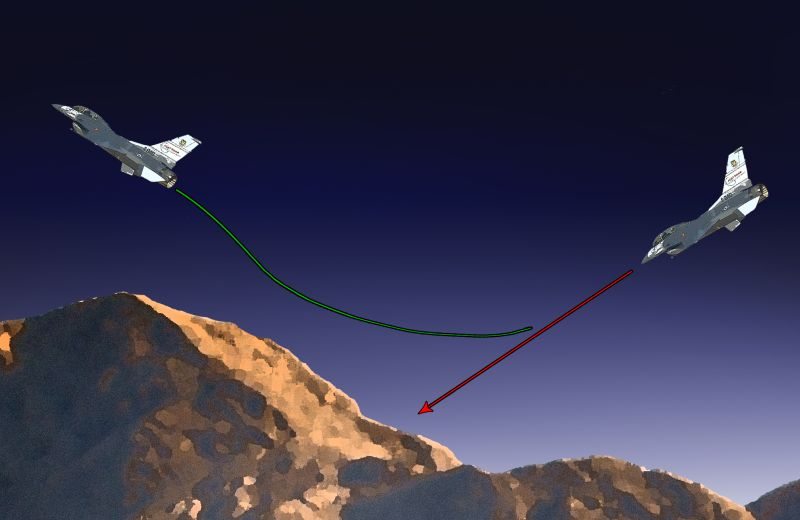
Since the partnership between the Department of Defense, NASA and Lockheed Martin began, the Automatic Ground Collision Avoidance System has evolved into an instrument intended to keep civilian and military aircrew members fit to fly and fight another day.
More than 25 years later, 416th Flight Test Squadron team members continue to test that life-saving technology to ensure it is fully integrated into the Air Force’s fourth generation fighters.
“Controlled flight into terrain, or CFIT, has proven to be a significant contributor to loss of life and aircraft in the U.S. Air Force fighter aircraft fleet. Between 1992 and 2004 there were 34 F-16 CFIT mishaps with 24 fatalities in the U.S. Air Force. The Auto GCAS was developed under the Automatic Collision Avoidance Technology program to reduce the number of CFITs in direct response to a Secretary of Defense mandated 75-percent reduction of DOD mishaps,” said Jessica Peterson, 416th FLTS flight dynamics lead.
“From the combat effectiveness standpoint, each aircraft lost to CFIT is one less asset combatant commanders have to employ during wartime. Clearly, that impacts our national security,” added Lt. Col. Robert Ungerman, 416th FLTS director of operations. “From the human standpoint, nothing destroys morale like losing a squadron mate and friend. Families and friends are devastated with each F-16 fatality we experience. The prevention of CFIT mishaps will avoid that anguish for dozens of spouses, parents, and children of lost pilots.”
According to the flight dynamics team, the Auto GCAS is designed to prevent CFIT mishaps by executing an automatic recovery maneuver when terrain impact is imminent. The system predicts CFIT conditions by means of a continuous comparison between a trajectory prediction and a terrain profile that is generated from onboard terrain elevation data. At the instant the predicted trajectory touches the terrain profile; the automatic recovery is executed by the Auto GCAS autopilot. The automatic recovery consists of an abrupt roll-to-upright and a nominal 5-g pull until terrain clearance is assured. The Auto GCAS recovery maneuver can be terminated at any time by the pilot.
“The Auto GCAS was not only designed to prevent CFIT, but to not interfere during normal F-16 operational maneuvers such as strafing missions and low-level flights,” added Peterson. “Furthermore, since spatial disorientation is a common cause of CFIT mishaps, the Pilot Activated Recovery System, or PARS, was designed to provide a disoriented pilot with a way to manually engage an automated recovery.”
The Air Force Research Laboratory, in partnership with the NASA Dryden Flight Research Center, Lockheed Martin Aero and the Air Force Flight Test Center initially demonstrated the feasibility of integrating an Auto GCAS and PARS into the F-16 during the Fighter Risk Reduction Project in 2010, conducting more than 2,000 auto-recoveries.
“Although there are other automatic systems in development for other platforms, nothing has been implemented at this point,” Peterson said. “Since 2010, minor changes have been made to increase the protection envelope and decrease nuisance potential by making adjustments to the trajectory predictions, automatic recoveries, altitude buffers and the pilot-vehicle interface.”
The F-16 design try out flight test program has been ongoing at the 416th FLTS since fall 2011.
“In the end, Auto GCAS is an amazing compilation of technologies that will provide the final safety net should a pilot ever unknowingly put the aircraft in danger of hitting the ground,” said Maj. Kyle Schlappi, 416th FLTS Auto GCAS project test pilot. “Once AGCAS is fully fielded, I imagine we’ll see an abrupt decrease in fatal F-16 accidents as the CFIT rate drops to nearly zero. To the warfighter, and the warfighter’s family, Auto GCAS provides significant peace of mind to know such a capable system is keeping our pilots safe.”
The F-16 Auto GCAS is projected to save the U.S. Air Force 14 F-16 aircraft, 10 personnel, and $530 million over the future life of the F-16, according to Peterson. The system is expected to be fielded on all U.S. Air Force Block 40/42/50/52 F-16s by spring 2014, which totals approximately 640 aircraft.