North Korea’s army says it has approved plans for nuclear attacks on US targets, the latest in a series of apocalyptic threats that have sent tensions soaring on the divided Korean peninsula.
Many analysts say the North’s rhetoric is for internal consumption, intended to bolster the authority of young leader Kim Jong-Un over the powerful military.
But they also see the possibility that the situation could spiral out of control, with a limited border provocation triggering a wider conflict.
Here are some facts on the capabilities — conventional and nuclear — of the militaries on the Korean peninsula and some possible conflict scenarios.
THE MILITARY BALANCE
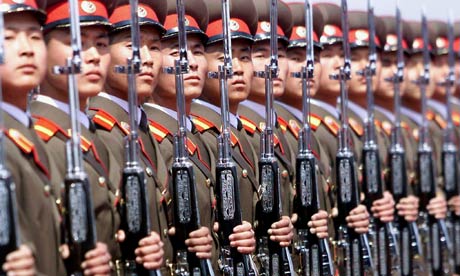
The North’s 1.2 million-strong armed forces, the world’s fifth largest, boast 4,100 tanks, 8,500 field artillery pieces and 5,100 multiple rocket launchers. It has some 620 combat aircraft.
About 600 Scud missiles are capable of hitting targets in South Korea, plus another 200-300 that could reach Japan.
The North probably has enough plutonium to make four to eight nuclear bombs, but no one knows whether it has the technology to deliver them as missile warheads.
Experts say much of its equipment is obsolete and plagued by shortages of fuel and spare parts. But conventional artillery and missiles could inflict heavy casualties and severe damage in Seoul, which lies just 50 kilometres (30 miles) south of the border, in any surprise attack.
The North is also believed to have up to 5,000 tons of chemical weapons deliverable by artillery or missile.
South Korea’s 655,000-strong military is supported by US troops, based in the South since the 1950-53 war and currently numbering 28,000. The South has some 2,400 battle tanks plus 50 US tanks, 5,200 field artillery pieces and 200 multiple rocket launchers.
The South has some 460 combat aircraft plus 90 US machines, but as with most military hardware the quality is superior to the North’s. At sea, it can deploy 19 principal combat vessels compared to the North’s three.
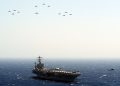
Massive US reinforcements would be shipped to the peninsula if war broke out, to bolster the troops and assorted hardware including tanks and artillery already deployed on South Korean soil.
THE NUCLEAR UMBRELLA
The US army withdrew all its tactical nuclear weapons from South Korea in 1991 and the South has no such weapons. But the US guarantees a “nuclear umbrella” in case its ally comes comes under atomic attack.
WHAT MIGHT HAPPEN
Quite possibly, nothing. But the North might stage a limited border provocation like the shelling of the South’s Yeonpyeong island in 2010, which killed four people.
Such an incident could quickly escalate — the South’s military has promised to hit back hard after being criticised for its perceived weak response in 2010. A South Korea-US pact signed last month provides for a joint military response even to low-level provocations.
IF WAR BROKE OUT, WHO WOULD WIN?
Despite the chilling threats, most analysts believe the North would never risk obliteration by launching a first-strike nuclear attack on US or South Korean forces.
Most North Korean troops and conventional firepower are based close to the border with the South, theoretically allowing for a swift invasion as in 1950.
Any attack could be preceded by a devastating artillery attack on military positions south of the border and on Seoul itself.
“I’m confident we would be able to stop an attack. There would still be a lot of destruction. I don’t want to minimise it,” General Walter Sharp, the then-US military commander in South Korea, said in a 2011 interview with the Wall Street Journal.
The London-based International Institute for Strategic Studies said that with both sides facing catastrophic losses, neither wants to fight a war for fear of the consequences.
“The danger is that war will begin out of miscalculation, misperception and escalation, rather than design,” the IISS said.