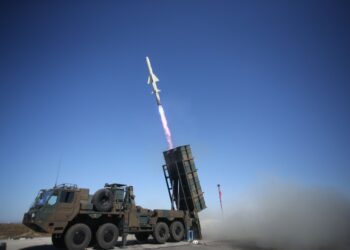
US State Department, WASHINGTON (DefenceTalk): The proposed U.S. missile defense system in Central Europe would not fire any explosive projectiles, only an unarmed interceptor, a senior U.S. official says, adding that the United States would like to link the system with NATO and, possibly, Russian defenses.
The system is intended to intercept intercontinental warheads fired from the greater Middle East region, particularly Iran, which is expected to be capable of firing a long-range missile at the United States by 2015.
The United States does not believe the plan will launch an arms race reminiscent of the Cold War because it involves no attack capability and targets only a small number of missiles, says Eric Edelman, under secretary of defense for policy.
“The plan which we have been discussing –- which would include 10 interceptors -– is completely defensive in nature,” Edelman said at an April 3 Pentagon briefing. “It doesn’t pose a threat, we believe, to Russia’s nuclear deterrent because we don’t think that 10 kinetic interceptors with no explosive warhead –- much less a nuclear warhead – would pose a threat to Russia’s hundreds of missiles and thousands of warheads.”
The United States is in discussions to place interceptors in Poland and a high tech radar system in the Czech Republic. U.S. officials say the Czech-based radar would have approximately as much energy as radar used for weather forecasting or air traffic control.
In potential host countries, the decision to field the defensive system, as well as control procedures and rules of engagement, would be agreed to by both the United States and the host government, Edelman said. “This is a matter that is going to be subject to their democratic parliamentary debate,” he said. “That’s perfectly appropriate.”
Some members of the Russian government have expressed concerns that an anti-missile system would upset the long-standing arms balance that exists among nuclear nations. However, Edelman said the tone of debate has improved since President Bush discussed the matter directly with Russian President Vladimir Putin in a late-March phone call.
“Since the president’s phone call with President Putin, we’ve had a bit of a cessation of the incessantly negative statements from Russia,” Edelman said. He added that missile defense will be discussed April 18 at meetings of the North Atlantic Council and the NATO-Russia Council. “One of the things we’ve agreed to discuss is, in some detail, the potential for cooperation with Russia.”
One way Russia and the United States might cooperate would be “to look at how sensor and early-warning technology might be used so that we can have a common operational picture,” Edelman said. In that way, air defense data could be shared with Russia. He pointed out that, because of the distances involved, missile launches from Iran or North Korea are more of a threat to Russia than to the United States.
The anti-missile systems use high-precision technology to “shoot a bullet with a bullet.” Rather than use an explosive warhead, the interceptor strikes an intercontinental missile while in suborbital flight, and the high velocity of the impact destroys both craft.
Successfully targeting such a missile requires reacting within two minutes to 15 minutes, a time frame much shorter than the nuclear deterrence of the Cold War era, when governments believed they had as long as 30 minutes to launch a retaliatory strike, Edelman said.
Launching a missile interceptor also involves a different set of decisions compared to the nuclear deterrence, Edelman said. In the Cold War era, “your concern was someone might inadvertently – by using offensive weapons – start another world war that would have catastrophic consequences,” he said. “With defenses, it slips around; so your concern is more not that you fired an interceptor in error, but that you didn’t fire it and lost a city because of a failure to intercept a weapon.”
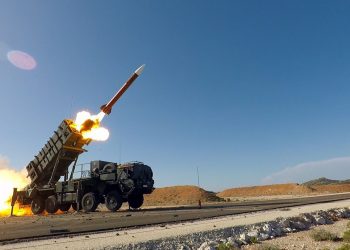
Patriot missile defense system deployed in central Turkey
Turkey said Tuesday a Patriot missile defence system was being deployed in the centre of the country, a day after...