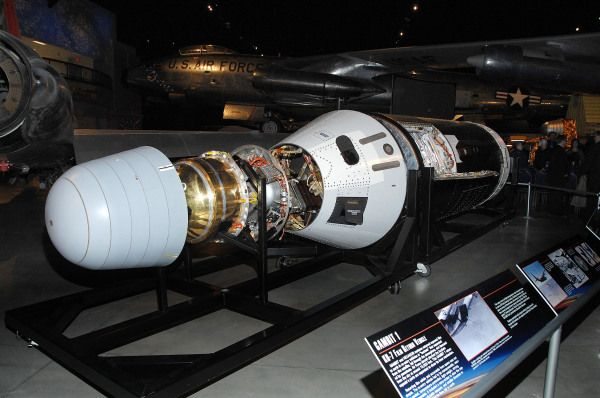
Military, government and industry officials gathered Jan. 26 to officially place three formerly classified reconnaissance satellites on public display in the Cold War Gallery at the National Museum of the U.S. Air Force here.
The three satellites — Gambit 1 KH-7, Gambit 3 KH-8 and Hexagon KH-9 — were among the most important U.S. photo reconnaissance systems used from the 1960s to the 1980s, and played a critical role in winning the Cold War and maintaining U.S. national security, officials said.
Passing in space high over their targets, these satellites used specially-designed film and cameras to take photos in orbit. The satellites were unmanned and unlikely to be shot down, and therefore minimized risks to military personnel while still obtaining information about areas of the world that the U.S. could not access.
Led by the National Reconnaissance Office, the Department of Defense, U.S. Air Force, Central Intelligence Agency and industry partners worked together to create these amazingly complex and capable satellites, officials said.
According to retired Air Force Gen. Bruce Carlson, the NRO director, NRO reconnaissance systems — from planes to satellites such as Gambit and Hexagon — have been and continue to be the foundation for global situational awareness in protection of our nation.
“Last year the NRO celebrated its 50th anniversary, and we announced the declassification of two NRO systems, Gambit and Hexagon, which were America’s eyes in space and the most sophisticated satellites of their time,” Carlson said. “These systems were critical for monitoring key targets in the USSR and around the globe and provided much-needed cartographic information to the DOD to produce accurate, large-scale maps.”
Gambit 1 satellites were the first American high-resolution space reconnaissance systems. This first generation of Gambit vehicle flew from 1963-1967. Gambit 1 added important new close-up capability to wide-search satellites already in use and were the first satellites to feature stereo high resolution cameras.
Gambit 3 satellites improved upon the Gambit 1 by providing much better image resolution in tracking adversaries’ weapons development. Gambit 3 was a long-lived system and completed 54 missions from 1966-1984. The most notable advancement from Gambit 1 to Gambit 3 was the addition of a “roll joint” between the camera module and the Agena control vehicle in the rear. This rolling joint made the satellite extremely stable as a photo platform, conserved film and increased the number of targets photographed. In addition, new super-thin photographic film allowed the vehicle to carry more film.
Hexagon satellites were the largest and last U.S. intelligence satellites to return photographic film to earth. Hexagon provided vital intelligence and mapping photos from space that allowed U.S. planners to counter Cold War threats. Between 1971 and 1984, 19 Hexagon missions imaged 877 million square miles of the earth’s surface. Objects smaller than two feet across could be imaged from around 80-100 miles altitude. Analysts could search broad and wide areas for threats with Hexagon and then focus in on suspect areas with surveillance from Gambit satellites.
Both Gambit and Hexagon systems returned exposed film to earth in re-entry vehicles or “buckets” that separated from the satellite, fell through the atmosphere, and descended by parachute. Air Force aircraft were assigned to pluck the buckets from the sky at around 15,000 feet.
Retired Air Force Lt. Gen. Jack Hudson, the director of the National Museum of the U.S. Air Force, said the three satellites are a great addition for the Air Force’s national museum because the Air Force played a key role in space reconnaissance from the beginning.
“Gambit 1, Gambit 3 and Hexagon satellites are significant and rare artifacts, which will enable us to better present the story of Air Force operations in space,” Hudson said. “The Air Force has provided launch, tracking, control and range safety services for reconnaissance satellites throughout the entire Cold War, and it continues these activities today.”
To commemorate the event, Hudson presented Carlson with a painting of the Hexagon satellite by nationally recognized artist and Dayton, Ohio, resident Dr. Richard Black, which was commissioned by the Air Force Museum Foundation.
Eventually, the satellites will be placed in the museum’s planned fourth building, which will house the Space Gallery, Presidential Aircraft Gallery and Global Reach Gallery.
The National Museum of the United States Air Force is located on Springfield Street, six miles northeast of downtown Dayton. It is open seven days a week from 9 a.m. to 5 p.m. (closed Thanksgiving, Christmas and New Year’s Day). Admission and parking are free.