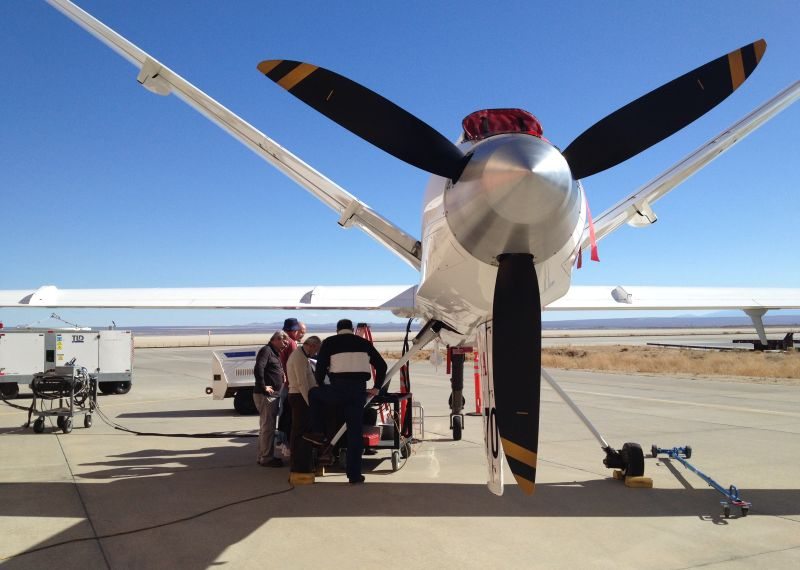
NASA’s Dryden Flight Research Center flew its Ikhana MQ-9 unmanned aircraft with an Automatic Dependent Surveillance-Broadcast, or ADS-B, device, for the first time on March 15.
It was the first time an unmanned aircraft as large as Ikhana – with a 66-foot wingspan, a takeoff weight of more than 10,000 pounds, and a cruising altitude of 40,000 feet – has flown while equipped with ADS-B. ADS-B is an aircraft tracking technology that all planes operating in certain U.S. airspace must adopt by January 2020 to comply with Federal Aviation Administration (FAA) regulations.
It also was the first flight of hardware for the NASA Aeronautics research project known as UAS in the NAS, which is short for Unmanned Aircraft Systems Integration in the National Airspace System.
The equipment performed well during a flight lasting nearly three hours in restricted air space over Dryden’s Western Aeronautical Test Range, which is part of Edwards Air Force Base and the China Lake Naval Air Warfare Center.
Being equipped with ADS-B enables NASA’s Ikhana to provide much more detailed position, velocity, and altitude information about itself to air traffic controllers, airborne pilots of other ADS-B equipped aircraft flying in its vicinity, and to its pilots on the ground. Currently, only air traffic controllers can see all the aircraft in any given section of the sky.
The ADS-B checkout flight aboard Ikhana kicked off a series in which researchers will collect ADS-B data while performing representative air traffic control-directed maneuvers.
As part of a collaborative effort, FAA’s William J. Hughes Technical Center in Atlantic City, N.J., recorded ADS-B data from the flight and will help analyze the performance of the system installed in the aircraft. Researchers also evaluated new ADS-B laptop software for displaying surrounding air traffic information to the UAS pilots on the ground.
“ADS-B is a cornerstone capability required in the NextGen, and understanding its performance and suitability for integrating unmanned aircraft into the national airspace system is critical to the overall goals of the project,” said Sam Kim, deputy manager of integrated test and evaluation for NASA’s UAS in the NAS Project.
Developing technologies that will enable unmanned aircraft to fly safely among other planes in the nation’s skies is the job of Kim’s team.
ADS-B is a key component of the largest transformation of air traffic control ever attempted in the United States. Known as the Next Generation Air Transportation System, or NextGen, it is a multi-billion-dollar technology modernization effort that will make air travel safer, more flexible and more efficient.
As the system gets better, its capacity will grow and the demand for different types of air transportation – even unmanned aircraft – will increase.
Current tracking devices aboard aircraft are called transponders, but the ADS-B isn’t just a new-fangled transponder. It provides much more detailed and accurate information to air traffic controllers, and will enable navigation by satellite in addition to the current system of ground radars.
Ground radars interact with transponders once every four to 12 seconds in order to get an aircraft’s position, velocity, and altitude. In contrast, the ADS-B constantly and automatically broadcasts information every second to air traffic controllers.
The more frequent updates, coupled with information updated through the Global Positioning System, result in much greater accuracy in the display of an aircraft’s position, velocity and altitude.
The effort is part of the Dryden-led UAS in the NAS Project, which is designed to contribute capabilities to reduce technical barriers related to the safety and operational challenges of unmanned and passenger-carrying airplanes sharing the same air space.
The UAS in the NAS Project is managed from Washington by the Integrated Systems Research Program office in NASA’s Aeronautics Research Mission Directorate.