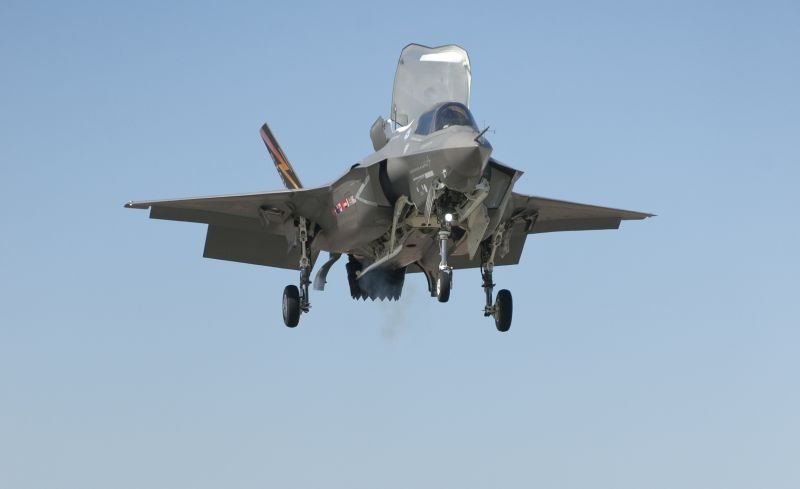
This morning, veteran defense aerospace reporter Bill Sweetman took a look at the different unit costs of F-35 Joint Strike Fighter (JSF) variants in the new fiscal year 2012 budget request.
His findings suggest that the JSF fighters will be far more expensive—even more than previously believed—than the aircraft they are set to replace, which include the F/A-18, F-15, F-16, A-10, AV-8B and other planes. The budget request, unveiled yesterday, is “the first to fully reflect the major changes in the F-35 program that started early last year,” Sweetman wrote.
Sweetman found the following average per-unit costs, or APUCs:
- F-35A: $110 million ($7.7 billion for 70 aircraft)
- F-35B: $150 million ($2.71 billion, for 18 aircraft)
- F-35C: $139.5 million ($2.79 billion for 20 aircraft)
In contrast, the U.S. is buying 28 F/A-18E/F Super Hornets for an APUC of $86 million—around 60% of the APUC of the F-35C. The F-35C is the JSF variant that is supposed to replace the Navy Super Hornet. Super Hornets are being purchased now because the JSF program is behind schedule and the Navy is hedging its bets because there could still be more delays.
There are, as always, caveats to these figures. Lockheed Martin, the prime contractor for the F-35, may (and probably will) argue that these costs could come down over time because of the “learning curve.” Lockheed will also likely argue that the per-unit price will come down as the U.S. and other customers buy larger amounts of aircraft in the future, creating economies of scale. However, it remains to be seen how much more the F-35 will benefit from economies of scale. As Sweetman noted, the F-35A alone will be rolling off the line in higher quantities than the Super Hornet.
There is also reason to doubt the learning curve argument, argues Winslow Wheeler, a defense expert at the Center for Defense Information. Last year, Wheeler wrote that projections that the learning curve will bring per-unit F-35 costs down should be viewed with suspicion:
“The last 50 years of actual DOD aircraft cost history, especially of “stealth” aircraft, do not treat the Carter-Fox estimates, and the prevailing conventional wisdom, very politely, however. The absence of any such progressive “learning curve” in unit cost has been thoroughly demonstrated by the analysis of Chuck Spinney, using actual procurement data.
These APUCs also do not reflect development costs—and the U.S. is spending more to develop the F-35 than was originally estimated. APUCs also do not reflect the life cycle costs, on a per-unit basis, of the aircraft. This is no small matter and has grave implications for the fiscal sustainability of American tactical aviation.
Keep in mind that the development and production phases of the F-35 program could cost a total of $382 billion, according to one Pentagon estimate. But compare that with life cycle costs. The Government Accountability Office (GAO) estimated in 2008 that, including life cycle costs, the F-35 program will cost more than $950 billion. The lion’s share of life cycle costs is the cost of both operating and maintaining the aircraft. If the operations and maintenance costs are substantially higher than the GAO estimated, the program easily may have moved well beyond the $1 trillion mark.
It looks like that may be the case. Recently the Air Force indicated that it agrees with the Navy’s assessment that F-35 aircraft could cost 30 to 40 percent more to maintain and operate over the course of the program’s lifespan than the aircraft it is replacing. This is a big problem because the F-35 was supposed to be cheaper to operate and maintain than the legacy aircraft it is supposed to replace. According to DoD Buzz:
A source familiar with the issue said that the Air Force believes a study performed by the Navy one year ago looks increasingly accurate, based on preliminary data the service has compiled. Buzz readers will remember that the Navy study found the F-35 would cost between 30 percent and 40 percent more per plane than does the current F/A-18 fleet. Since one of the primary goals of the F-35 program, with its web of international partners, was to lower maintenance costs by achieving economies of scale through large program buys by a significant number of countries this would call into question one of the fundamental goals of the program.
by Nick Schwellenbach, POGO’s Director of Investigations