Sunday, April 5, 2026
  • About us
    • Write for us
    • Disclaimer
    • Terms of use
    • Privacy Policy
  • RSS Feeds
  • Advertise with us
  • Contact us
DefenceTalk
  • Home
  • Defense News
    • Defense & Geopolitics News
    • War Conflicts News
    • Army News
    • Air Force News
    • Navy News
    • Missiles Systems News
    • Nuclear Weapons
    • Defense Technology
    • Cybersecurity News
  • Military Photos
  • Defense Forum
  • Military Videos
  • Military Weapon Systems
    • Weapon Systems
    • Reports
No Result
View All Result
  • Home
  • Defense News
    • Defense & Geopolitics News
    • War Conflicts News
    • Army News
    • Air Force News
    • Navy News
    • Missiles Systems News
    • Nuclear Weapons
    • Defense Technology
    • Cybersecurity News
  • Military Photos
  • Defense Forum
  • Military Videos
  • Military Weapon Systems
    • Weapon Systems
    • Reports
No Result
View All Result
DefenceTalk
No Result
View All Result
Home Defence & Military News Technology News

Firms Demo New Hybrid Technology to Prevent Icing on Aircraft and Drones

by Editor
January 22, 2020
in Technology News
2 min read
0
Firms Demo New Hybrid Technology to Prevent Icing on Aircraft and Drones

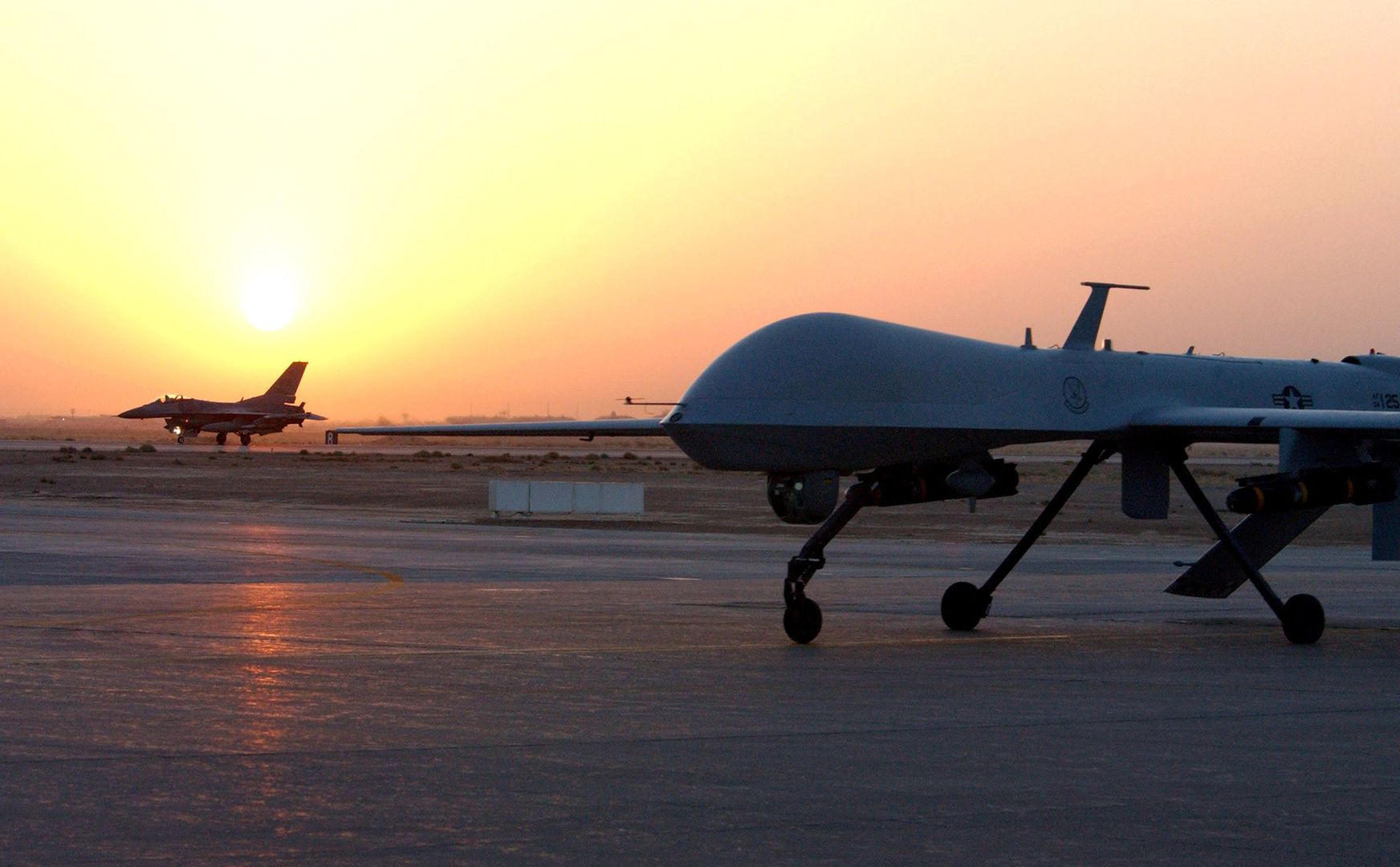
An MQ-1 Predator unmanned aerial vehicle and F-16 Fighting Falcon return from an Operation Iraqi Freedom combat mission. Both aircraft provide intelligence, search and reconnaissance gathering features, as well as munitions capability to support ground troops and base defense. (U.S. Air Force photo/1st Lt. Shannon Collins)

14
VIEWS

Invercon and NEI Corporation’s newly developed de-icing system tested successfully at NASA’s Icing Research Tunnel, and was advanced to a Technology Readiness Level of 6. The hybrid technology is designed to prevent ice accretion on aircraft and drones.

Invercon Inc. and NEI Corporation have recently announced that their newly developed de-icing system was tested successfully at the NASA Glenn Research Center’s Icing Research Tunnel. The test was witnessed by engineers and scientists at the Research Center, as well as from the industry. The Invercon-NEI team met the objective of demonstrating a low power anti-ice system in conjunction with NEI’s NANOMYTE® SuperAi anti-ice coating that prevents ice accretion on the leading edge of an airfoil. The test was performed on a full-size airfoil under simulated in-flight conditions, following nearly two years of development and laboratory testing.

All commercial aircraft have a built-in ice protection system, which could be either a thermal, thermo-mechanical, electro-mechanical, or pneumatic system. A common issue with de-icing devices is that they consume substantial power. Aircraft generally look to reduce power consumption, and with the advent of battery-powered aircraft, mechanisms or features that reduce power consumption are critically important. Icing presents a particular challenge for commercial and military drones, where ice can build up on the wings and propellers and result in crashes. In fact, the current practice is not to fly drones when icing conditions are predicted. Applying a passive anti-ice coating that functions synergistically with an active de-icing device is an attractive hybrid approach, which the team of NEI and Invercon has now demonstrated on full-scale prototypes.

NEI’s NANOMYTE® SuperAi anti-ice coating is a durable coating, suitable for permanent application. The coating leads to a lubricating surface that drastically reduces the adhesion strength of ice – by as much as 80%, compared to bare polished aluminum. The coating is usually applied by spraying, similar to conventional painting. NANOMYTE® SuperAi coating is available for commercial use.

Invercon has developed a new, retrofittable, electro-pneumatic deicing system that combines the most attractive aspects of several existing systems without their associated drawbacks. The Invercon system requires remarkably low power (≤ 2.5 kW), is retrofittable on any airfoil, adds very little weight (~50 lbs), and is durable enough to last the life of the aircraft once retrofitted. Importantly, the system looks, feels, and acts like the original leading edge and can provide millions of maintenance-free deicing cycles. The entire wing test section (Figure 1) was coated with NANOMYTE® SuperAi.
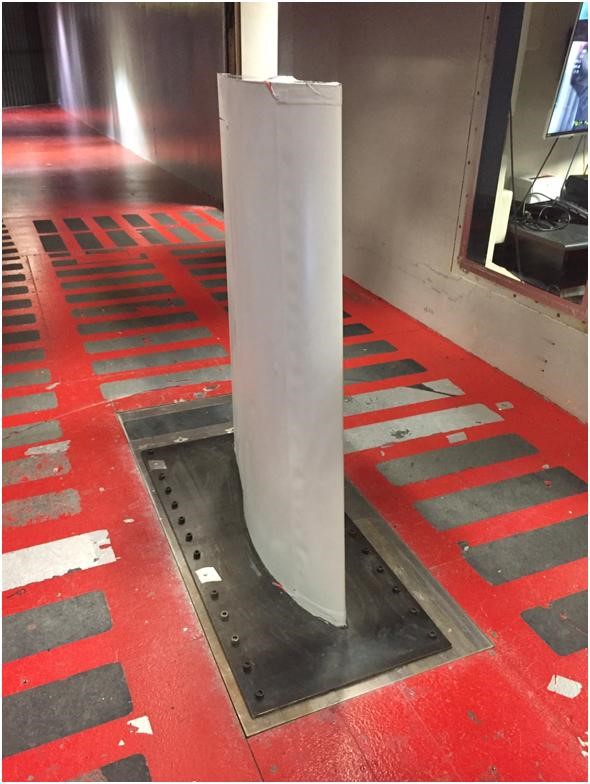
MQ-1 wing test section installed in the IRT tunnel

Invercon successfully completed icing tests of the electro-pneumatic deicing system at NASA Glenn’s Icing Research Tunnel (IRT) under a full range of representative icing conditions. The Invercon system was able to provide continuous deicing of the wing section leading edge over all of the test conditions ranging from temperatures of -3°C to -20°C with various liquid water content. Typically, the system allows ice to accrete for about 2 minutes and then completely sheds upper and lower surface ice upon system activation.

The testing at NASA’s IRT, which is the longest running icing facility in the world, has moved the hybrid technology to a readiness level of 6 (i.e., TRL6), which is a scale used by NASA and Department of Defense to gauge the maturity level of a technology.

Both NEI Corporation and INVERCON LLC are grateful for the financial support extended by the Small Business Innovation Research Program from the Air Force and NASA. The SBIR program funds product development efforts that reduce concepts to practice and then to prototypes, thereby reducing technology risk. The successful full-scale demonstration by the team has advanced a new technology to a state of commercial readiness.


Tags: aircraftdronesNASA
Previous Post

First woman enters Japan’s submarine academy

Next Post

Over 120 Missiles for Russian S-400 Systems Delivered to Turkey

Related Posts

US needs top cyber coordinator, better hacker ‘deterrence’

‘Digital fog of war’ around Iranian cyberattacks

March 13, 2026

Hostilities on the digital front have intensified since the outbreak of war between the US, Israel and Iran, with many...

US moves closer to retaliation over hacking as cyber woes grow

Cyberattack Disrupts Operations at MedTech Giant Stryker

March 11, 2026

A cybersecurity incident affecting Stryker Corporation—one of the world’s largest manufacturers of medical devices—has drawn renewed attention to the growing...

Next Post
Over 120 Missiles for Russian S-400 Systems Delivered to Turkey

Over 120 Missiles for Russian S-400 Systems Delivered to Turkey

Latest Defense News

US needs top cyber coordinator, better hacker ‘deterrence’

‘Digital fog of war’ around Iranian cyberattacks

March 13, 2026
US military says aircraft crash in Iraq killed 4 crew members

US military says aircraft crash in Iraq killed 4 crew members

March 13, 2026
Northrop Grumman moves to boost B-21 Raider output

Northrop Grumman moves to boost B-21 Raider output

March 13, 2026
US Navy evacuates virus-struck aircraft carrier Roosevelt

US military ‘not ready’ to escort tankers through Hormuz Strait

March 12, 2026
Israel cancels leave for combat units after Iran consulate strike

US says Iran campaign cost $11 billion in six days

March 12, 2026
US moves closer to retaliation over hacking as cyber woes grow

Cyberattack Disrupts Operations at MedTech Giant Stryker

March 11, 2026

Defense Forum Discussions

  • Middle East Defence & Security
  • Royal Australian Navy Discussions and Updates 2.0
  • General Naval News
  • The Russian-Ukrainian War Thread
  • Indonesia: 'green water navy'
  • Australian Army Discussions and Updates
  • Royal Australian Air Force [RAAF] News, Discussions and Updates
  • Royal Canadian Navy Discussions and updates
  • Russian Navy Discussions and Updates
  • General Space News.
DefenceTalk

© 2003-2020 DefenceTalk.com

Navigate Site

  • Defence Forum
  • Military Photos
  • RSS Feeds
  • About us
  • Advertise with us
  • Contact us

Follow Us

No Result
View All Result
  • Home
  • Defense News
    • Defense & Geopolitics News
    • War Conflicts News
    • Army News
    • Air Force News
    • Navy News
    • Missiles Systems News
    • Nuclear Weapons
    • Defense Technology
    • Cybersecurity News
  • Military Photos
  • Defense Forum
  • Military Videos
  • Military Weapon Systems
    • Weapon Systems
    • Reports

© 2003-2020 DefenceTalk.com