US Department of Defense, WASHINGTON: When five unmanned vehicles crossed the finish line last weekend after a 132-mile race through the Mojave Desert, they signaled more than just a technological breakthrough.
“These vehicles haven't just achieved world records, they've made history,” said Tony Tether, director of the Defense Advanced Research Projects Agency, as the DARPA Grand Challenge concluded in Primm, Nev.
Four of the finishers crossed the finish line Oct. 8 and the fifth, the following day.
The DARPA Grand Challenge was the first race of its kind in which autonomous ground vehicles used nothing but onboard sensors and navigation equipment to steer themselves along the desert course in under 10 hours. And unlike traditional vehicle races that include mostly straights and curves, this race included tunnels, mountain switchbacks, lake beds and on- and off-road stretches – similar to routes typical military convoys follow.
The race was the second Grand Challenge for DARPA. None of the competitors was successful during the last race, in March 2004, fueling some naysayers' doubts about the suitability of autonomous vehicles for long-range military missions. But following this year's successful race, Tether compared it to the Wright Brothers' first flight in 1903 in Kitty Hawk, N.C., “proving it could be done.”
Similarly, the DARPA Grand Challenge “demonstrated the possible,” agency spokeswoman Jan Walker told the American Forces Press Service.
Walker said the race demonstrated once and for all that autonomous vehicles are indeed capable of traveling long distances over difficult terrain at high enough speeds to be “tactically relevant.”
The breakthrough represents a big step forward for battlefield technology that DARPA officials hope will have long-term benefit for U.S. troops.
Five autonomous vehicles successfully completed the DARPA Grand Challenge, led by “Stanley,” the Stanford University team's entry that finished the course in 6 hours, 53 minutes and 58 seconds, Walker said.
The winning team of faculty and students from Stanford's School of Engineering in Palo Alto, Calif., modified a stock, diesel-powered Volkswagen Touareg sport utility vehicle with full-body skid plates, a reinforced front bumper and a drive-by-wire system.
For their efforts, the team earned a $2 million prize, which Tether presented during the closing ceremony. But defense officials call that a small down payment on what they consider the ultimate prize: fewer U.S. deaths on future battlefields.
Two robotic vehicles entered by teams from Carnegie-Mellon University, Red Team's “Sandstorm” and Red Team Too's “H1ghlander” followed closely behind. The modified Hummers finished the course at 7 hours, 4 minutes, 50 seconds and 7 hours, 14 minutes, respectively.
“KAT-5,” a vehicle sponsored by Gray Insurance Company in Metarie, La., and named after Hurricane Katrina, completed the course in 7 hours, 30 minutes, 16 seconds.
The first four finishers entered the history books as the first ground vehicle robots to complete such a demanding course in under 10 hours. Stanley averaged 19.1 mph over the course; Sandstorm, 18.6 mph; H1ghlander, 18.2 mph; and KAT-5, 17.5 mph.
Another vehicle, the Oshkosh Trucks 16-ton robot, “TerraMax,” finished the course Oct. 9, exceeding the time limit with an unofficial time of 12 hours, 51 minutes.
Tether called the finishes a major achievement for DARPA, DoD's lead agency for accelerating the development of promising new technologies and turning them over to others to develop viable applications.
“The DARPA Grand Challenge is about fresh thinking and new approaches to the tough technical problem of developing a truly autonomous ground vehicle,” Tether said.
He expressed hope that the results would follow the course of the Wright Brothers' historic flight in Kitty Hawk. “And just as aviation 'took off' after those achievements, so will the very exciting and promising robotics technologies displayed here today,” he predicted following the race.
Walker said it's now up to the services to determine if they'll build on the technology showcased during the race.
Grand Challenge Program Manager Ron Kurjanowicz called the innovations demonstrated by the 23 teams that participated in the competition a testament to the nation's “heritage of ingenuity and resourcefulness.”
The 23 finalists were among 195 teams from 36 states and four foreign countries that filed applications to compete. Over the past several months, the teams advanced to the final event by completing a series of rigorous tests that helped gauge their capability to finish the desert course.
“The competing teams have worked many hours to develop their vehicles, and this event demonstrates their vision, creativity, inspiration and hard work,” Tether said.
Unmanned systems are playing an increasingly important role in combat operations. Unmanned air vehicles such as the Predator and Global Hawk have carried out reconnaissance and surveillance missions in Iraq, and the Predator has performed precision air strikes.
The Defense Department also is stepping up efforts to develop unmanned ground systems that would work together with manned systems to enhance the capabilities of U.S. forces and save lives.
During Operation Iraqi Freedom, for example, combat troops moved quickly toward Baghdad, followed by supplies and material. Protecting the supply lines was critical. In the future, officials said unmanned systems may be able to conduct resupply missions without using humans as drivers, and without requiring troops for protection.
While unmanned vehicle technology is advancing, most current models rely on a person to operate the vehicle remotely. Vehicles that don't require a human operator tend to move very slowly and have difficulty traversing terrain with minimal obstacles.
For unmanned ground vehicles to be truly useful to the military, officials said, they must be able to cross rugged terrain quickly and easily without needing human assistance – something the DARPA Grand Challenge proved possible.
Ultimately, Walker said, the technology showcased during the DARPA Grand Challenge could lead to autonomous vehicles capable of “taking people out of the driver's seat,” particularly during dangerous missions.
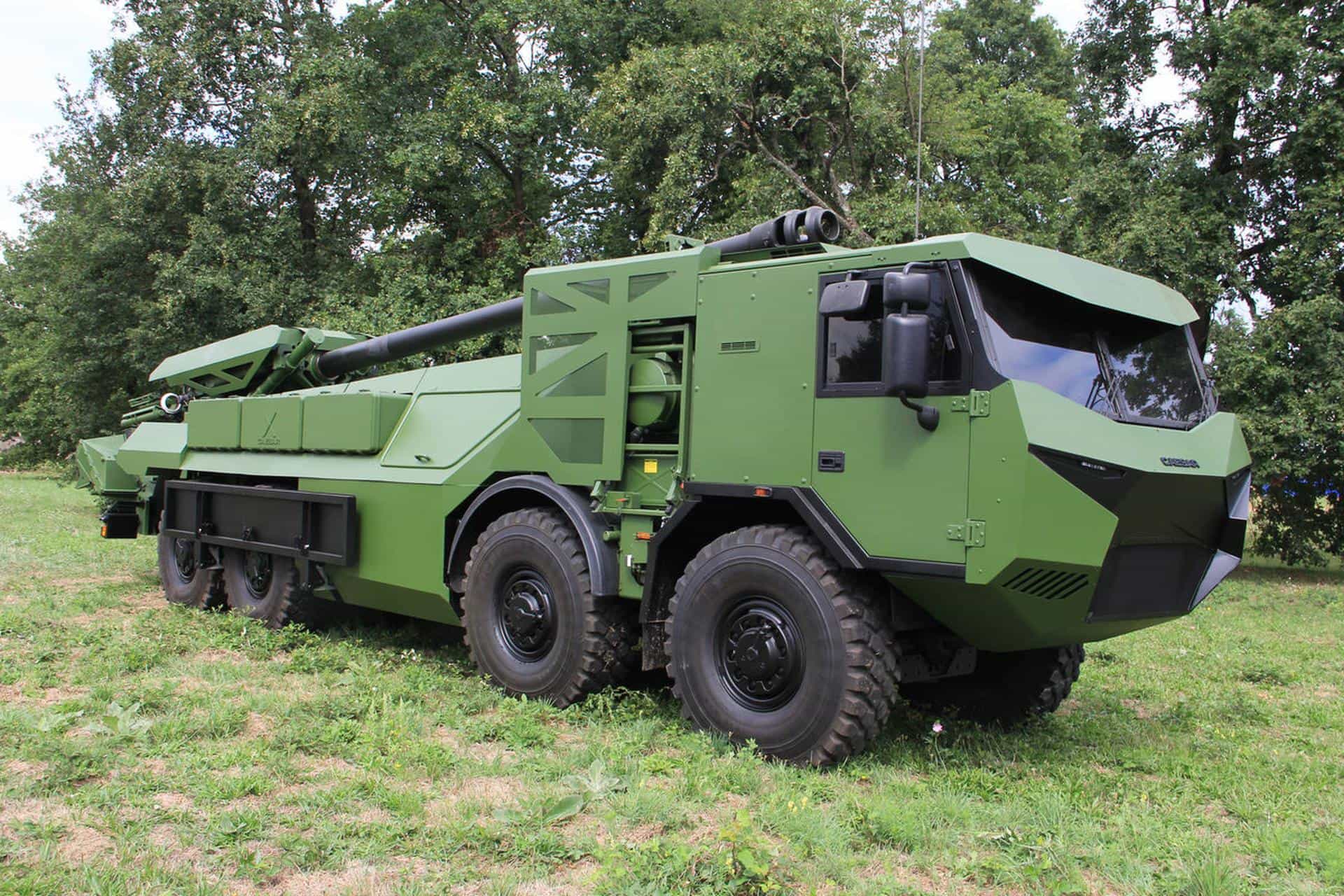
France to send more mobile artillery to Ukraine
France will ship 12 more Caesar truck-mounted howitzers and fresh air defence equipment to Ukraine to bolster the fight against...