Three cadets spent part of their summer secluded in a locked research lab with its windows blackened inside Mahan Hall. Their contribution to a research project yielded results which, given its classified status, they can’t really talk much about. Suffice it to say, as they briefed major supporters to the project recently, with a nod and a smile, the cadets confirmed its success.
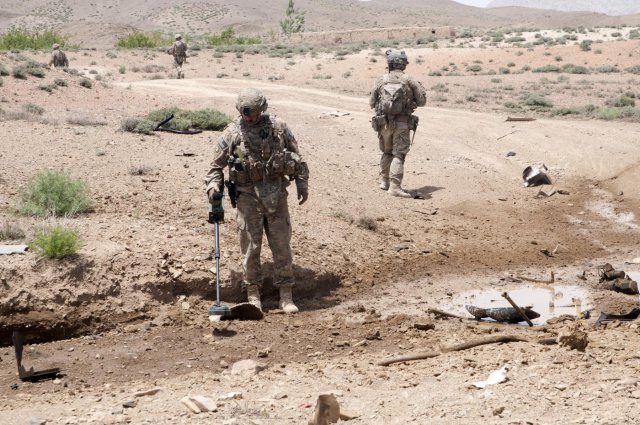
The project involved a new piece of software that can identify the location of weapons caches in theater using a mathematical model, based on the research theory of geospatial abduction. With significant accuracy, the software can predict where an enemy’s improvised explosive device, or IED, depot is, based on previous attack locations and other intelligence.
The original version of the software is called SCARE, or Spatio-Cultural Abductive Reasoning Engine, and was created by Maj. Paulo Shakarian, an assistant professor in the Department of Electrical Engineering and Computer Science. The software developed this summer is a modified version called C-SCARE/A, which focuses on the theater of Afghanistan.
This was an interdisciplinary effort, which is quite obvious from the academic pursuits of the three cadets involved in the final phase of the counter-IED project. Class of 2013 Cadet Jeff Nielsen, cadet-in-charge, is a math major, Class of 2013 Cadet Will Wright is a Department of Foreign Languages major and Class of 2014 Cadet Andrew Oswald is majoring in electrical engineering. Earlier in the summer, Class of 2015 Cadet Ellis Valdez, Class of 2013 Cadet Tim Stein, an international relations major, and Class of 2014 Cadet Geoff Moores, a computer science major, contributed to the project.
The project also involved faculty and staff from organizations to include EECS, Mathematical Science, Systems Engineering, the Operations Research Center and the Network Science Center.
The team worked with deployed combat engineers tasked with an explosive investigation unit in Afghanistan to provide support in the mission to mitigate the effects of IEDs. The team tested and provided results of the software concurrently to the combat unit along with regular video teleconferences.
“The Combat-SCARE-Afghanistan is a new piece of software that includes the road network, tribal information and a lot of external intelligence, which is the cool stuff I’m not allowed to talk about,” Nielsen said. “A lot of great things have happened to show that this program can actually contribute to the fight and save lives by finding these weapons.”
The three objectives, Nielsen said, were to create a program that is easy to use, produces results and integrates other intelligence to improve accuracy. They served as the last of three teams on this project, which launched shortly after class graduation in May. Part of their effort was to integrate additional intelligence and distribute the completed software package.
“That’s a major emphasis, and there are some very interested people here and downrange that would like to use this,” Oswald said.
Maj. Charles Levine, a math instructor, deployed this summer to get the software into the hands of Soldiers and Shakarian said the battlefield circulation has been well-received.
Shortly before the academic year began, Shakarian and the cadets briefed the dean of the academic board and administrative personnel who supported this Academic Individual Advanced Development project.
Col. John Graham, NSC director, said their contributions to cadet projects are remarkable, though often underscored. It is a complex process which legal, finance and other administrative members of the academy undertake to secure the necessary resources — from establishing a working relationship with a combat unit in Afghanistan to installing a dedicated computer network for classified research in an otherwise unclassified hall of classrooms.
Vicki Kiernan, a team lead budget analyst in the Directorate of Resource Management, attended one of the briefings and was amazed by what cadets can do to support the troops in current operations.
“I cannot tell you how much that short briefing meant to me. The AIADs our cadets participate in have always impressed me. It touched me both as a finance manager and the mother of a Soldier who served,” Kiernan said, via email.
Shakarian recently earned his doctorate degree from the University of Maryland where he garnered attention from projects like SCARE. He said this software will be integrated into the Systems senior capstone project and there are other applications to cadet studies being discussed.
“Cadet education, research and outreach to the Army, this is really what the academy is all about. I feel we hit all three of these strongly in this project,” Shakarian, a Class of 2002 graduate, said.
As a French and international relations major, Wright might have otherwise missed an opportunity like this had it not been for Shakarian, his information technology instructor.
“This was a good way to contribute to our units in the field, and this was something I normally wouldn’t have exposure to, if only for a short time,” Wright said.
Considering the sensitive nature of the project and the clandestine conditions they worked under, Oswald found this AIAD to be much different than what he participated in last summer.
“Normally, you’re asked to take pictures and show everyone what you did. Here we can’t really show anything. There’s a lot we would love to say to show how successful it was, but we can’t,” Oswald said. “Still, it was rewarding being able to do something that will make a difference downrange.”