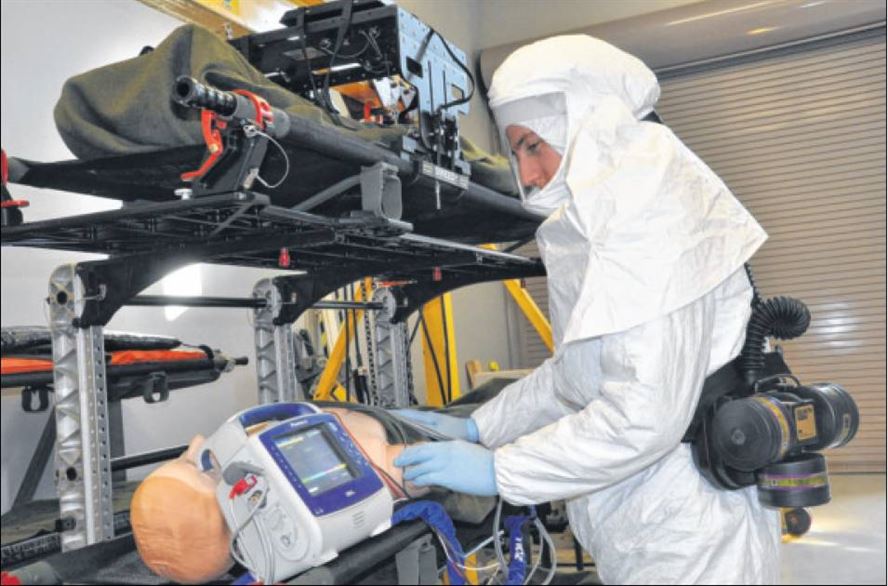
The Air Force Life Cycle Management Center (AFLCMC) is playing a unique role in the United States’ comprehensive Ebola response efforts in West Africa through the center’s involvement in developing a transport isolation system.
The system will enable safe aeromedical evacuation of Department of Defense patients in C-130 Hercules and C-17 Globemaster IIIs.
The Human Systems Division — one of nine divisions within AFLCMC’s Agile Combat Support Directorate — is leading the integration of multiple System Program Offices to support the Defense Threat Reduction Agency’s task to rapidly field the transport isolation system (TIS) by January.
Lt. Col. Scott Bergren, the chief of the Aircrew Performance Branch, is among those involved in the project.
“AFLCMC was notified the third week of October that its help was needed,” Bergren said. “We also were informed that the intent was to fly this system in an operational test beginning Dec. 1. So we were given a month and a half to ensure this system is safe to fly. All involved offices within AFLCMC have rallied to help get the TIS out the door.
“While DTRA is providing overall program management and contracting actions, our efforts have focused on quickly collecting the test data needed to assess the safety of the system for use in identified aircraft,” Bergren continued. “For example, we reached out to the Navy and obtained existing test data for subcomponents of the TIS used in Navy weapon systems today. This prevented us from having to redo those tests, which saved time. Fortunately, we have those connections and our division possesses the capability to analyze test data and certify components already in use within DOD.
“We’re thinking differently and more creatively to ensure we keep pace with the Pentagon’s timeline for this isolation system,” Bergren added. “We want to ensure this project is completed on time and safely.”
An example of creative thinking is that the AFLCMC team identified a proven LED lighting system used in the KC-135 Stratotanker platform today as a means to provide medical lighting in the TIS.
“This avoided a development effort by the contractor and cut roughly two weeks from a schedule in which every day counts,” Bergren said.
According to Melina Baez-Bowersox, a technical lead engineer in the Aeromedical Branch, additional challenges arise anytime there is a proposal to add a new system or equipment to an Air Force platform, such as an aircraft.
“Part of our responsibility is to assess the TIS’s capability by testing and evaluating the system on the aircraft,” she said. “We ask ourselves, ‘How does it (TIS) behave?’, ‘What does adding the system do to the structural integrity of the aircraft?’, ‘Is the TIS safe for patients, aircrews and the aircraft?’
“Ultimately, we want to be able to safely transport infected individuals back to the United States in a way that contains Ebola exposure to others while also preventing contamination of an aircraft or losing a precious Air Force asset,” she continued.
“We’re the right organization to be involved to deliver this critical capability that is quite complex and under an extremely compressed timeline,” said Col. William McGuffey, the chief of the Human Systems Division. “It’s another example of how AFLCMC acquires, fields and sustains systems and capabilities to support the urgent needs of other Air Force major commands and the DOD.
Pentagon officials say they do not expect the 3,000 U.S. troops heading to or already in the region to need the TIS because military personnel will not be treating Ebola patients directly.
“But we want to be prepared to care for the people we do have there just out of an abundance of caution,” Defense Department spokeswoman Jennifer Elzea said.
Currently, transport of Ebola patients from overseas is done by Phoenix Air, a government contractor based in Georgia whose modified business jet is capable of carrying just a single patient.
The Pentagon’s TIS will be similar but larger than the units used by Phoenix Air, whose containment system is a tent-like structure held up by a metal framework within the aircraft.