Saturday, March 14, 2026
  • About us
    • Write for us
    • Disclaimer
    • Terms of use
    • Privacy Policy
  • RSS Feeds
  • Advertise with us
  • Contact us
DefenceTalk
  • Home
  • Defense News
    • Defense & Geopolitics News
    • War Conflicts News
    • Army News
    • Air Force News
    • Navy News
    • Missiles Systems News
    • Nuclear Weapons
    • Defense Technology
    • Cybersecurity News
  • Military Photos
  • Defense Forum
  • Military Videos
  • Military Weapon Systems
    • Weapon Systems
    • Reports
No Result
View All Result
  • Home
  • Defense News
    • Defense & Geopolitics News
    • War Conflicts News
    • Army News
    • Air Force News
    • Navy News
    • Missiles Systems News
    • Nuclear Weapons
    • Defense Technology
    • Cybersecurity News
  • Military Photos
  • Defense Forum
  • Military Videos
  • Military Weapon Systems
    • Weapon Systems
    • Reports
No Result
View All Result
DefenceTalk
No Result
View All Result
Home Defence & Military News Navy News

US Navy’s Autonomous Swarmboats Can Overwhelm Adversaries

by US Navy
October 8, 2014
in Navy News
2 min read
0
US Navy’s Autonomous Swarmboats Can Overwhelm Adversaries
14
VIEWS

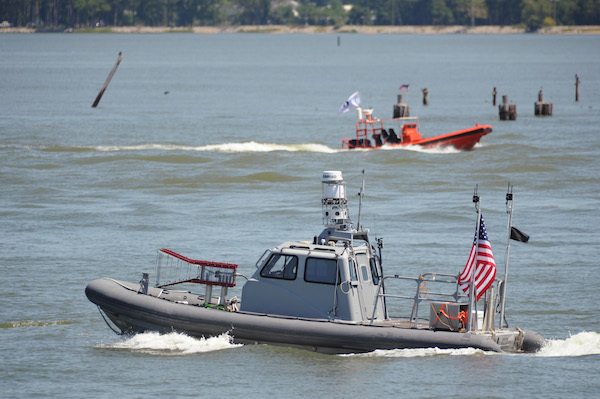
A technological breakthrough will allow any unmanned surface vehicle (USV) to not only protect Navy ships, but also, for the first time, autonomously “swarm” offensively on hostile vessels, officals at the Office of Naval Research (ONR) announced Oct. 5.

The first-of-its-kind technology, successfully demonstrated over two weeks in August on the James River in Virginia, allows unmanned Navy vessels to overwhelm an adversary. Its sensors and software enable swarming capability, giving naval warfighters a decisive edge.

“This networking unmanned platforms demonstration was a cost-effective way to integrate many small, cheap and autonomous capabilities that can significantly improve our warfighting advantage,” said Adm. Jonathan Greenert, chief of naval operations.

The technology, called CARACaS (Control Architecture for Robotic Agent Command and Sensing), is under development by ONR and can be put into a transportable kit and installed on almost any boat. It allows boats to operate autonomously, without a Sailor physically needing to be at the controls including operating in sync with other unmanned vessels, choosing their own routes, swarming to interdict enemy vessels and escorting/protecting naval assets.

“Our Sailors and Marines can’t fight tomorrow’s battles using yesterday’s technology,” said Chief of Naval Research Rear Adm. Matthew Klunder. “This kind of breakthrough is the result of the Navy’s long-term support for innovative research in science and technology.”

In the demonstrations, as many as 13 Navy boats operated using either autonomous or remote control. First they escorted a high-value Navy ship, and when a simulated enemy vessel was detected, the boats sped into action, swarming around the threat.

In the future, the capability could scale to include even greater numbers of USVs and even to other platforms, including unmanned aerial vehicles (UAVs).

“This multiplies combat power by allowing CARACaS-enabled boats to do some of the dangerous work,” said Dr. Robert Brizzolara, program manager at ONR. “It will remove our Sailors and Marines from many dangerous situations — for instance, when they need to approach hostile or suspicious vessels. If an adversary were to fire on the USVs, no humans would be at risk.”

The new technology will allow the USVs to detect, deter or destroy attacking adversaries. Any weapons fire from the USVs would need to be initiated by a Sailor supervising the mission.

Naval leadership has emphasized a blended force of manned and unmanned systems in recent years. Not only can USVs take on dangerous missions, thus protecting the warfighter, but even multiple USVs are a fraction of the cost of a single large manned ship.

The swarm demo announcement comes near the somber anniversary of the terrorist attack on USS Cole (DDG-67) off the coast of Yemen. In that October 2000 attack, a small boat laden with explosives was able to get near a guided-missile destroyer and detonate, killing 17 Sailors and injuring 39 others.

Autonomous swarmboat capabilities could play a vital role in protecting people, ports and commerce.

“While the attack on Cole was not the only motivation for developing autonomous swarm capability, it certainly is front and center in our minds and hearts,” said Klunder. “If Cole had been supported by autonomous USVs, they could have stopped that attack long before it got close to our brave men and women on board.”
Tags: AutonomousswarmboatsUnmanned BoatsUS navy
Previous Post

China Test Fires 10,000-Km Range Nuclear Missile, DF-31B

Next Post

M1271 Medium Flail Clearing Vehicles Enter US Army Service

Related Posts

US Navy evacuates virus-struck aircraft carrier Roosevelt

US military ‘not ready’ to escort tankers through Hormuz Strait

March 12, 2026

The US military is currently "not ready" to escort tankers through the critical Strait of Hormuz because all its assets...

North Korea’s Kim oversees naval destroyer, cruise missile test

North Korea’s Kim oversees naval destroyer, cruise missile test

March 6, 2026

North Korean leader Kim Jong Un oversaw tests this week of his country's naval destroyer, claiming Pyongyang is in the...

Next Post
M1271 Medium Flail Clearing Vehicles Enter US Army Service

M1271 Medium Flail Clearing Vehicles Enter US Army Service

Latest Defense News

US needs top cyber coordinator, better hacker ‘deterrence’

‘Digital fog of war’ around Iranian cyberattacks

March 13, 2026
US military says aircraft crash in Iraq killed 4 crew members

US military says aircraft crash in Iraq killed 4 crew members

March 13, 2026
Northrop Grumman moves to boost B-21 Raider output

Northrop Grumman moves to boost B-21 Raider output

March 13, 2026
US Navy evacuates virus-struck aircraft carrier Roosevelt

US military ‘not ready’ to escort tankers through Hormuz Strait

March 12, 2026
Israel cancels leave for combat units after Iran consulate strike

US says Iran campaign cost $11 billion in six days

March 12, 2026
US moves closer to retaliation over hacking as cyber woes grow

Cyberattack Disrupts Operations at MedTech Giant Stryker

March 11, 2026

Defense Forum Discussions

  • Japanese Maritime Self Defense Force Thread
  • RSN capabilities
  • The Russian-Ukrainian War Thread
  • Royal Australian Navy Discussions and Updates 2.0
  • Australian Army Discussions and Updates
  • Middle East Defence & Security
  • Royal New Zealand Navy Discussions and Updates
  • Looking for good book resources
  • USAF News and Discussion
  • Military Aviation News and Discussion
DefenceTalk

© 2003-2020 DefenceTalk.com

Navigate Site

  • Defence Forum
  • Military Photos
  • RSS Feeds
  • About us
  • Advertise with us
  • Contact us

Follow Us

No Result
View All Result
  • Home
  • Defense News
    • Defense & Geopolitics News
    • War Conflicts News
    • Army News
    • Air Force News
    • Navy News
    • Missiles Systems News
    • Nuclear Weapons
    • Defense Technology
    • Cybersecurity News
  • Military Photos
  • Defense Forum
  • Military Videos
  • Military Weapon Systems
    • Weapon Systems
    • Reports

© 2003-2020 DefenceTalk.com