Radio Free Europe/Radio Liberty, Moscow and New Delhi today signed a $1.6 billion deal finalizing India's purchase of a refurbished Russian aircraft carrier, fighter jets, and helicopters. Observers say it's a sweet agreement for both sides, allowing Russia to bolster its sagging arms industry and India its regional strategic capacity.
MOSCOW — “To be strong on land, we must be supreme on sea.” Those were the words of Jawaharlal Nehru, the first prime minister of independent India. And it appears that a $1.6 billion arms deal signed today with Moscow will effectively nudge New Delhi in that direction.
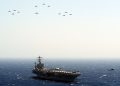
India is now the proud owner of the “Admiral Gorshkov,” a Soviet-era aircraft carrier complete with fighter planes and helicopters. It's not every day that a 45,000-ton floating military fortress changes hands.
Maksim Pyadushkin is the deputy director of the Center for Analysis of Strategies and Technologies, a Moscow-based think tank specializing in defense issues. He explains why the “Admiral Gorshkov” deal has attracted so much attention. “Buying this aircraft carrier gives India enormous naval capabilities.”First, it is “one of the largest arms delivery contracts ever between Russia and India,” he says. “And second, an aircraft carrier is quite rare merchandise on the international arms market.”
The “Admiral Gorshkov,” formerly known as the “Baku,” is the last of four aircraft carriers known by the name of their flagship, the” Kiev.” Commissioned by the Soviet Navy in 1987, all four vessels were retired by 1994, with the “Admiral Gorshkov” the last to be withdrawn. The three previous carriers were sold to China for scrap metal. In 1998, India and Russia agreed in principle on the sale of the “Admiral Gorshkov” — India would get the hull for free but would finance the refurbishing of the warship, something that would provide a much-needed boost to Russia's beleaguered defense industry.
The basic agreement made, it took another six years to work out a price and specifics. India's $1.6 billion price tag will be split roughly down the middle. Half the funds will be going to the Northern machine-building factory in Severodvinsk, which is refurbishing the “Admiral Gorshkov.” The other half will be spent on aircraft — fighter jets and anti-submarine helicopters.
“Russia will be making money on the repairs of the ship, it was part of the Soviet fleet, it used vertical take-off aircraft. Now it will use MiG-29K planes, and therefore the deck needs to be refurbished to accommodate the installation of a landing strip and a catapult. The rest of the money is going to the acquisition of 16 MiG-29K fighter jets, like I said, and up to 10 helicopters that can fit onto the ship,” Pyadushkin said.
The deal — inked today in New Delhi in the presence of Russian Defense Minister Sergei Ivanov and his Indian counterpart George Fernandes — says a lot about how Russia views its two main partners in the region. China is its number-one arms buyer and India, its number two. Moscow has signed strategic partnership contracts with both. But Russia's favored partner is India, Pyadushkin says, which it sees as a reliable ally. China, meanwhile, is viewed as posing a potential security risk. So while the bulk of Moscow's sales go to Beijing, it is New Delhi that gets the cream of advanced military technologies.
Speaking today, Ivanov said the partnership may eventually extend beyond naval deals to other types of arms sales: “Of course, we did not discuss only the ties between the Russian and Indian navies. The Indian defense minister and I agree that prospects for cooperation between the armies and the air forces of the two nations are just as good.”
Andrew Kuchins, the head of the Moscow office of the Carnegie Endowment, says today's deal is the culmination of a drive begun by former Prime Minister Yevgenii Primakov to improve relations with India. Primakov sought closer ties with both New Delhi and Beijing as a way to counterbalance what he considered U.S. hegemony. “This doesn't mean that Russia is looking to develop an alliance-like relationship with either country, but the interest in developing ties with India and China are broader than just the arms sales,” Kuchins says. “They differ to some extent, and also the degree of trust differs to some extent.” Russia and India have also found common cause in growing concerns over Islamic terrorist threats, mainly from Pakistan and Afghanistan. New Delhi even recently welcomed a Russian naval exercise in the Indian Ocean, something Kuchins says shows Moscow's interest in once again demonstrating its military might.
“Fairly recently, a Russian naval expedition went to the Indian Ocean, and this again fits into the broader framework of Russia trying to resurrect some of its power-projection capabilities — or at least showing the world they have not entirely gone to seed since the collapse of the Soviet Union,” Kuchins said.
India often defines its security perimeter as the extreme limits of the Indian Ocean — from the Strait of Malacca to the Strait of Hormuz, and from the coast of Africa to the western shores of Australia. Security analysts say India, encircled by China and a number of Muslim-majority nations, hopes a revamped “Admiral Gorshkov” will add muscle to India's foreign policy priorities — and alter the geopolitical balance in South Asia.
Maksim Pyadushkin says today's deal may stir concerns among India's regional rivals. “Buying this aircraft carrier gives India enormous naval capabilities. In effect, having two aircraft carriers — India already has one, and is now buying the second from Russia — brings India close to its strategy of gaining control over the Indian Ocean,” Pyadushkin said.

US says Iran campaign cost $11 billion in six days
The opening week of the war against Iran cost the United States more than $11.3 billion, lawmakers were told in...