I dont think people reslise just how good SAAB, and the Swedes in general, are at integrating other nations systems into different capabilities.Unlike shipbuilding which Canada has shown itself to be moderately successful in as of late, setting ourselves up for the Saab fighter "production" proposal domestically is a laughable waste of time. More relevant to the discussion here however, the adoption of a two tiered fleet has some potentially disastrous consequences for cross service interoperability between the RCAF and RCN. The AEGIS equipped River class destroyers are out of the box able to integrate themselves seamlessly with the MADL datalinks of the F-35A, permitting them to discretely share substantial amounts of data quickly to the point that you can create high quality targeting tracks able to gain weapons locks on targets. Gripen E/F only has NATO standard LINK datalinks which while adequate, offer nowhere near the fidelity, bandwidth, stealth and interoperability that the MADL offers from the F-35.
Yet another example of poor procurement decisions being weighed due to emotional, politically charged situations.

Royal Canadian Navy Discussions and updates
- Thread starter stephen weist
- Start date
See Erieye. Tested on one aircraft, in service on three other types before a major upgrade to Erieye ER, now in service on one of the three, plus another type. This seems to have been achieved with no fuss.
That's an example of doing it the other way, integrating their systems onto multiple (mostly foreign) platforms.
That's an example of doing it the other way, integrating their systems onto multiple (mostly foreign) platforms.

CorvetteCrunch
Member
I'm not saying that Saab cannot integrate systems, I am saying that we are potentially looking at far more risky options that will require significant cooperative, effort and work to make baseline workable compared to alternatives which already work with each other as delivered. Saab are also prolific BS artists who I trust about as far as I can throw them even as far as the MIC goes, their marketing team are living in an entirely different reality from basically everybody else not in an overly nationalistic place like India or Pakistan.I dont think people reslise just how good SAAB, and the Swedes in general, are at integrating other nations systems into different capabilities.
CorvetteCrunch
Member
Boeing wanted something like $5.5B for those 18 interim Super Hornets, which is total highway robbery as far as aircraft pricing goes. It made little sense to expand this interim fleet when prices were that poor, the Canadian Govt was involved in a slapfight between Bombardier and Boeing and the basically required conformal fuel tanks for RCAF service were in a troubled space. It makes very little sense for me to have the RCAF operate a multi-fleet split of Hornets, Super Hornets, F-35 (?) and 6th gens given the continual concerns by the RCAF about personnel, costs and infrastructure issues just talking about two fleets.The interim SH plan made more sense than used Hornets from Australia. The 18 planned would likely have become at least 40 or more given the current political environment. F-35s ordered from 2030 onwards, say 30-40 would get us to 2050-60 at which time 6th Gen could be an option. Gen 4+ jets like the F-15EX or SH combined with the F-35 is a decent CYA approach given LM’s performance with the F-35 program. The current conflict could show how well the F-35 holds up if it continues for another 1-2 months.
LM's performance with the F-35 program is more than adequate enough that multiple other nations in Europe have shifted entirely/will be shifting to a single homogenous F-35 fleet (Belgium, Denmark, Finland, Netherlands, Norway, Switzerland), so I personally do not support any kind of mixed fleet anytime soon. The F-35 has proven itself to be more than workable in high intensity conflicts shown by Israel in the past, I am not especially worried about its operations, neither is the RCAF or have they been in the past by operating a single fleet of legacy Hornets.
CorvetteCrunch
Member
https://x.com/judyatrinh/status/2029564434574893076?s=20
Secretary of State for defence procurement Stephen Fuhr reiterates that despite rumours, the federal govt is not going to be doing a split fleet for its submarine procurement. Whoever it is continually bringing up this idea and leaking it to the media is obviously flying in the face of established Govt policy and the direct words of the PM last year.
Secretary of State for defence procurement Stephen Fuhr reiterates that despite rumours, the federal govt is not going to be doing a split fleet for its submarine procurement. Whoever it is continually bringing up this idea and leaking it to the media is obviously flying in the face of established Govt policy and the direct words of the PM last year.

John Fedup
The Bunker Group
The current operation in Iran will show if F-35s can sustain operations properly assuming this aerial conflict goes on for 2 months or more. I expect at the very least the production rate for new jets will slow.Boeing wanted something like $5.5B for those 18 interim Super Hornets, which is total highway robbery as far as aircraft pricing goes. It made little sense to expand this interim fleet when prices were that poor, the Canadian Govt was involved in a slapfight between Bombardier and Boeing and the basically required conformal fuel tanks for RCAF service were in a troubled space. It makes very little sense for me to have the RCAF operate a multi-fleet split of Hornets, Super Hornets, F-35 (?) and 6th gens given the continual concerns by the RCAF about personnel, costs and infrastructure issues just talking about two fleets.
LM's performance with the F-35 program is more than adequate enough that multiple other nations in Europe have shifted entirely/will be shifting to a single homogenous F-35 fleet (Belgium, Denmark, Finland, Netherlands, Norway, Switzerland), so I personally do not support any kind of mixed fleet anytime soon. The F-35 has proven itself to be more than workable in high intensity conflicts shown by Israel in the past, I am not especially worried about its operations, neither is the RCAF or have they been in the past by operating a single fleet of legacy Hornets.
Has the availability rate improved. I've seen figures as low as 60% in peacetime.The current operation in Iran will show if F-35s can sustain operations properly...
and to keep this naval, here is a short clip from RCN.
John Fedup
The Bunker Group
That is number I have heard, sometimes lower, but I haven’t heard any recent number and obviously the US and other allies won’t disclose in public realistic number, even less so now. As you mentioned, the 60% is a peace time number. Israel likely has some realistic war numbers.Has the availability rate improved. I've seen figures as low as 60% in peacetime.
and to keep this naval, here is a short clip from RCN.
All of them much smaller than Canada, in every way: area, population, economy . . . Countries with larger populations & economies are tending to have more than one type of combat aircraft.LM's performance with the F-35 program is more than adequate enough that multiple other nations in Europe have shifted entirely/will be shifting to a single homogenous F-35 fleet (Belgium, Denmark, Finland, Netherlands, Norway, Switzerland), ...
That doesn't mean that Canada has to follow suit, of course, but I don't think they're necessarily good models for Canada.
A little bit of hate for SAAB there...I'm not saying that Saab cannot integrate systems, I am saying that we are potentially looking at far more risky options that will require significant cooperative, effort and work to make baseline workable compared to alternatives which already work with each other as delivered. Saab are also prolific BS artists who I trust about as far as I can throw them even as far as the MIC goes, their marketing team are living in an entirely different reality from basically everybody else not in an overly nationalistic place like India or Pakistan.
It doesnt change the fact that they are very good at what they do and they will accommodate the requirements of the customer far better than many other primes i have encountered.
CorvetteCrunch
Member
I mentioned it as an example of other key NATO allies taking up single aircraft fleets specifically built around the F-35. Many of the nations in Europe operating multiple types of aircraft continue forward with mixed fleets because they are part of a wider multi-national aerospace industrial effort like Typhoon or have their own domestic design to support like the Rafale or Gripen. This does not apply to Canada as the only aerospace program we are a part of is the F-35 program, and we have no ongoing domestic designs to adequately support. Saab's pie in the sky pitch to recreate their maligned Brazilian endeavor in Canada should be looked at with significant scrutiny as well.All of them much smaller than Canada, in every way: area, population, economy . . . Countries with larger populations & economies are tending to have more than one type of combat aircraft.
That doesn't mean that Canada has to follow suit, of course, but I don't think they're necessarily good models for Canada.
Just like submarines for the Navy, there is significant benefits for sticking with a homogenous fighter fleet and we've seen the RCAF do this in the past with the CF-18.
Yes and their marketing team entirely deserves that hate, I've been watching them spin their nonsense around the Gripen E/F for Canada for over a decade at this point and the nightmare still isn't over. Much of Saab's integration is good alongside their equipment, but they are prolific fact spinners when it comes specifically to the Gripen. I'd give them much more slack if they weren't using disingenuous comparisons and nonsensical lines in their marketing. My concerns around integration into NORAD and especially with the F-35 still stand, from both a capability and political reality standpoint.A little bit of hate for SAAB there...
It doesnt change the fact that they are very good at what they do and they will accommodate the requirements of the customer far better than many other primes i have encountered.
I'll leave this here as we're encroaching RCAF talk into the RCN channel, more than happy to continue this in the appropriate channel.
CorvetteCrunch
Member
The CEO of TKMS came in to give an interview with the CBC and the result was......interesting to say the least.
I think it is definitely an interesting strategy to come onto a major Canadian news outlet in the current political landscape and be unwilling to provide even a vague jobs figure tied to your bid, it comes off as TKMS being unprepared or unwilling to back their proposal publicly. This sort of social media strategy has proven effective for Hanwha and especially Saab was of late, and only serves to undermine the Germans. Sitting back and continuing to answer with "our proposal has been sent to Government but we will not share it with the public" does not reflect well on your transparency and trustworthiness as a major partner. With that being said as always these jobs estimates are just that and even then, they are always blown up and very charitable (look at Saab's recent Gripen in Canada nonsense). That doesn't change the PR issues that come with zipping your lips and refusing to engage on such a public stage. Doubly so when such a poor attitude is taken, being dismissive and coming off as smug in the interview itself.
TKMS's CEO did clarify that the German delivery date seems to be pushed up somewhat, now promising a pair of subs by 2032 compared to the prior claim of only a single sub by said date. Worryingly though, it seems he also attached a caveat to that statement where the Canadian Govt will need to have talks with Norway and Germany to get these submarines out of the ongoing production run. Germany has already had to give up submarines out of their original order to Norway when they entered the program, now they seemingly want Canada to fight its way in as well and start playing musical chairs to earn hulls on a reasonable timeline? The timeline and production line is already becoming worryingly clogged, with Germany being forced to purchase and retrofit another entire shipyard to build additional submarines just to keep the process going eventually. It seems exceptionally unlikely that either Germany or Norway will accept further delays to an already hindered program, while Hanwha has reiterated their previous stance that they will provide Canada with one submarine by 2032 and another trio by 2035.
This would allow the Victoria class to be retired in 2035, freeing up effort, funding and personnel to transition over to the new vessels. The Korean timeline does seem somewhat fast so there is definitely some concern to be had with their truthfulness however, they don't seem to be juggling multiple customers and facing chronic yard space shortages like their German counterparts.
With the talk about a split fleet gone and a likely contract awarding by the Summer, things are looking up for the CPSP program. It's a shame TKMS came off looking so poor from this interview, I think they have a great product but I am seriously concerned about their delivery timeline and related stipulations.
John Fedup
The Bunker Group
I think delivery is key and SKorea seems confident on their schedule. The faster delivery means less money wasted on the Victoria class.
The CEO of TKMS came in to give an interview with the CBC and the result was......interesting to say the least.
I think it is definitely an interesting strategy to come onto a major Canadian news outlet in the current political landscape and be unwilling to provide even a vague jobs figure tied to your bid, it comes off as TKMS being unprepared or unwilling to back their proposal publicly. This sort of social media strategy has proven effective for Hanwha and especially Saab was of late, and only serves to undermine the Germans. Sitting back and continuing to answer with "our proposal has been sent to Government but we will not share it with the public" does not reflect well on your transparency and trustworthiness as a major partner. With that being said as always these jobs estimates are just that and even then, they are always blown up and very charitable (look at Saab's recent Gripen in Canada nonsense). That doesn't change the PR issues that come with zipping your lips and refusing to engage on such a public stage. Doubly so when such a poor attitude is taken, being dismissive and coming off as smug in the interview itself.
TKMS's CEO did clarify that the German delivery date seems to be pushed up somewhat, now promising a pair of subs by 2032 compared to the prior claim of only a single sub by said date. Worryingly though, it seems he also attached a caveat to that statement where the Canadian Govt will need to have talks with Norway and Germany to get these submarines out of the ongoing production run. Germany has already had to give up submarines out of their original order to Norway when they entered the program, now they seemingly want Canada to fight its way in as well and start playing musical chairs to earn hulls on a reasonable timeline? The timeline and production line is already becoming worryingly clogged, with Germany being forced to purchase and retrofit another entire shipyard to build additional submarines just to keep the process going eventually. It seems exceptionally unlikely that either Germany or Norway will accept further delays to an already hindered program, while Hanwha has reiterated their previous stance that they will provide Canada with one submarine by 2032 and another trio by 2035.
This would allow the Victoria class to be retired in 2035, freeing up effort, funding and personnel to transition over to the new vessels. The Korean timeline does seem somewhat fast so there is definitely some concern to be had with their truthfulness however, they don't seem to be juggling multiple customers and facing chronic yard space shortages like their German counterparts.
With the talk about a split fleet gone and a likely contract awarding by the Summer, things are looking up for the CPSP program. It's a shame TKMS came off looking so poor from this interview, I think they have a great product but I am seriously concerned about their delivery timeline and related stipulations.
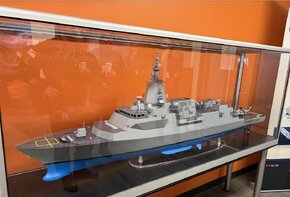
A new model for the River Class has been revealed. Note the changes.
Vulcano and Lionfish are out, replaced by the Mk.45 gun and Mk.38 respectively.
The Leonardo suite (including NA-30S Mk.2) appears to be fully removed.
AN/SLQ-32(V)6 EW suite is now included.
RAM placement is finally confirmed - but only one launcher, not two.
ExLS is gone, confirming it's no longer part of the design.
Still sitting at 24 VLS cells.
NSM placement has changed again.
New unidentified launcher system showing up on the model (still unclear what it is).
Overall, this model confirms a lot of what's been expected over the past year, simplification, more standard NATO systems, and fewer experimental additions.
Still some mysteries, but we're likely getting closer to the final configuration as the program moves toward CDR.
Picture and commentary courtesy of NOAH.
Vulcano and Lionfish are out, replaced by the Mk.45 gun and Mk.38 respectively.
The Leonardo suite (including NA-30S Mk.2) appears to be fully removed.
AN/SLQ-32(V)6 EW suite is now included.
RAM placement is finally confirmed - but only one launcher, not two.
ExLS is gone, confirming it's no longer part of the design.
Still sitting at 24 VLS cells.
NSM placement has changed again.
New unidentified launcher system showing up on the model (still unclear what it is).
Overall, this model confirms a lot of what's been expected over the past year, simplification, more standard NATO systems, and fewer experimental additions.
Still some mysteries, but we're likely getting closer to the final configuration as the program moves toward CDR.
Picture and commentary courtesy of NOAH.
Attachments
-
 147.2 KB Views: 43
Last edited:
John Fedup
The Bunker Group
I will wait for some official sources rather than a picture of a model with SFA information.A new model for the River Class has been revealed. Note the changes.
Vulcano and Lionfish are out, replaced by the Mk.45 gun and Mk.38 respectively.
The Leonardo suite (including NA-30S Mk.2) appears to be fully removed.
AN/SLQ-32(V)6 EW suite is now included.
RAM placement is finally confirmed - but only one launcher, not two.

That is a a lot of changes with no announcements or indications confirming it. Either the whole project has taken a very hard turn, or the model is not accurate.A new model for the River Class has been revealed. Note the changes.
I would love to see some Canadian sources either verify or correct the model. There are a lot of asymmetric design choices. But weirdly, they seem to try to balance each other out, presumably with some engineering input. So I don't know if this configuration is final, but it would seem entirely possible that the Canadian program has seen significant changes.
This model was unveiled by Vice-Admiral Topshee today. It is the most up to date one. Most of the changes have already been discussed and known about. One item on the ship has everyone guessing however as to what it is and that is box above deck launcher amidships below the funnel and sat dome. This is a report by Noah from True North Strategic Review.
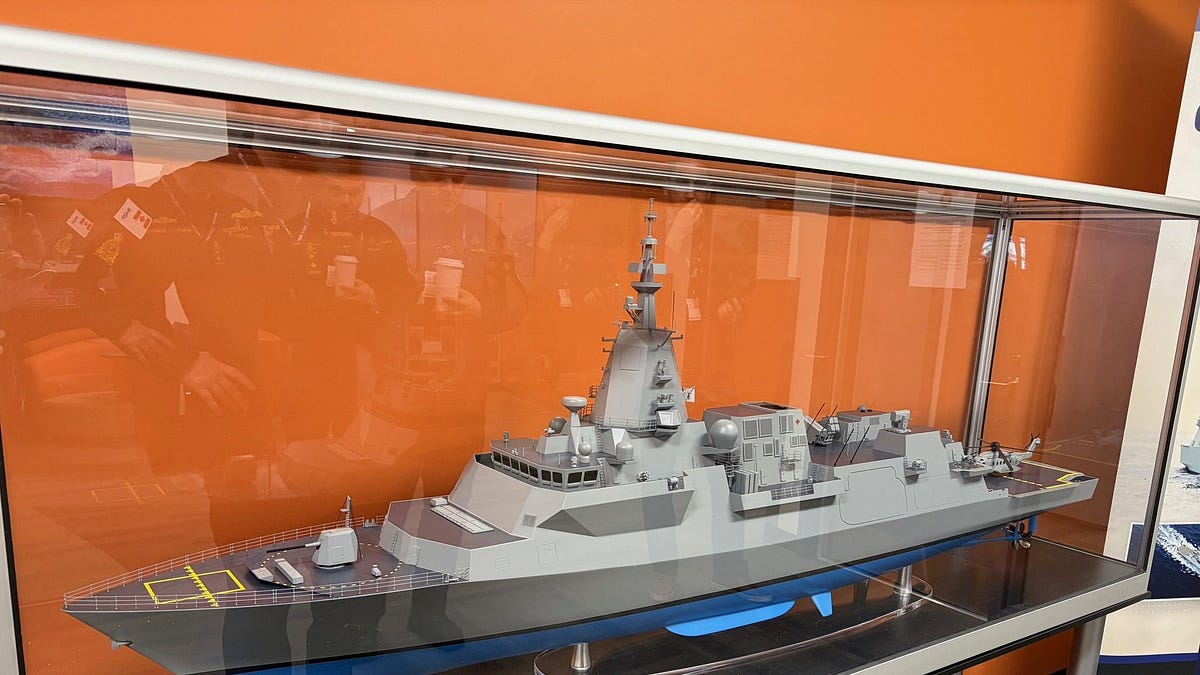

Was the change in:
I'm not that surprised at the main gun the automation takes up significant space. Single RAM launcher and its location is interesting. The mysterbox I would guess at Nulka or similar, but apparently not.
Australia significantly upsized its design to allow its radar, multiple CIWS, 16 naval launchers, 32 VLS, etc. The Canadian mast looks bigger than what the UK is fitting so that may have eaten into the top weight margin for such systems.
- main gun mk45
- single RAM
- Lionfish RWS
I'm not that surprised at the main gun the automation takes up significant space. Single RAM launcher and its location is interesting. The mysterbox I would guess at Nulka or similar, but apparently not.
Australia significantly upsized its design to allow its radar, multiple CIWS, 16 naval launchers, 32 VLS, etc. The Canadian mast looks bigger than what the UK is fitting so that may have eaten into the top weight margin for such systems.
CorvetteCrunch
Member
These items have been rumoured for quite sometime, and shown off recently for a short time before Irving Shipbuilding quickly removed a rendering from a public release back in February. Personally, this confirms what was shown in that rendering was partially accurate to the point they weren't supposed to show it and it was subsequently pulled from release. None of this has been officially communicated as has been typical for this program however, it has been teased in various elements. The most recent fact sheet removed mention of the Italian gun systems, leaving them as generic 127mm and 30mm systems. The RAM launcher was long rumoured to be coming, and has been reflected in the fact sheet text for quite sometime although we've only got one launcher instead of two.Was the change in:
Communicated before?
- main gun mk45
- single RAM
- Lionfish RWS
I'm not that surprised at the main gun the automation takes up significant space. Single RAM launcher and its location is interesting. The mysterbox I would guess at Nulka or similar, but apparently not.
Australia significantly upsized its design to allow its radar, multiple CIWS, 16 naval launchers, 32 VLS, etc. The Canadian mast looks bigger than what the UK is fitting so that may have eaten into the top weight margin for such systems.
I'll go through the changes and rationale I've either heard or can come up with logically myself, take it with a grain of salt. The overarching thing to take into consideration is that the Halifax class frigates are falling apart and the Navy desperately needs the River class to be delivered ASAP, so the design is being simplified to remove anything not already integrated with AEGIS to allow it to be finalized and delivered faster.
- The Italian 127mm and 30mm guns were high capability, but otherwise expensive and were not integrated into AEGIS out of the box. The BAE Mark 45 gun is lighter, cheaper, less complex, takes up less room below decks and delivers more than adequate capability while also being interoperable with the USN/the other Type 26 operators. The Dutch and Germans are apparently having integration issues with the Italian 127mm gun and its expansive below decks automated drum magazine system, so this might be a blessing. We are also taking on the Mark 38 30mm model for an autocannon, not the lesser 25mm model previously used. This will fill the gap of the Lionfish.
- 24 VLS is being kept for now due to concerns about weight, future growth margins and to simplify the final design. I don't have to explain to an Australian that the Type 26 design can be troublesome when overly laden with modifications, it seems the RCN is learning from the RAN and being more conservative with early batches, although the head of the Navy has stated he wants more VLS without losing the mission bay on future batches.
- There is a strange launcher type system forward on the amidships breezeway, it's rumoured that this is a JAGM launcher to supplement the Rivers defences against aerial and surface targets, including drones. Assuming each one of those boxes is a 3 cell JAGM launcher (with 1 slot per being an exhaust), you'd get 27 shots per launcher and with likely another fitted to the opposing side, that's a total of 54 low cost and reasonably capable interceptors. I have concerns about the placement running into issues about firing angles and exhaust uptake into the main ventilation stack, but a lot of people seem to agree its like JAGM as the USN is fitting to its ships.
- NSM is apparently fitted asymmetrically to help balance the weight of the RAM launcher being fitted to high up while also keeping the toxic rocket exhaust as far from the main ventilation intakes on the stack as possible. This arrangement has been shown in multiple renders previously, so it seems to be a trend and likely to stay.
- RAM launcher was moved as high up on the design as possible to get proper firing arcs along the sides and aft of the vessel, placing two launchers in the spots of the RN/RAN Phalanx might not work size wise and would drastically lower the overall angles/elevation of the mount itself. There is not a great spot to fit another one anywhere on the Type 26 design, as it was not built for this purpose originally.
- There looks to be a Nulka launcher present aft on the hanger roof.
CorvetteCrunch
Member
As a follow up to this, what I thought to be a Nulka launcher aft looks to be some kind of antenna or radar instead. With this taken into consideration alongside some other bits of info I've heard, what I described as a JAGM launcher could instead be a consolidated decoy launcher for Nulka, its future USN replacement in LEED and a number of other drones or various other systems. Soft launched items seem far more likely than rocket launched JAGM given their proximity to the superstructure as I mentioned earlier, so I am leaning towards them not being JAGM at this point. Things could change though, we do not have official confirmation and this is rumour milling/OSINT work.- There is a strange launcher type system forward on the amidships breezeway, it's rumoured that this is a JAGM launcher to supplement the Rivers defences against aerial and surface targets, including drones. Assuming each one of those boxes is a 3 cell JAGM launcher (with 1 slot per being an exhaust), you'd get 27 shots per launcher and with likely another fitted to the opposing side, that's a total of 54 low cost and reasonably capable interceptors. I have concerns about the placement running into issues about firing angles and exhaust uptake into the main ventilation stack, but a lot of people seem to agree its like JAGM as the USN is fitting to its ships.
- There looks to be a Nulka launcher present aft on the hanger roof.