AFP,
Singapore: From tsunami-hit Aceh to hurricane-battered New Orleans, Singapore's role in international relief efforts has thrown the spotlight on the city-state's rise as a Southeast Asian military power.
Thanks to billions of dollars in defense spending powered by explosive economic growth, the Singapore Armed Forces (SAF) has left its neighbors behind in terms of sheer firepower, although it has yet to be tested in combat.
“The SAF lacks operational experience no doubt, but in terms of its training, its military hardware, and its doctrines, it is certainly the most developed and mature conventional military force in Southeast Asia,” said Assistant Professor Bernard Loo, a military analyst in Singapore.
Singapore's new arms orders will further reinforce its position.
The ministry of defense has announced that it is negotiating with Boeing to buy a squadron of F-15 Eagle fighters, just two months after taking delivery of the first of six “stealth” frigates from French contractor DCN.
The fighter and frigate deals are estimated to be worth one billion US dollars each. The F-15 will replace an older generation of fighters and join F-16s already in Singapore's arsenal.
Singapore has been spending around six percent of gross domestic product – its total economic output – annually on defense, a legacy of its vulnerable early days as a republic.
In the fiscal year to March 2006, its defense budget is 9.26 billion Singapore dollars (5.5 billion US), up 7.4 percent from a year ago and accounting for almost a third of the national budget.
The island once contemptuously dismissed by former Indonesian president BJ Habibie as a “little red dot” on the map came to its giant neighbor's aid last December when a tsunami struck Aceh province, leaving some 131,000 people dead.
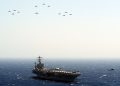
The SAF's C130 transport aircraft, heavy naval vessels and Super Puma and Chinook helicopters threw a lifeline to Aceh's survivors in the crucial days before a massive global relief effort could be launched.
The role was repeated on a smaller scale when Singapore's Texas-based Chinook helicopters helped in the post-hurricane relief efforts in New Orleans.
Four Chinooks flew more than 80 sorties, transporting over 800 evacuees and security personnel and more than 540 tonnes of equipment, humanitarian supplies and sand in the Hurricane Katrina disaster zone.
Because of its limited land area and air space, Singapore has to station some of its air assets in friendly countries like the United States, Australia and France for training.
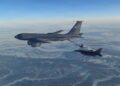
Singapore has also played a minor role supporting US forces in the Gulf. Last weekend, a KC-135 refuelling aircraft returned here after completing a three-month mission with the multinational reconstruction effort in Iraq.
– Siege mentality –
While untested in combat, analysts say the SAF has become a formidable force thanks to compulsory military service, in addition to the hardware.
All able-bodied Singaporean men including permanent residents are required to undergo two years of full-time National Service training, followed by regular refresher courses until they are in their mid-30s.
This gives Singapore, which has only 3.4 million citizens and permanent residents, a pool of some 350,000 reservists who can, at least in theory, be mobilized within hours for combat.
Robert Karniol, Asia-Pacific editor of the military affairs journal Jane's Defence Weekly, said only Vietnam among the Southeast Asian nations could possibly be a military match for Singapore.
“In terms of a standing army and combat capability, the Vietnamese armed forces have an awful lot of combat experience which the Singaporeans don't,” he said. “The Singaporeans have proven to be capable when called upon, but they've never been able to do anything as complex as the Vietnamese have.”
Before building up its firepower to current levels, Singapore used to follow a “poisoned shrimp” doctrine, he said.
“We're small but if you try to eat us, you will get very sick,” Karniol said, summing up the philosophy.
“But it's not a relevant policy anymore because the SAF have become increasingly more powerful and their primary function as with any military force is to deter attack and if attacked to defeat an attack.”
The SAF was a puny force in the early years after Singapore was ejected from the Malaysian federation in 1965 and its survival as a republic was in doubt.
When other countries refused to help, Israel sent military advisers but they were officially disguised as Mexicans to avoid offending Singapore's Muslim neighbors.
“They looked swarthy enough,” independence leader Lee Kuan Yew wrote in his memoirs.
Abdul Razak Baginda, executive director of the Malaysian Strategic Research Centre, maintained that Singapore still has an “Israeli siege mentality”.
“That mentality is I think embedded in the psyche of the Singapore leadership, the Singapore people and the military,” he said. “Singapore is surrounded by the Malay world.”
But others point out that instead of a hardline stance, Singapore has opted for what Karniol called “defense diplomacy” to enhance its security.
“It effectively involves using your armed forces as one of your tools of diplomacy. It's an established function for armed forces, except that the Singaporeans are much better at it.”
Singaporean analyst Loo of the Nanyang Technological University said the city-state “has always maintained that it sees no direct military threats coming from the region of Southeast Asia”.
“Its deterrent posture is one of general deterrence, derived from the basic assumption that international politics is one of self-help, and if ever a direct military threat arose, the country would then need a strong, well-trained SAF that can deter a more immediate military threat.”