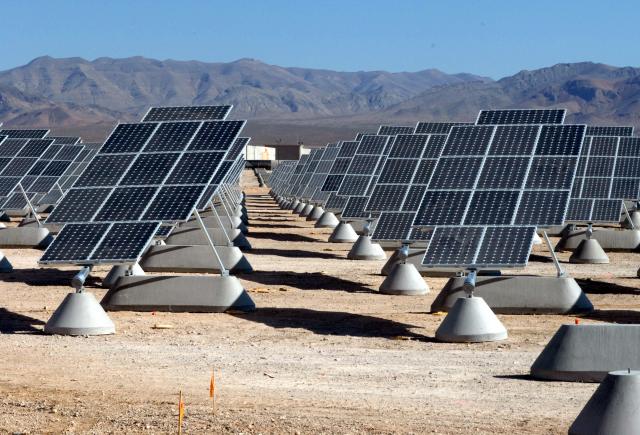
Last week’s groundbreaking for a new solar micro grid at Fort Hunter Liggett, Calif., is the latest example of a military “going green” — saving environmental resources and taxpayer dollars, too.
The 1-megawatt facility, to become operational later this year, will provide one-third of the power for the nation’s largest Army Reserve training post, and ultimately it will save $1 million in energy costs annually, Addison D. “Tad” Davis IV, command executive officer for U.S. Army Reserve Command at Fort Bragg, N.C., told American Forces Press Service.
Taking advantage of the post’s 292 annual days of sunshine, the facility’s two grids, each stretching about 40 feet by 1,200 feet over an existing parking lot, will shade vehicles below while generating renewable solar energy.
“This is pretty exciting stuff, when you think about the fact that we are able to do this and generate that much energy for this installation,” Davis said.
And if the Army decides to expand the initiative into its second and third phases, it could enable Fort Hunter Liggett to become one of the Defense Department’s first “net-zero energy installations,” meaning it produces as much energy as it uses, he said.
Davis said he’s seen the military make huge strides in energy conservation. A decade ago, as the garrison commander of Fort Bragg, N.C., he introduced the Army’s first installation-wide sustainability program.
Costs largely drove that decision.
“As the installation commander for the largest populated military installation in the world here, at Fort Bragg, I had the checkbook, and I had to pay the energy bill and the water bill every month,” he said.
It didn’t take long to recognize that conserving resources saved money that could be used for infrastructure upgrades and new facilities.
“So it was the economics of this that really got me excited about sustainability,” Davis said.
Fort Bragg’s early sustainability programs addressed the broad scope of issues, from how energy, water, wastewater and solid and hazardous waste was managed to how new buildings were constructed. The result, Davis said, was more effective and efficient use of resources, reduced consumption and, as a result, cost savings that could be applied to other projects.
The concept caught on quickly, expanding to more than 30 Army installations, including posts in Germany, Alaska and Hawaii. Now, the Army hopes to take it a step further with net-zero energy, waste and water initiatives. Several pilot programs are expected to be announced during next week’s Earth Day observance.
These sustainability initiatives support what Davis called the Army’s “triple bottom line” that incorporates mission, environment and community.
“Obviously, the mission is most important to us — to be able to provide our Soldiers, civilians and family members for worldwide deployments and be able to go forth and conduct missions and return home safe and sound,” he said.
That mission focus is accompanied with the responsibility to be a good steward of the environment, Davis said.
“This is looking at our resources and taking deliberate steps to address our consumption and reducing our impact on the environment,” he explained.
It also involves working as partners with communities — those directly on the installation as well as beyond its gates — to pursue environmental goals. Davis pointed to the example of the Sustainable Sandhills Initiative, which was established in 2003 and brings together Fort Bragg, neighboring Pope Air Force Base and eight surrounding counties to support regional conservation programs and initiatives.
Those experiences have proven valuable in Davis’ current post as CEO for the Army Reserve, with responsibility for its 1,200 facilities worldwide.
“We in the Army Reserve are inextricably linked to the communities, because our reserve centers are there in the communities,” he said. “So the thought is, if we can get this [sustainability effort] distributed to as many of our facilities as possible, it will help us economically, it will help us to be good stewards of the taxpayer dollar, but it will also connect us to the communities — many of which are trying to do much of the same thing we are doing.”
Evidence of a sustainability mind set is cropping up throughout the Army Reserve. It’s seen in a photovoltaic solar panel system on the roof of the 99th Regional Support Command headquarters at Joint Base McGuire-Dix-Lakehurst, N.J.; a geothermal initiative at Fort Devens, Mass.; and in renovations of older buildings to make them more efficient.
One of the most exciting new developments, Davis said, is a new reserve center being built at Las Cruces, N.M., to the most stringent Leadership in Energy and Environmental Design, or LEED, standards.
“This is a really big deal,” he said of the plans that will achieve either gold- or platinum-level LEED certification and exceed the silver certification the Army requires for all new buildings. “It is a huge accomplishment, by any stretch, to have a building able to meet [those] criteria,” Davis said.
While the Army Reserve builds state-of-the-art facilities and renovates older ones to make them more energy- and resource-efficient, its members are identifying new ways of doing business that promote conservation. New temperature-control systems enable users to heat and cool entire facilities during high-occupancy weekend periods, but only parts of those buildings during weekdays, when they’re minimally manned.
New energy, water and natural gas meters are being installed to encourage conservation. Hybrid vehicles are being put to use at the Army Reserve’s larger training centers, and a new emphasis has been put on buying recyclable and reusable products.
Meanwhile, the Army Reserve has joined “big Army” in expanding this focus to the operational force.
“We’re trying to look at how we can apply some of these lessons learned to our forward-deployed forces, enable the mission to continue, but reduce the reliance on fossil fuel” to run generators and provide other critical support, Davis said, citing solar or wind power as possible options.
“When you boil it down to what we are trying to accomplish, we are trying to build green, buy green, go green,” he said. “From the big-picture perspective, this is obviously something that is very important to the military.”