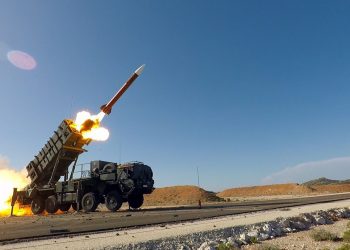
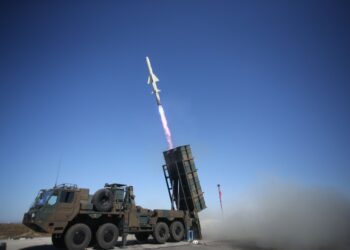
WASHINGTON: The key to a successful missile defense strategy is layers, the director of the Missile Defense Agency said today.
“Different missiles systems [are needed] so that if one fails or one can be tricked, you have a completely different missile system going after the second shot,” Army Lt. Gen. Patrick O’Reilly said. It’s “very challenging to get through two systems.”
O’Reilly covered everything from U.S. missile defense priorities to cooperative efforts with Russia during a Defense Writers Group breakfast here.
The Missile Defense Agency is in the midst of developing the implementation for the Ballistic Missile Defense Review, which was released in February, O’Reilly said. This review set several priorities based on a 10-year outlook.
The No. 1 priority is the defense of the United States, the general said, followed by enhancing regional defenses. Next is the development of a testing program that establishes which missile defense systems work, and gaining a sense of their capabilities and limitations before making a purchase.
By doing so, “we develop a fiscally sustainable missile defense, and we also develop one that hedges against future threats,” O’Reilly said.
The final priority is to expand international capacity, he said.
“In other words, have not only capability, but have the capacity in this defense area to work closely and rely and leverage on the contributions from our allies,” O’Reilly said. These priorities are what “drive our budget development, our technology priorities and so forth,” he added.
On the technology front, O’Reilly noted that long-range targets pose the greatest challenge for the United States. Intelligence experts work to predict whether countries can build a long-range missile, such as an intermediate-range ballistic missile or intercontinental ballistic missile, on their own.
O’Reilly said his agency works closely with the entire intelligence community “constantly judging this.” The challenges are determining how an adversary will build and develop a missile and determining information in a generally “clandestine business,” the general said.
“We do see a growth of underground factories,” O’Reilly said, as well as missiles being built in caves and launcher vehicles being camouflaged as civilian vehicles. None of this is new, he noted, but it does indicate the difficulties in trying to judge how much progress has been made.
He pointed out a proliferation of Scud missiles that originate from the old Soviet Union. According to intelligence, he said, more than 6,000 missiles are in countries other than NATO, the United States, China and Russia, as well as more than 1,000 launchers.
The United States has witnessed many failures in the development and testing of these systems. However, O’Reilly cautioned against complacency in the face of other countries’ efforts. The United States experienced failures as well in the 1960s and in missile defense in the 1990s, he noted.
“History shows that if they are persistent, they will be successful,” he said. “But history also shows that it is extremely challenging to be precise on when they will be successful.”
On a potential missile threat from Iran, O’Reilly noted, “If we’re looking at one or two or even five Iranian missiles. … we have a large ability to respond to that.” To pose a significant threat, the country not only would have to be successful in development, but in numbers, he said.
“In my estimation, it would have to be more than 10,” he said. “And they would have to be able to successfully launch 10.” That would pose a challenge for the U.S. program, let alone a program in a different stage of development, he added.
Iran has shown a space-launch capability, he acknowledged, based on a test in February. And there’s no indication they won’t attempt another, he said.
“Space launch does give you some of the capability you need to develop an offensive missile,” he said. However, the general underscored the difficulty of designing a missile to re-enter the atmosphere and be somewhat accurate, let alone survive re-entry. This ability level would require sophisticated science and testing, “and we don’t see evidence of that testing,” he added.
O’Reilly said the United States and Russia have been working together on joint threat assessments.
“We’ve also had a lot of interaction from a technical point of view of opening the access so they can better understand our missile defense,” he said. “We have had now, for a couple of years, a standing open invitation for the Russians to visit our missile defense assets and go to our missile defense fields.”
Despite the lack of response to that blanket invitation, he said, Russia recently accepted an invitation to attend a test of the Theater High Altitude Area Defense system.
“There is more engagement than we’ve seen before, but it is still at the preliminary steps,” he said.
On the road ahead, O’Reilly predicted remotely piloted vehicles will figure prominently and said the Missile Defense Agency is working closely with the Air Force to maximize their potential. The goal, he said, is to “have an aircraft at the right place at the right time in order to intercept.”
An advantage of remotely piloted vehicles is that they’re persistent — they can get into a region and stay there for long durations of time, O’Reilly explained. The other advantage is their sensor capability.
“We literally were shocked when we found out the capability for missile defense,” he said. “You can be well over 1,000 kilometers away, and you have a very good track of a missile.”
Predators now fly in many of the agency’s tests, he said. Predators and future versions of the sensor system on board are “fantastic” at tracking missile clusters, he added.
A possible future development is attachment pods that can go on a wing, enabling any remotely piloted vehicle to have a missile defense capability as a sensor, he said.