Air-ground fire coordination-also known as Close Air Support or CAS-is a dangerous and difficult business. Pilots and dismounted ground agents must ensure they hit only the intended target using just voice directions and, if they’re lucky, a common paper map. It can often take up to an hour to confer, get in position and strike-time in which targets can attack first or move out of reach. To help address these challenges, DARPA recently awarded a contract for Phase II of its Persistent Close Air Support (PCAS) program to the Raytheon Company of Waltham, Mass.
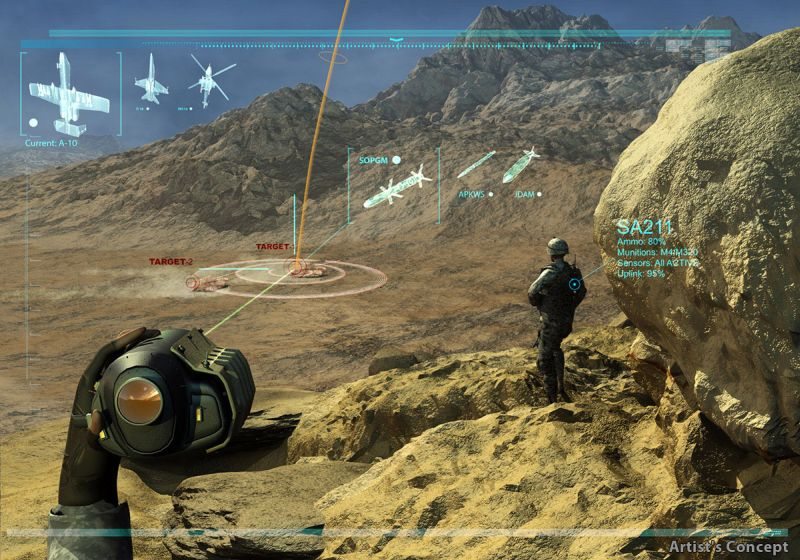
PCAS aims to enable ground forces and combat aircrews to jointly select and employ precision-guided weapons from a diverse set of airborne platforms. The program seeks to leverage advances in computing and communications technologies to fundamentally increase CAS effectiveness, as well as improve the speed and survivability of ground forces engaged with enemy forces.
“Our goal is to make Close Air Support more precise, prompt and easy to coordinate under stressful operational conditions,” said Dan Patt, DARPA program manager. “We could use smaller munitions to hit smaller or moving targets, minimizing the risk of friendly fire or collateral damage.”
While its tools have become more sophisticated, CAS has not fundamentally changed since World War I. To accelerate CAS capabilities well beyond the current technological state of the art, PCAS envisions an all-digital system that incorporates commercial IT products and models such as open interfaces, element modularity and mobile software applications.
PCAS designs currently include two main components, PCAS-Air and PCAS-Ground. PCAS-Air would consist of an internal guidance system, weapons and engagement management systems, and high-speed data transfer via Ethernet, existing aircraft wiring or wireless networks.
Based on tactical information, PCAS-Air’s automated algorithms would recommend optimal travel routes to the target, which weapon to use on arrival and how best to deploy it. Aircrews could receive information either through hardwired interfaces or wirelessly via tablet computers.
PCAS-Air would inform ground forces through PCAS-Ground, a suite of technologies enabling improved mobility, situational awareness and communications for fire coordination. A HUD eyepiece wired to a tablet computer like that used in PCAS-Air would display tactical imagery, maps and other information, enabling ground forces to keep their eyes more on the target and less on a computer screen.
Parts of PCAS-Ground are already in field trials that mark some of the first large-scale use of commercial tablets for air-ground fire coordination. From December 2012 through March 2013, PCAS deployed 500 Android tablets equipped with PCAS-Ground situational awareness software to units stationed in Afghanistan.
The tablets provided warfighters with added capabilities including digital gridded reference graphics (GRGs), digital terrain elevation data and other mission planning and execution tools. In the air, in-flight GPS tracking enabled pilots and ground forces to locate their relative positions in real time. Field reports show that PCAS-Ground has replaced those units’ legacy paper maps, dramatically improving ground forces’ ability to quickly and safely coordinate air engagements.
One of the most potentially groundbreaking elements of PCAS is its Smart Rail, a modular system that would attach to standard external mounting rails on many common fixed- and rotor-wing aircraft. The Smart Rail would initially carry and perform engagement computations for the PCAS-Air components, but it would also enable quick, inexpensive installation of new piloting aids and new radios to communicate to ground agents. The plug-and-play system could accommodate legacy and future equipment with equal ease, and eventually could also be compatible with unmanned air vehicles (UAVs).
“The Smart Rail is an easy way to get digital air-ground coordination onto current and future aircraft,” Patt said. “Just as the USB revolutionized how we use IT-enabled devices, modular technologies like the Smart Rail could greatly reduce development time and costs for military technology and speed deployment of PCAS and other capabilities across the Services.”