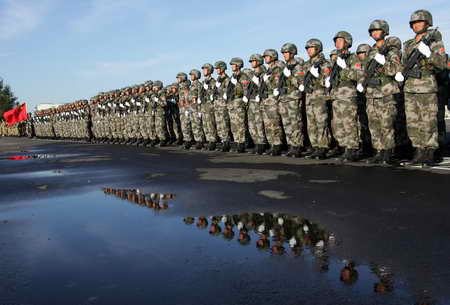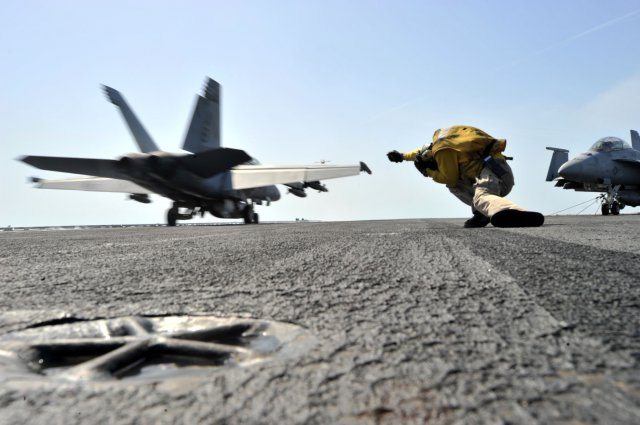
When the Army, Navy and Air Force maneuver in the same airspace, a straightforward request to engage a target often has to pass through multiple communications systems and manual approvals, slowing down a process that depends on speed.
Now the three services are looking to cut that time significantly — achieving “dynamic airspace management” by fusing new web services technologies. A joint experiment kicking off this month will attempt to bridge the data gap between the services’ systems while automating some steps to speed communications, said officials with the U.S. Army Research, Development and Engineering Command, or RDECOM’s, communications-electronics center, or CERDEC.
“What we’re trying to do is use new technologies to shorten that cycle for airspace deconfliction to minutes, rather than hours,” said Greg Davis, an engineer with CERDEC’s Command and Control Directorate, or C2D, which is participating in the experiment for the first time.
Along with dynamic airspace management, other mission areas that could benefit from the 2011 Multi-Service Limited Technology Experiment, or LTE, include transmitting mission command information over intermittent or bandwidth-limited networks, and real-time monitoring of system status and message completion. Those capabilities can make a big difference in battle, when forces need reliable and actionable awareness on what information is getting through.
“The ability of leaders to have quick access to critical information from multiple services operating in the same battle space will increase combat capability by allowing leaders and staffs to more efficiently synchronize resources and focus combat power,” said Scott Rutter, with CERDEC.
The use of open-source software for these solutions makes them flexible and scalable to scenarios involving mission command systems used by Soldiers, Sailors, Airmen, Marines, or a combination, officials said.
The experiment — which began with integration work in July and runs through mid-September — will involve Army, Navy and Air Force locations around the country, including Charleston, S.C., Rome, N.Y. and Aberdeen Proving Ground, Md. For CERDEC C2D, the event is one of the first multi-service experiments that will involve a major contribution from Aberdeen Proving Ground, where the organization relocated under the Base Realignment and Closure transition that concludes Sept. 15.
Beyond serving as a venue to evaluate and transition emerging technologies, the multi-service LTE will help forge long-term partnerships between systems engineering experts across the Joint force.
The technical hurdles faced by those experts are high.
As they would in the field, the services in the experiment will start from different baselines of information known as federated data — or data that is stored in a single location, but can be widely used for a consistent user experience. The Army will rely on Service Oriented Architecture Foundation — Army, or SOAF-A, Lite, which was developed by CERDEC C2D using Government Off-The-Shelf and open source software.
Packaged as a virtual machine for quick deployment in connected and disconnected environments, SOAF-A Lite provides users with a web portal, service discovery, service repository, directory, security, workflow and other features.
The Navy and Air Force will be using a different framework known as Afloat Core Services, or ACS, which provides users with a software infrastructure platform upon which to mix and match services.
“We’ve had to analyze what data format is used for the Army, what data format is used for the Navy, what data format is used for the Air Force. None of them are identical,” said Oanh Trinh, an Army engineer with CERDEC. “So how do you bridge the gap? How do you find a way to get the data from one side to appear on the other side? That’s the challenge.”
To accomplish this conversion, the experiment will leverage Semantic Mediation for Army Reasoning and Teamwork, or SMART, a “translation” technology developed by CERDEC C2D under the Collaborative Battlespace Reasoning and Awareness , known as COBRA, Army Technology Objective, or ATO, for data mediation between disparate software systems. Data mediation involves mapping data between existing, incompatible data formats, allowing multiple software systems to share information for faster collaboration, deconfliction and integration.
The COBRA ATO team has experience bridging such gaps. Last year, it produced software called the Universal Collaboration Bridge, which allows different military text chat systems to communicate without changing their existing properties.
The SMART solution will be tested in two scenarios requiring the Army, Navy and Air Force to communicate and clear the airspace of any friendly forces before employing indirect fire power: one situation where satellite network connectivity is available, and one without it. The networks will be stressed with high-bandwidth loads to test whether the systems can detect and send the most critical information through first.
“If your communications become burdened or you’re under attack, you want some communications prioritized over others,” Davis said. With mission-based data prioritization, he said, “When things go awry, the right information gets through.”
To visualize the battlespace during the exercise, users will leverage Geospatial Environment for Command and Control Operations, known as GEC2O, a CERDEC product that ties imagery from Google Earth maps into mission command systems.
They will be able to monitor whether their messages are getting through the tangle of different systems and networks with Open Enterprise Service Management, known as OpenESM, which monitors the real-time performance of web services. If a message is slowed at a particular node, timestamps pinpoint the problem for quick troubleshooting, said Alex O’Ree, a CERDEC engineer who leads the OpenESM initiative.
E-mail alerts provide leaders with instant awareness of an abnormal message or a long delay.
“Applications of OpenESM range from in the R & D lab, pinging servers, to how well a Network Operations Center is functioning now,” O’Ree said. As an open-source
Government Off The Shelf product, he said, “It can be customized by user and service to see performance metrics.”
At the LTE, OpenESM will also store the statistics on message execution between the Army, Navy and Air Force for later analysis and lessons-learned. Its performance during the experiment will allow further improvement of the product and help support fielding decisions by the Navy and Air Force, officials said.
This LTE will “blaze a path” for future multi-service experiments by introducing Army science and technology stakeholders to the other services’ security procedures, organizational cultures and other aspects of Joint partnerships that must be understood and accepted for any collaboration to be a success.
“The act of convening the three services together and executing a relevant and distributed experiment is no small feat,” said Gina Guiducci, who leads the CERDEC C2D team participating in the event. “We’re excited that the multi-service LTE is breaking ground by allowing deep collaboration between the Army, Navy, and Air Force between their respective research centers.”