US Air Force, LANGLEY AIR FORCE BASE: The men and women of Air Combat Command's intelligence directorate haven't been stocking up on distilled water and plywood, but they are prepared for the busy part of the 2006 hurricane season or any natural disaster that might affect the United States.
“We're light-years ahead of where we were this time last year in our ability to rapidly provide imagery and mapping support to disaster response forces,” said Col. James Poss, the command's intelligence director.
Of course, this time last year people at ACC — and throughout the nation — held their breath as Hurricane Katrina made landfall near New Orleans. Katrina caused more than $50 billion in damage and claimed more than 1,600 lives, earning it a place in history as the nation's costliest hurricane and the sixth most intense Atlantic storm. Four weeks later, Hurricane Rita stormed ashore and added to the misery and destruction in the Gulf Coast region.
The Air Force response was swift: more than 5,500 people rescued, 12,258 tons of relief supplies delivered and 29,661 people airlifted from the areas are just a few of the highlights. The command's intelligence directorate did its part, too, deploying resources more commonly associated with the battlefield to collect and produce imagery that helped save lives and assess damage to critical infrastructure.
Though still providing around-the-clock support to warfighters in Afghanistan and Iraq, ACC's intelligence team deployed 31 people in support of Katrina operations and produced more than 2,300 imagery and mapping products for use by national, military, state and local civilian authorities.
In the aftermath, however, Air Force officials looked for ways to improve disaster response operations.
“The most valuable lesson we learned (from Katrina) was to be able to provide timely imagery to civil authorities,” said Lt. Col. Michael Hill, chief of the directorate's force level intelligence systems branch. “Dealing with civil authorities quickly identified the need to support crisis operations at the unclassified level.”
A host of other issues — some logistical and some organizational — needed closer examination, Colonel Hill said. The directorate also had to remain ever-mindful of the legal issues with regard to defense support and military imagery support to civil and law enforcement authorities.
The directorate got a jump on the 2006 hurricane season in April by sponsoring a multi-agency workshop to discuss defense support to civil authorities. At the workshop, representatives from 27 federal and Defense Department agencies, including the Department of Homeland Security, the National Geospatial-Intelligence Agency, Joint Staff, Air Staff, National Guard Bureau, Northern Command, Joint Forces Command and various Air Force agencies focused on developing an imagery collection, production and dissemination strategy to support contingencies.
“From this workshop, the directorate of intelligence set forth on a two-track approach to the hurricane season. One was a comprehensive look at roles, responsibilities, policies, procedures and manning for defense support to civil authorities, and the other focused on imagery dissemination,” said Colonel Hill.
At the heart of the workshop was the question of who takes the lead, who works for whom, how the civil support mission is executed and, as might be expected, who supports the mission, Colonel Hill said. These roles, responsibilities, policies, procedures and manning issues, along with the process for developing a prioritized imagery collection list for use by all services during a natural disaster were “clearly spelled out” during the workshop, the colonel said.
Another part of the workshop focused on the Air Force imagery dissemination architecture. In the event ACC assets are again called upon to conduct civil support operations, officials here want to provide as much data to the lowest level as quickly as possible.
Plans are in place to use an unclassified, centralized Web-based area to get imagery to users with Internet capability and to provide an alternative to those who don't.
The directorate also formed a tiger team focused on aiding Air Forces North in civil support operations. AFNORTH, located at Tyndall Air Force Base, Fla., is the Combined Forces Air Component Commander to Northern Command and provides command and control of assets involved in air operations supporting recovery efforts.
During the 2005 hurricane season, AFNORTH established the first Air and Space Expeditionary Task Force in support of Hurricane Katrina, Wilma and Rita recovery operations. The tiger team formed a cooperative effort with the AFNORTH staff and the two organizations worked together to ensure processes, training and needs for additional manpower were well documented to meet the potential challenges of the 2006 hurricane season.
Colonel Poss saw this effort as a critical measure in getting the Air Force support function poised and properly equipped to execute state-of-the-art intelligence, surveillance and reconnaissance operations, at a moment's notice, whenever and wherever needed.
“In the immediate aftermath of a disaster, first responders and local officials at the scene may not have the means to receive data electronically,” Colonel Hill said. “It's important that we establish an alternate means of providing information to them as quickly as possible.”
One means of getting data to disadvantaged users would be to deploy imagery and communications packages such as Eagle Vision and the National Geospatial-Intelligence Agency's Mobile Integrated Geospatial-Intelligence System. Eagle Vision, a ground station for processing imagery received directly from commercial satellite platforms, and MIGS, a ground station capable of processing intelligence data from space, airborne and surface sensors, both offer the capability of receiving and exploiting still imagery at forward-deployed — or in the case of a disaster, isolated — locations.
“Intelligence, surveillance and reconnaissance assets can provide imagery and video products invaluable to federal agencies, first responders, local law enforcement and even private citizens,” said Colonel Poss. “As the principal operator of these U.S.-based assets, ACC has an important role in ensuring ISR products get to customers who need them — as quickly as possible — in the most appropriate format.”
One year after Katrina, the command's intelligence assets are poised to provide unparalleled support to civil authorities — should another natural disaster strike. Aircraft and space-based cameras combined with recently approved flights by the Predator unmanned aerial vehicles and a partnership with National Geospatial-Intelligence Agency will ensure those authorities have a better than bird's-eye, though still unclassified, look at the affected area — providing imagery key to rescue, response and recovery operations.
“We will incorporate lessons learned, capitalize on emerging technology, and continue protecting and supporting Americans in time of need after disasters such as Hurricane Katrina,” said Colonel Poss.
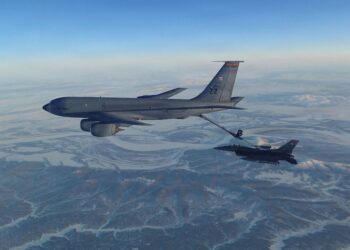
US military says aircraft crash in Iraq killed 4 crew members
A US KC?135 aerial refueling aircraft crashed in western Iraq killing four crew members, the military said Friday, adding that...