Imagine going from looking at the outside of a building, to seeing the internal workings of its electrical system simply by walking around a display case. The sophistication of 3-D holographic technology allows just that.
For Soldiers on the battlefield, the level of intelligence they’re getting about a dangerous location — like a site they’re about to ambush or a room where U.S. interests may be located — can’t come to them in a more safe, realistic way.
It’s called Tactical Digital Hologram technology, and more than 10,000 units, which at first glance look like flat plastic maps, have already been fielded to Special Forces in Iraq and Afghanistan.
Research engineers at the Army Research Laboratory’s Simulation and Training Technology Center in Orlando, Fla., are investing in commercially available 3-D holographic technology. As the Defense Department’s managing agency for all such programs, the STTC is the first organization to actually evaluate and compare 3-D holographic static images against conventional topographic data that troops currently rely on for planning and mission rehearsal.
“Although the Army has been fielding these images for about the past five years, no substantiating data existed to support their utility except for anecdotal feedback like ‘this is great’ or ‘this really helps me’ from the warfighter,” said H. Michelle Kalphat, STTC chief engineer.
A study she co-authored with an Air Force Research Laboratory expert in 2009 showed that the appropriate use of 3-D holographic imagery improves training, mission rehearsal and mission operational effectiveness, due in part to visual learners making up roughly 65 percent of the military population. A visual scene of a 3-D world is a more intuitive and natural representation than a 2-D display, and a single integrated object reduces the need for mental integration of two or three separate representations, the report stated.
The medical community wants this technology to help them, at a minimum, teach residents how to perform surgery on the cornea and other body parts that otherwise could only be achieved with a live patient. She said homeland protection agencies want these images to show their officers how to neutralize a bomb, and Border Patrol administrators want to use these images to help immigration workers memorize terrain features and quickly spot and report locations of suspicious activities.
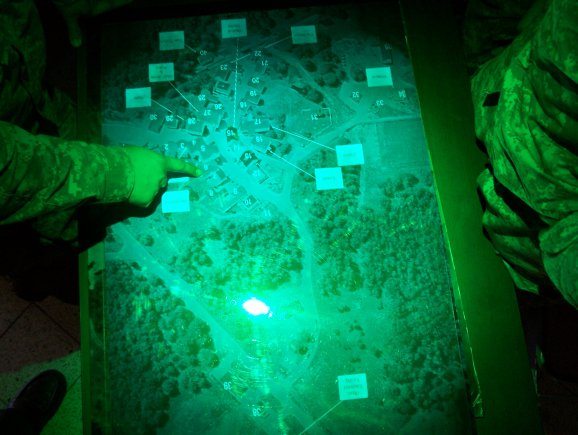
“A whole unit can stand around the image to quickly plan ingress/egress routes for a cordon and search mission, determine where their vehicles will be positioned, casualty collection points, indirect fire support, etc. You can also write on it safely with either a grease pencil or dry erase marker,” said Kalphat, a member of the board of directors for the Association for Unmanned Systems Vehicles International.
Detailed images created from dozens of intelligence sources are laser inscribed on special film to make digital holograms. They’re helping military commanders in battle with mission planning, mission rehearsal and human intelligence debriefing. A version of this technology called “channeled holograms” allows commanders to peer at, around, over and even under fixed objects in theater, like tall buildings, raised monuments and vehicles, seeing points of interest four layers deep.
“Creating a channeled hologram of the head, you can see the full face, but if you move 90 degrees out, you could see skin removed and just blood vessels. Another 90 degrees out, you see nerves. Another 90 degrees again and see bones.”
The holographic images are durable and can be rolled up or cut to any size. Images are typically produced from Light Detection and Ranging/Buckeye data, which provides a high-resolution source to register data from other sensors, such as Constant Hawk and Angel Fire.
The image is full parallax, meaning no special equipment — like movie-style 3-D eyewear or computer equipment — is needed. Just a single, direct light source — like a light-emitting diode, or LED light, standard-issue flashlight or even the sun — needs to hit the image at a 90-degree angle to illuminate the 3-D effects. And, the images aren’t distorted when viewed under night vision goggles.
The holograms permit simultaneous viewing for up to 20 participants and are interactive, allowing images to be frozen, rotated and zoomed up to the resolution limit of the data.