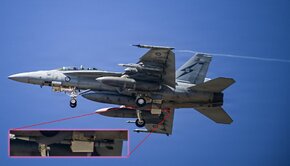
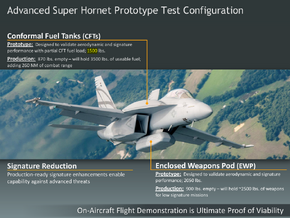
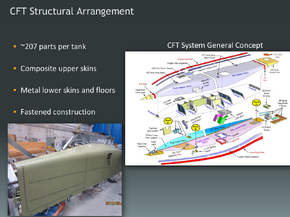
I had heard the development progressed much further along and cancelled at the last minute. AFAIK it was the weapons pod that was nothing but a mock up and never had any development effort put into it. IMO its not even clear how that would even work to deploy munitions? Mini doors? Stealthy munitions like JSM and LRASM in a separate pod on a centre mount pylon an in a separate enclosure is silly. And large munitions would be hugely problematic. Certainly some aspects of the advanced Super hornet were, seemly, not very good ideas. The weapon pod concept died early on within 3 years of the initial advanced super hornet announcement, The CFT lasted 8 years later before being cancelled.
Boeing said it was mostly a budget decision. Which is understandable. I agree, this would cost money. But does it justify the savings and long term ownership benefits.
View attachment 55734
View attachment 55735
Not to go it alone, but the USN currently operates 4 squadrons of Growlers from land bases, they integrate with USAF platforms and allied forces. These would be prime candidates for a CFT as none of the carrier issues are relevant. From my understanding a lot of the issue a lot of the concern came up late when they were looking at carrier operations with the tank and servicing the aircraft then became problematic. So right up to the full qualification test flights, which would likely need to be redone on an advanced growler anyway. With these type of upgrades often they make the entire program bigger and more expensive and require further qualifications going forward with and without tanks. For the USN, with ample refuelling and movable carriers, single seat fighters may not need this level of complication.
But as I understand it they did fly with 1,500lb of fuel. The early versions were mockups, but there was certainly a later version where it was holding fuel, and demonstrated with limited amount of testing, but not full flight integration testing.
We are spending $6b in upgrading the growlers to advanced growlers. But this plane is draggy, and has limited range and limited capability to employ external fuel tanks. We are part of that program. We could make request for it to be looked at (and possibly rejected).
It would be applicable to the Australian super hornets and Growlers. While in USN it would only be land based growlers that would be of interest. Depending on US appetite and needs particularly when operating in the pacific. But threats on refuelling capability in the pacific are high and being unable to match range of other USAF (ie F-15EX or F-35) is significant. So maybe a 80%+ US input program. Funding environment now of increasing EW aircraft in the Pacific may have more resonance.
Israel has developed CFT for its aircraft separately multiple times with the F-16 and F-15. The F-15 is interesting because the USAF are not that interested in it, but on latter appraisal, are now fitting them to the F-15EX they ordered without them.
| Aircraft | Configuration | Approx. published range / combat radius |
|---|
| F-15EX | No CFT | ~687 nmi combat radius* |
| F-15EX | With CFT | ~790–800 nmi combat radius* |
| F/A-18E/F Super Hornet | Standard internal fuel | ~570–590 nmi combat radius |
| F/A-18E/F Super Hornet | With CFT | 700+ nmi combat radius |
| EA-18G Growler | Standard, with 2 × 480 gal drop tanks | 850+ nmi combat range |
| EA-18G Growler | With CFT | roughly +100–130 nmi radius, or >30 min extra station time |
| F-35A | Internal fuel only | 590+ nmi combat radius |
So in a Singapore or Japan type mission, With F-15s.. with CFT you get more like F-15 SE range.
You gain two pylons, which means the growlers could carry additional AARGM, strike, etc. or gain enough range with drop tanks to match the F-15EX with CFT.. Which the USAF is now fielding and wasn't in 2021-2022.
Just a brainfart of an idea. It would have to have significant US funding and need.


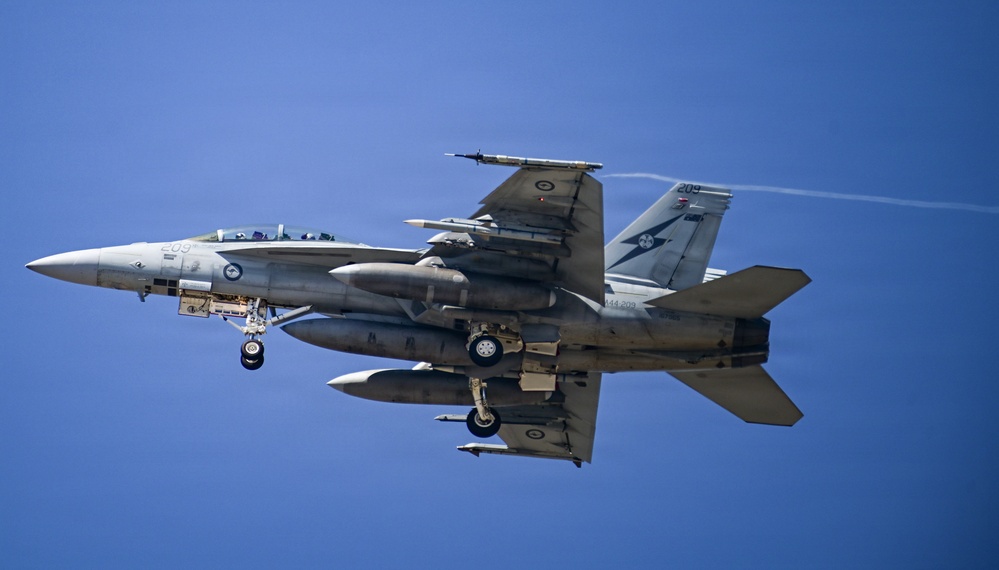
www.dvidshub.net