Analysis of sixty drone incidents in Europe: a lot of panic and little evidence
Drone notifications shut down airports across Europe and cause unrest. Trouw analyzed about sixty incidents. This shows a lot of confusion, regular false alarm and hardly any harsh evidence for Russian involvement.
'Exclusive footage shows huge drone above Zaventem Airport'. A terrifying video appeared earlier this month on the website of the Belgian newspaper
Het Laatste Nieuws. That happened after air traffic from Zaventem National Airport was shut down twice on the evening of November 4 due to reports of drones.
The images show a flying object with lights. Some Dutch media also published about the video. The unrest was great, as Belgium was flooded with drone sightings at airports and military objects at the time of this incident.
But two weeks later, the flying object on the images turns out not to be a drone at all. It was a police helicopter, research by the
VRT shows
. Videos of two other 'drone incidents' around Belgian military bases in the days after also turn out to be a false alarm, the fact checkers conclude. It was a police helicopter and a DHL cargo plane landing.
View attachment 53985
Drones everywhere in Europe
The Belgian video footage illustrates the panic about the wave of drone reports that has been holding Europe for months. The sightings shut down airports for hours and cause unrest around ports, military bases and other (critical) infrastructure. But the question is whether they were drones. What ultimately yielded police investigation into all these incidents?
Using platform Dronewatch,
Trouw mapped out about sixty incidents with drones in eleven European countries. These took place in the last three months. The conclusion: a lot of confusion and ambiguity and regular false alarms. No hard evidence has been provided for Russian involvement, which some authorities and experts point out in the vast majority of cases.
In about forty incidents, the origin is still unclear or no evidence has been found at all for drones in the airspace. An example is Oslo, where drone reports shut down air traffic at the end of September, affecting thousands of travelers. The police later found no confirmation that drones were actually flying. The same applied to reports at the airport of Sweden's Gothenburg in early November.
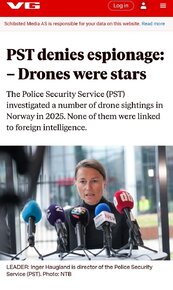
In at least fourteen cases, it turned out to be something completely different afterwards. For example, people in Belgium looked at (small) planes and helicopters for drones, while the flying objects in South Limburg and the Danish Billund were stars. The Norwegian police concluded that a suspicious 'drone' at an oil platform in the North Sea was probably a ship.
A number of times it has been found that drone flights were the work of a hobbyist or that it later turned out to be a tourist. In an incident in Warsaw where a drone flew over government buildings, Polish police arrested a Ukrainian and a 17-year-old girl from Belarus. There is no evidence for espionage.
Russian involvement
The authorities and experts regularly spoke about the involvement of 'a state actor' and Russia in incidents in Denmark, Belgium and Germany. This happened without waiting for the results of (police) investigation.
Spying and causing unrest with unmanned planes fits into the hybrid warfare of the Russians, is a frequently heard lecture. For example, Moscow would possibly use accomplices in Europe who shot small unmanned aircraft or drones would be launched from ships.
But an analysis of the sixty incidents shows little hard evidence of Russian involvement. An exception are incidents in Poland, Romania and Moldova, where Russian drones have indeed entered the airspace in recent months. For example, debris was found and in Poland Dutch F-35s shot Russian drones from the sky.
Attack or regular plane?
Although there is a lack of strong evidence in incidents elsewhere, Danish Prime Minister Mette Frederiksen spoke shortly after observing drones at Copenhagen airport at the end of September of “an attack on Danish critical infrastructure”. To this day, however, it is unclear whether the sightings in Copenhagen were drones. Many reports were attributable to regular air traffic, according to a reconstruction of the Danish channel
TV2.
“Our suspicion is that Russia is behind most of these drone flights,” Chancellor Friedrich Merz said after incidents at Munich Airport in early October, without providing evidence. Belgium also pointed to possible Russian involvement, and spoke of 'professional' pilots who 'flew in formation', although handy hobbyists can too.
Lack of drone detection
Dutch authorities are cautious with conclusions after drone incidents last weekend at Volkel airbase and Eindhoven Airport. According to Defense, 'weapons have been used', but no object has been removed from the air.
The Royal Netherlands Marechaussee says that drones have actually been seen, but according to a spokesman there is “no reason to panic for the time being”. At the moment it seems to be private or hobby drones with unclear origin. The spokesman adds that the military police have recently received many reports, but that it is not always a drone. "The cause of this can of course be all the attention, also in the media."
Defense Minister Ruben Brekelmans said in the debate on Wednesday that the investigations are still ongoing. But he tempered expectations. Detective work in Denmark, Norway, Belgium and Germany for drone incidents has “not yielded a very clear picture,” he said.
Authorities are almost blind to drones in many places and must rely on (unreliable) human observations. Therefore, experts point out the importance of good drone detection. In Belgium, that seems to have helped. It has been quiet there in recent weeks, exactly after additional drone detection has been installed. That may mean that malicious people have been put off, but just as well that those other alarmist reports may not have represented so much after all.
P. S. from me: I have no idea what the map shows and didn’t bother translating it separately. All bolding is from the article (I only modified the “foreword” into italics).


 www.bbc.co.uk
 voennoedelo.com