In regard to being released after the contract is over. Can an occasional story in the UA media about some recently returned Russian soldier killing his wife, robbing a store and the like be considered evidence? Stories in Russian media about veterans being treated unfairly, a veteran saving the day, etc? Common sense suggests that if there is an occasional story like that, many return home after their contract ends, I would think.
I would also think that if contracts were automatically renewed with no real date of expiration, we probably would not see tens of thousands signing up every month, no?
Ukrainian media also from time to time talks about the fact that Russian forces regularly rotate in and out of the combat zone, get rest and even vacations (saw some Russian reports that corroborate this as well), etc, unlike the opposing side, which is the point they are usually making in these articles. I cited a few of these here previously.
The
law about job protection for the returnees from the front, for what purpose if no one returns unless handicapped? Including job protection would make zero sense in the severe shortage of labour in the civilian sector.
Then, there are Syrsky’s numbers. From
April of last year:
Russia has increased its force in Ukraine "fivefold since the beginning of the aggression," Syrskyi said in the interview, putting the number of Russian troops currently deployed in the country at 623,000.
"Every month, they increase it by 8,000-9,000; in a year, it's 120,000-130,000."
From
May, a month later:
Russia has deployed up to 640,000 soldiers in combat against Ukraine, Ukrainian Commander-in-Chief Oleksandr Syrskyi said at the NATO-Ukraine Council on May 15.
December:
Russia has increased the size of its military grouping to about 710,000 troops to conduct a strategic offensive operation.
You can also trace back his earlier statements, as well as in between. April to December makes a reported increase of 87,000 in about 8 months, so roughly 11,000 per month increase in troops allegedly dedicated to Ukraine. We then should, perhaps, account for the increase in the rear, like a reported planned expansion of the Rubicon trained drone pilots to some 200,000 or some such. I had already written about it previously, but here is another
example:
The General Staff of the Armed Forces of Ukraine reports that Syrskyi said Russia has already created its separate drone force of 80,000 personnel and is moving to expand it.
“At the second stage, in 2026, they plan to expand it twofold — to 165,500,” he said, adding that this number could rise to “almost 210,000” by 2030.
From memory, these are to go (and already do so) through an intense training, like an actual school or something like that, and operate from the frontline, as well as the rear, and building reserves, clearly, these people do not appear out of nowhere and are not resurrected dead.
Then there is also this:
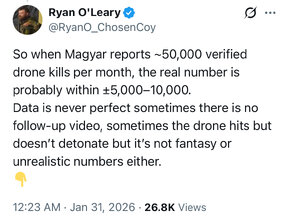
10K dead per month is highly unlikely, in my opinion (I discussed it previously in detail a year or two ago).
Another
piece of the puzzle:
Russian forces currently have a threefold advantage in troops and equipment, and on key fronts, they outnumber Ukrainian forces by four to six times.
This was stated by the Commander-in-Chief of the Armed Forces of Ukraine, Oleksandr Syrskyi.
So there are 3 times as many Russians fighting in Ukraine, losing 2 men for every Ukrainian soldier, on average (the CSIS “study” cited here recently). Everything sure makes sense, right? It could, if the Ukes constantly stayed in their positions or being thrown from one hot spot to another (ie no rotations), while Russians rotate their forces, say half and half, while being satisfied with the progression of war, intensity, causalities and their replacement, slow growth of pressure without causing internal concerns, increasing at first rapidly and now slower military production, and so on. On the other hand, this is actually about what is being described in media reports and various frontline interviews since about the end of the great counteroffensive (or even before?).
So while we do not have any direct evidence for anything, basically, just various statements from officials, experts and media reports, probably mostly propaganda, put all together we can conclude and assume to be reasonably right that the Russian forces grow and people do come back home after their contracts end. Nothing we can say with utmost certainty, of course.
Furthermore, would it be reasonable to assume that, while the events taking place are horrible in general, the conditions at the front for the Russian troops are not as monstrous as constantly being presented? Smaller Ukrainian force has significantly higher reported AWOLs, “highly motivated people” prefer to hide at home or illegally cross the border in order to avoid being sent to defend the country at the risk of disappearing (ie, existential war), offer of comparable to (and better than) Russian remuneration attracts a few hundred troops in the entire year since implemented, as was already discussed, but here is another example:
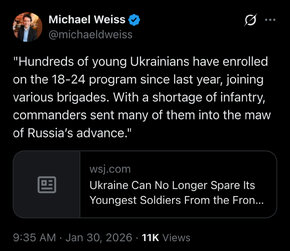
Most of those had already been killed or maimed and not fighting (Reuters report I cited earlier, among others). Here is more from the same WSJ article:
Kyrylo Horbenko joined the Ukrainian army at 18 under the “18–24” contract. After six months of service, he was killed by Russian artillery near Pokrovsk. He was what Ukraine calls “the future of the army,”
Right after turning 18, Kyrylo joined the Armed Forces. He wanted frontline experience to later enter a military academy his family could not afford. He wanted to become an officer. He wanted to serve for life. Less than six months later, he was dead.
In October 2025, the 18-year-old soldier was sent to the Pokrovsk sector. Russian forces there outnumbered Ukrainian units by up to 10 to 1. Kyrylo was killed during an artillery strike when his group was rushed to reinforce positions. Out of six soldiers, only one had real combat experience.
Ukraine’s Defense Minister Mykhailo Fedorov says around 2 million Ukrainians are dodging the draft, and more than 200,000 soldiers have deserted. That is roughly one-fifth of the entire army.
Most men willing to fight volunteered in the early years of the war. Today, many infantry units are made up of exhausted, older soldiers with extended frontline rotations. Reserves are running out.
That is why the “18–24” contract exists: high pay, benefits, and promises of education. It is an admission that manpower shortages are now critical.
Kyrylo believed he would manage. He trained, studied combat footage, lifted weights on base. Before deployment, he proposed to his girlfriend. They planned a wedding. They planned a family.
His body could not be evacuated. The family has not received official confirmation of his death. His mother: “He was not ready for war.”
From here:
https://x.com/Mylovanov/status/2017282455137346005
So, perhaps, the propaganda does not exactly represent the reality? Perhaps, conditions for the Ukrainian troops are worse -> hence the difficulties in recruitment even for significant money, etc? The point is that we can debate (speculate) this all day, every day and not get anywhere. I believe Ropcke got it right:
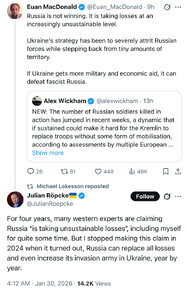
This probably all that matters, really, at this time. I do remember him posting all kinds of nonsense though, almost constantly previously and I stopped taking him seriously, along with many other journos. He seems to have changed his views rather dramatically in the past while. Some suggest he turned into a Russian asset, of course, which is usually the case for someone talking sensible things.