The Russian-Ukrainian War Thread

Feanor

Super Moderator
Staff member
Do we have evidence that large numbers of RU contractural soldiers who are not permanently maimed are being released at the end of their initial contracts ?
Only indirect evidence. When Russia stop-lossed contracts in 2022 and extended new contracts to the end of the war in 2023 it led to grumbling and people talking on the internet. We do have anecdotal evidence from social media of Russian soldiers going home after the end of their 6 month contract with money and medals. We don't have any grumbling about the 6-month contracts being stop-lossed, and recently I encountered a couple of examples of soldiers from 1-year contracts going home. So unfortunately there are no good statistics that I'm aware of. I will try to dig something up though.

And many dont.
The point is the math doesn't line up. Hence the need for some explanation.


The RU tank production (new + refurb) estimates are all over the map. Once thing I would be curious to know is whether or not RU is building new T-90 hulls, or at this time, using refurbed T-72 hulls with T-90 turrets.
They are building some new hulls. A T-90M has a new hull or a T-90A hull. I'm not aware of any T-72s with T-90 turrets.
 

vikingatespam

Well-Known Member
Remember, they're also releasing people at the end of their 6 month obligations and iirc even the one-year contracts are being released at the end of their time. So they have to replace the churn.
There is evidence (see earlier post) that contracts are automatically extended for the duration ("stop loss"). Given the awful casualty rates to date I am skeptical that most/any soldiers (outside of those maimed) are released on time of their original contracts. Other than what I presented earlier, I havnt found hard statistical data.

A quick search claims typical RU service life (sign a contract to time of death) is 4.5 months.


https://www.reddit.com/r/UkraineWarVideoReport/comments/16pcfqy
There's also the fact that more forces doesn't necessarily mean faster advances in this war. It will be in the next update, but it appears one of the things happening is multiple Russian small cross-border entries across many sections of the international border that were previously quiet for years. In other words part of the explanation might be that the extra forces are going into expanding the fighting to more areas.
I can certainly believe that RU is piling up more forces to open up new fronts. The Sumy area became a hotspot last year, albeit with almost no success.

I cannot believe that RU permanent losses are 30K/month. Its too much. So I think RU definitely building up reserves. Somewhere. Or, they could be back-filling those units that were consumed in previous fighting, such as the strategic rocket forces, or Navy.
 

vikingatespam

Well-Known Member
Look at what vikingatespam wrote. He's talking about permanent losses. The 30 000 a month figure includes WIA. Many of those recover.
The rule of thumb for conventional warfare (QJM) is that for every KIA there are 4 WIA. Of the WIA 1/4 are maimed and out of service. 1/4 of the wounded return very quickly ("its just a flesh wound") and the other return to duty over 60 days.

This doesnt include POW, but that cant really be predicted.
 

vikingatespam

Well-Known Member
And many dont.
My dude, we get it. We are all sick of the RU armed forces being herded like cattle to early graves, just so Putin can pat himself on the back. The damage done to the RU military and economy will have negative repercussions for decades.

However, unless the KIA:WIA ratios are skewing far from 20th century conventional warfare data, the likely answer is that RU is accumulating forces faster than UKR is killing them off.

We will have to see after the war is done what the K:W ratios are. While it is tempting to believe the stories of piss-poor RU medical care leading to excessive mortality, it is too convenient to take as fact without further evidence.
 

Feanor

Super Moderator
Staff member
Following some of the earlier posts I made, here's some materials on Ukrainsk. The town fell to Russian forces in iirc September of 2024. Today the town is relatively far behind front lines though still within range of drones and longer range artillery systems. The town took relatively little damage, falling in just 5 days, though relatively little doesn't mean little. The city does have many damaged buildings, just fewer actual ruins. Today the town still has no water, and only limited power, with allegedly power lines under construction now to connect them back to the grid. There are still graves in the yards from the fighting, and the main road has a new sign warning drivers to watch for UAV-placed mines. Today the town has reportedly 250-300 people left, out of ~10 000. Residents do mention receiving Russian pensions for retirees and humanitarian aid to be able to live, and Russian passports. Heating is being done by wood-fire and coal-fire stoves. There are multiple generators allowing people to charge their phones, and there is cell service in the town. There are also reportedly 8 stores open in the town and even one cafe. Lastly, the next-door town of Gornyak has a twice-a-week bus to Donetsk. I was only able to find one good piece on the town, from last November, and one video from April of last year. I suspect the name of the town is part of the issue, being obscured by search results about Ukraine as a country, rather than the specific town.


Feanor

Super Moderator
Staff member
There is evidence (see earlier post) that contracts are automatically extended for the duration ("stop loss"). Given the awful casualty rates to date I am skeptical that most/any soldiers (outside of those maimed) are released on time of their original contracts. Other than what I presented earlier, I havnt found hard statistical data.
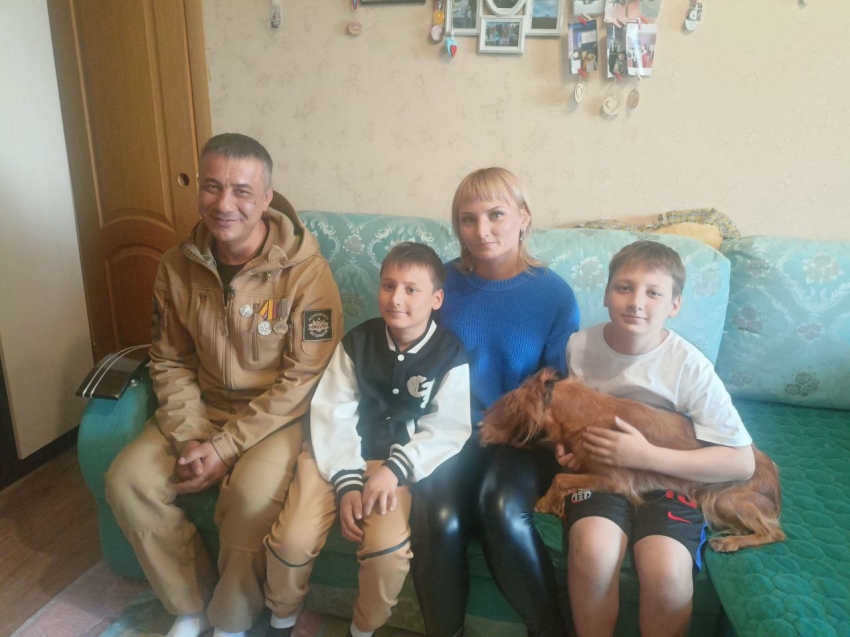
So there's some evidence of the opposite. Here's a Russian cop that had apparently a reservist contract with a BARS unit, went to war, and has since returned home and gone back to working as a cop.


Here's a man who was actually granted early release from his service contract, to go home to his newly born triplets. It's unclear what kind of contract he had.


Here's a Russian sniper who spent 3 months in the war zone, no info on total contract length, but who has been released home.


Here's a service member that returned home to civilian life after 6 months. Details are lacking, but the "medical services" mentioned are an eye exam and a sponsored vacation package. Given that they omit any mention of rehabilitation or physical therapy, it doesn't appear he was wounded.


Here's a Russian article talking about the challenges of readjusting to civilian life after serving in the SMO (the war). It specifically mentions that some return after their contract ends.


An this article from June of last year claims 137 000 returned from the front back to civilian life.


Making more difficult to say anything for sure is the fact that there are many different kinds of contracts. For example there are still some quasi-mercenary outfits but contracted by the MoD operating in the war. There are BARS units with reservist contracts. There are straight volunteer formations that tend to get paid by the Russian state and "count as" veterans but technically weren't in the military as such, there are Rosgvardia (National Guard) units that rotate in and out of the war zone, and there are straight MoD contracts which come in multiple varieties, including 6, 12, month, 1, 2, 3, 5, 6 year. Mobilized personnel are often released from service if they have a serious injury, even if they fully recover eventually. I suspect the same applies for many contract personnel. Also people exchanged as POWs are often released from further service obligation, though neither of those last two categories are prevented from re-enlisting as far as I know.

A quick search claims typical RU service life (sign a contract to time of death) is 4.5 months.


https://www.reddit.com/r/UkraineWarVideoReport/comments/16pcfqy
So that business insider piece, which sounds like it's based on some good data, is specifically referring to mobilized personnel. I'm pretty sure they're talking about Russia's partial mobilization done in the fall of '22. And the piece is 2.5 years old. I suspect the pattern has shifted since then. The nature of the fighting certainly has. Unfortunately this doesn't even mean we can conclude their number is wrong, it might still be accurate. It's just not reliable for current trends.

I can certainly believe that RU is piling up more forces to open up new fronts. The Sumy area became a hotspot last year, albeit with almost no success.
They've done quite a few spots over the past ~month where they either re-opened hostilities after a long pause or entered in a new location. All of them are very small, but there's ~5 spots where they've done this, in addition to the continuing efforts around Melovoe and Volchansk. At this point they're not yet on their way to a continuous buffer zone even in Kharkov region, but it's not out of the question by year's end.

I cannot believe that RU permanent losses are 30K/month. Its too much. So I think RU definitely building up reserves. Somewhere. Or, they could be back-filling those units that were consumed in previous fighting, such as the strategic rocket forces, or Navy.
Well some new units are also being formed in the ground forces, and some units are being expanded. Marine Bdes are becoming divisions, though in some cases they had already ballooned to that size and it's merely a matter of changing the label to match the substance.
 

rsemmes

Active Member
We have already been over this. The statements of RU officials, combined with troop dispositions is more then enough to indicate the goals of the war are to take as much of UKR as possible.
Claiming that RU doesnt want to advance faster (other than outrunning your logistical tail, which at these rates of advance is unlikely) is simply nonsense. There is nothing to gain by being stuck in trench warfare.
The far more simple, and therefore likely answer to this assertion is that RU simply cannot advance any faster.
How about forever ?
.
.
Do we have evidence that large numbers of RU contractural soldiers who are not permanently maimed are being released at the end of their initial contracts ?
No forgetting at all, it wasnt the topic of the original question.
Since you feel so strongly about UKR demographics, etc, we eagerly look forward to your presentation of information.
The statements of RU officials, combined with troop dispositions is more then enough...
Maybe for you, not for me. I guess I am less gullible, I would rather see military plans than official statements.
Out of curiosity, what “troop dispositions” you are referring to and what is your military conclusion based on those dispositions?

Claiming that RU doesnt want to advance faster...
Claiming? You read whatever you want to read.
This is not an English Grammar forum, but could you remind me since when “if” is a “claim”?

The far more simple...
I would rather not use Occam's razor in military matters. Again, that's me.

Talking about official statements and “The RU tank production (new + refurb) estimates are all over the map.” These statements: "Ukrainian officials have previously estimated that the manufacturer can produce approximately 60 to 70 T-90 tanks per year under ideal conditions”?

No forgetting at all, it wasnt the topic of the original question...
I disagree. If Ukrainian situation is worse than that of Russia, how bad, or not, Russian situation is, it's a lot less relevant; but Ukrainian situation is.

Since you feel so strongly about UKR demographics...
I wouldn't use the word “feel”, but I feel that I can say that it is “standard knowledge” the Ukrainian low birth rate, its deserters and the millions of Ukrainian living abroad. Don't you agree?
 

KipPotapych

Well-Known Member
In regard to being released after the contract is over. Can an occasional story in the UA media about some recently returned Russian soldier killing his wife, robbing a store and the like be considered evidence? Stories in Russian media about veterans being treated unfairly, a veteran saving the day, etc? Common sense suggests that if there is an occasional story like that, many return home after their contract ends, I would think.

I would also think that if contracts were automatically renewed with no real date of expiration, we probably would not see tens of thousands signing up every month, no?

Ukrainian media also from time to time talks about the fact that Russian forces regularly rotate in and out of the combat zone, get rest and even vacations (saw some Russian reports that corroborate this as well), etc, unlike the opposing side, which is the point they are usually making in these articles. I cited a few of these here previously.

The law about job protection for the returnees from the front, for what purpose if no one returns unless handicapped? Including job protection would make zero sense in the severe shortage of labour in the civilian sector.

Then, there are Syrsky’s numbers. From April of last year:

Russia has increased its force in Ukraine "fivefold since the beginning of the aggression," Syrskyi said in the interview, putting the number of Russian troops currently deployed in the country at 623,000.

"Every month, they increase it by 8,000-9,000; in a year, it's 120,000-130,000."


From May, a month later:

Russia has deployed up to 640,000 soldiers in combat against Ukraine, Ukrainian Commander-in-Chief Oleksandr Syrskyi said at the NATO-Ukraine Council on May 15.

December:

Russia has increased the size of its military grouping to about 710,000 troops to conduct a strategic offensive operation.

You can also trace back his earlier statements, as well as in between. April to December makes a reported increase of 87,000 in about 8 months, so roughly 11,000 per month increase in troops allegedly dedicated to Ukraine. We then should, perhaps, account for the increase in the rear, like a reported planned expansion of the Rubicon trained drone pilots to some 200,000 or some such. I had already written about it previously, but here is another example:

The General Staff of the Armed Forces of Ukraine reports that Syrskyi said Russia has already created its separate drone force of 80,000 personnel and is moving to expand it.

“At the second stage, in 2026, they plan to expand it twofold — to 165,500,” he said, adding that this number could rise to “almost 210,000” by 2030.


From memory, these are to go (and already do so) through an intense training, like an actual school or something like that, and operate from the frontline, as well as the rear, and building reserves, clearly, these people do not appear out of nowhere and are not resurrected dead.

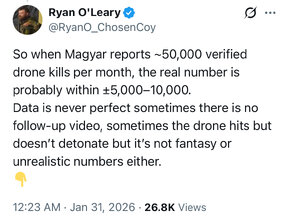
Then there is also this:
IMG_3772.jpeg

10K dead per month is highly unlikely, in my opinion (I discussed it previously in detail a year or two ago).

Another piece of the puzzle:

Russian forces currently have a threefold advantage in troops and equipment, and on key fronts, they outnumber Ukrainian forces by four to six times.

This was stated by the Commander-in-Chief of the Armed Forces of Ukraine, Oleksandr Syrskyi.


So there are 3 times as many Russians fighting in Ukraine, losing 2 men for every Ukrainian soldier, on average (the CSIS “study” cited here recently). Everything sure makes sense, right? It could, if the Ukes constantly stayed in their positions or being thrown from one hot spot to another (ie no rotations), while Russians rotate their forces, say half and half, while being satisfied with the progression of war, intensity, causalities and their replacement, slow growth of pressure without causing internal concerns, increasing at first rapidly and now slower military production, and so on. On the other hand, this is actually about what is being described in media reports and various frontline interviews since about the end of the great counteroffensive (or even before?).

So while we do not have any direct evidence for anything, basically, just various statements from officials, experts and media reports, probably mostly propaganda, put all together we can conclude and assume to be reasonably right that the Russian forces grow and people do come back home after their contracts end. Nothing we can say with utmost certainty, of course.

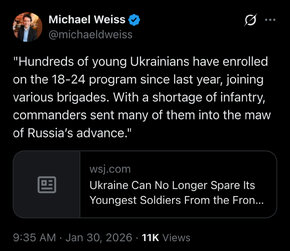
Furthermore, would it be reasonable to assume that, while the events taking place are horrible in general, the conditions at the front for the Russian troops are not as monstrous as constantly being presented? Smaller Ukrainian force has significantly higher reported AWOLs, “highly motivated people” prefer to hide at home or illegally cross the border in order to avoid being sent to defend the country at the risk of disappearing (ie, existential war), offer of comparable to (and better than) Russian remuneration attracts a few hundred troops in the entire year since implemented, as was already discussed, but here is another example:
IMG_3730.jpeg

Most of those had already been killed or maimed and not fighting (Reuters report I cited earlier, among others). Here is more from the same WSJ article:

Kyrylo Horbenko joined the Ukrainian army at 18 under the “18–24” contract. After six months of service, he was killed by Russian artillery near Pokrovsk. He was what Ukraine calls “the future of the army,”

Right after turning 18, Kyrylo joined the Armed Forces. He wanted frontline experience to later enter a military academy his family could not afford. He wanted to become an officer. He wanted to serve for life. Less than six months later, he was dead.

In October 2025, the 18-year-old soldier was sent to the Pokrovsk sector. Russian forces there outnumbered Ukrainian units by up to 10 to 1. Kyrylo was killed during an artillery strike when his group was rushed to reinforce positions. Out of six soldiers, only one had real combat experience.

Ukraine’s Defense Minister Mykhailo Fedorov says around 2 million Ukrainians are dodging the draft, and more than 200,000 soldiers have deserted. That is roughly one-fifth of the entire army.

Most men willing to fight volunteered in the early years of the war. Today, many infantry units are made up of exhausted, older soldiers with extended frontline rotations. Reserves are running out.

That is why the “18–24” contract exists: high pay, benefits, and promises of education. It is an admission that manpower shortages are now critical.

Kyrylo believed he would manage. He trained, studied combat footage, lifted weights on base. Before deployment, he proposed to his girlfriend. They planned a wedding. They planned a family.

His body could not be evacuated. The family has not received official confirmation of his death. His mother: “He was not ready for war.”


From here: https://x.com/Mylovanov/status/2017282455137346005

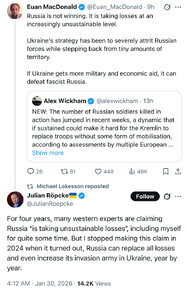
So, perhaps, the propaganda does not exactly represent the reality? Perhaps, conditions for the Ukrainian troops are worse -> hence the difficulties in recruitment even for significant money, etc? The point is that we can debate (speculate) this all day, every day and not get anywhere. I believe Ropcke got it right:
IMG_3721.jpeg

This probably all that matters, really, at this time. I do remember him posting all kinds of nonsense though, almost constantly previously and I stopped taking him seriously, along with many other journos. He seems to have changed his views rather dramatically in the past while. Some suggest he turned into a Russian asset, of course, which is usually the case for someone talking sensible things.

 

KipPotapych

Well-Known Member
And by “scientists” you mean O. Kvochka, who is not a scientist.
Something of "substance", like the "Orange Agent" during the Vietnam War?
Laughing.

Oleksandra Kvochka is a journalist and philologist from Ukraine. After several years working primarily in news media, she is now focusing on environmental reporting. For her, journalism is a form of written activism — a way to give voice to what might otherwise go unheard. She raises Trinity, a dog rescued from Kherson after the Kakhovka Dam flooding, and believes that by saving others, we save ourselves.
 
Top