For example a sub homeported on the east coast would start its patrol there go across the top and have a logistics stop at the west coast sub base before doing the second leg of its patrol back to its home port. Whether that actually happens is a totally different story.
Under ice operations for a submarine are limited not only by their endurance but also by their ability to do damage control. A small diesel submarine cannot break through much of the arctic icepack in the event of a casualty or fire to reach the surface. There are plenty of spots where a nuke can't either, but a nuke boat's advantage is they can make unlimited O2 with their unlimited (essentially) power. Thus they could fight a fire or deal with smoke should they be unable to reach the surface. They can sustain their under ice operations indefinitely as well, as a diesel will need to find thinner ice to recharge eventually.
Image site
found here:
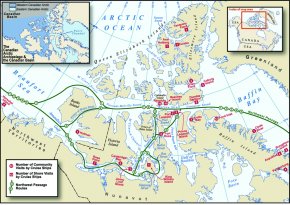
Northwest passage transit for any submarine is a nice fiction that is used to stir up "But the Russians/American subs in our arctic!" but the icepack often (even in summer if the winds drive the ice) can go all the way to the bottom at four main NWP chokepoints, either as ice dams, a freeze or iceburgs
scouring or dragging on the seafloor (Cambridge Bay, Simpson Strait, Bellot Strait and Prince of Wales Strait). Any arctic operations for a submarine in the Canadian arctic archipelago will likely be constrained to the entrances and exits of the NWP (Beaufort Sea and Baffin Bay).
There is a more consistant ice-free(ish) route that goes north of Baffin Island (M' Clure Straight through to Lancaster Sound) because the seas are more open there, with little risk of ice damming and the water is fairly deep. The government has placed a refueling station at
Nanisivik (right beside Arctic Bay) which was
christened two years ago now.
As far as range a 3000nm range is not enough to reach Nanisivik from the West Coast bases, one might be able to refuel in Yukon but that's a bit touch and go from what I understand. It's enough from St. Johns, Newfoundland (~2000nm, measured
here).
All of this to say, diesel subs can do near ice and under edge ice operations in Canada's arctic, (with appropriate ice detecting sonar) but for true arctic submarine patrol you need a nuke. I don't expect RCN subs will spend that much time up north. Their CONOPS will likely have a nice nod to near and edge ice but the focus will be on Canada's southern waters, NATO, and our Pacific allies.
*edited for spelling/grammar


