Royal Canadian Air Force (RCAF) News and Discussions

hauritz

Well-Known Member
Canada is in an awkward situation with the F-35. The 16 on order is barely enough for a single squadron. The cost of maintaining such a small fleet sounds like it could be a logistical nightmare. The 40/80 mix suggested in the article would give Canada at least some economy of scale while not being entirely dependant on the whims of the USA. Problem is that for all the discussion of getting Gripens you have to wonder if they are really the sort of aircraft you would want to be flying in the 2050s and beyond. There is GCAP on the horizon but that is still 10 - 15 years away.

As I said it is an akward position for Canada to find itself in.
 

Terran

Well-Known Member
“The 40/80 mix suggested in the article would give Canada at least some economy of scale while not being entirely dependant on the whims of the USA.”
Unless SAAB and Canada go through a major design overhaul to the Grippen it’s still using an American engine, American sourced life support. It’s still the Inferior aircraft by even the Canadian MOD measure. It’s going to take maybe a decade to build up the base of production which is going to be a 4.5 generation fighter in the mid to late 2030s.
 

hauritz

Well-Known Member
Unless SAAB and Canada go through a major design overhaul to the Grippen it’s still using an American engine, American sourced life support. It’s still the Inferior aircraft by even the Canadian MOD measure. It’s going to take maybe a decade to build up the base of production which is going to be a 4.5 generation fighter in the mid to late 2030s.
Yep, even fitting a RR engine won't solve the problem. The more I think about the more I think that Canada might have to stick with the F-35. Whether it commits to the full 88 is another issue. They could leave their options open for GCAP down the track.
 

John Fedup

The Bunker Group
Fewer F-35s is the likely decision regardless of whether Gripens are ordered or not. GCAP should absolutely be considered. No more F-35s until block 4 is finished and no going past 40 until the ECU is ready at which point GCAP will be close.
 

koxinga

Well-Known Member
Alert5 was at the Singapore Airshow 2026 and spoke with the Saab representatives on the global prospects for the E/F.


For Canada..

Canada’s Mixed Fleet Question
The most intriguing prospect for Saab may be Canada, which is conducting a strategic defense review that includes questions about its fighter fleet composition. Rather than replacing its planned F-35 purchases, Canada is exploring whether adding Gripens to create a mixed fleet would provide better capability and value.

Franzén acknowledged the unusual nature of the campaign. “Many are speculating, you know, will they replace the F-35 with Gripens. I don’t think that is what they’re looking for,” he said. “I think they’re looking for could it be stronger to have a mixed fleet.”

The pitch hinges on complementary strengths. The Gripen offers higher availability, lower operating costs, and rapid adaptability through software updates, while the F-35 brings stealth and other capabilities. For the same budget, Saab argues, Canada could field more total aircraft with a mixed fleet than with F-35s alone.

If Canada proceeds, Saab proposes building initial aircraft in Sweden for quick delivery, then shifting production to Canada using the country’s existing aerospace industrial base. When asked if a Canadian production line would serve only domestic needs, Franzén indicated it would produce for export as well.

The timeline is tight. Canada needs replacement capability before 2032, and speculation suggests the requirement could reach up to 80 Gripens if the mixed fleet concept proceeds. That would require moving quickly through what Saab acknowledges will be a complex process of integrating a second fighter type into Canadian operations.
 

King Wally

Active Member
Fewer F-35s is the likely decision regardless of whether Gripens are ordered or not. GCAP should absolutely be considered. No more F-35s until block 4 is finished and no going past 40 until the ECU is ready at which point GCAP will be close.
Could it be viable for Canada to lease something like Gripen to cover the wait period for GCAP to roll out?
30 x F35 (as would appear is incoming) + a couple squadrons of a leased solution might tide things over I was thinking?
 

John Fedup

The Bunker Group
Could it be viable for Canada to lease something like Gripen to cover the wait period for GCAP to roll out?
30 x F35 (as would appear is incoming) + a couple squadrons of a leased solution might tide things over I was thinking?
If the F-35 buy is limited to 30 jets then another fighter would be needed and Gripen is the realistic choice (Typhoon and Rafale too expensive). Can't see GCAP availability for Canada much before 2050-55 so might as well buy Gripens.
 

swerve

Super Moderator
SAAB's offering Canada production for other customers. Apparently, production capacity is a constraint on sales, so along with investing in increasing capacity in Sweden, they're looking for a third production line. I'm not sure why Embraer isn't increasing capacity.
 
GCAP should absolutely be considered.
I don't think its realistic at all for the RCAF to be considering GCAP, for a multitude of reasons. Canada seems to desperately want industrial benefits and workshare however, Japan is aggressively pushing away partners who want this and Canada also does not have much to realistically offer a 6th gen program. GCAP is an entirely unproven design with a somewhat dubious timeline, it does not make sense to me to cut out capability now for potential of a deal with GCAP sometime in the far off future. My biggest issue is the costs at hand, I've seen cost estimates between 2x-3x that of things like the F-35A for 6th generation fighters as a whole. People are winging and complaining enough now about fighter costs, I find buying any workable amount of fighters with these sorts of cost figures to be questionable.

Could it be viable for Canada to lease something like Gripen to cover the wait period for GCAP to roll out?
30 x F35 (as would appear is incoming) + a couple squadrons of a leased solution might tide things over I was thinking?
I don't think its especially likely or plausible, given how thinly spread the Gripen fleet is. Saab has just started recently drip feeding new E/F models to the Swedish Airforce, who desperately needs them given their own delays and the increasingly ragged C/D fleet they possess. Brazil will not part with their small E/F fleet, and there is customers in the pipeline ahead of us if we go down that route. Saab simply does not have the infrastructure to onboard Canada into the Gripen ecosystem without seriously degrading our own required capabilities.

SAAB's offering Canada production for other customers. Apparently, production capacity is a constraint on sales, so along with investing in increasing capacity in Sweden, they're looking for a third production line. I'm not sure why Embraer isn't increasing capacity.
Because similarly to what is being offered to Canada, Embraer isn't actually building Gripen's but assembling them from largely foreign built components imported either from Sweden, US or Europe while building some sub-components at home. They are long delayed and very fixated on getting the aircraft out the door for Brazil, not anybody else. This is the sort of thing Canada is potentially signing on for, and it will only make our ongoing fighter situation worse.
 

John Fedup

The Bunker Group
I don't think its realistic at all for the RCAF to be considering GCAP, for a multitude of reasons. Canada seems to desperately want industrial benefits and workshare however, Japan is aggressively pushing away partners who want this and Canada also does not have much to realistically offer a 6th gen program. GCAP is an entirely unproven design with a somewhat dubious timeline, it does not make sense to me to cut out capability now for potential of a deal with GCAP sometime in the far off future.
I am not suggesting the F-35 or F-35/Gripen acquisition should be cut back for GCAP but rather GCAP should be a longterm consideration and as fewer 6th Gen fighters will be needed no local production is realistic. CCA production should be an option though.

I don't think its especially likely or plausible, given how thinly spread the Gripen fleet is. Saab has just started recently drip feeding new E/F models to the Swedish Airforce, who desperately needs them given their own delays and the increasingly ragged C/D fleet they possess. Brazil will not part with their small E/F fleet, and there is customers in the pipeline ahead of us if we go down that route. Saab simply does not have the infrastructure to onboard Canada into the Gripen ecosystem without seriously degrading our own required capabilities.
I have my doubts about how realistic Canadian production would be. It only makes sense if Canada was going to export jets for Sweden's other clients. Also, Saab needs other engine at the very least and should be sourcing alternatives for other major Gripen components as well. This is due to the questionable path the MAGA/GOP is walking but also the real possibility the US supply chain will be maxed out by any US-China conflict. Can't see spares forthcoming for our fleet if this conflict comes about. Add in the questionable readiness rates and upgrade delays for the F-35, I really think having an addition fighter to fall back on despite the training and logistics hassles is worthwhile.
 
I am not suggesting the F-35 or F-35/Gripen acquisition should be cut back for GCAP but rather GCAP should be a longterm consideration and as fewer 6th Gen fighters will be needed no local production is realistic. CCA production should be an option though.
I still do not think a 6th generation is a smart or especially worthwhile investment for the RCAF anytime soon when the F-35 provides a very modern and long term relevant capability. I would much rather see Canada work to develop/produce our own CCA capabilities to supplement F-35 orders.

I have my doubts about how realistic Canadian production would be. It only makes sense if Canada was going to export jets for Sweden's other clients. Also, Saab needs other engine at the very least and should be sourcing alternatives for other major Gripen components as well. This is due to the questionable path the MAGA/GOP is walking but also the real possibility the US supply chain will be maxed out by any US-China conflict. Can't see spares forthcoming for our fleet if this conflict comes about. Add in the questionable readiness rates and upgrade delays for the F-35, I really think having an addition fighter to fall back on despite the training and logistics hassles is worthwhile.
The problem is Sweden doesn't really have any other clients, nowhere near enough to actually make a Canadian export case worthwhile. They are selling small scale orders to a few backwater nations, with Ukraine asking about potentially hundreds but their order is fundamentally unrealistic and unlikely to amount to anything. Saab is not considering another engine, their CEO came out recently and said getting another engine is uneconomical. Much of the vital, expensive systems in the Gripen such as the radar aren't even Swedish, but are exported items from various other European and American companies.

Lockheed Martin has a gigantic production capability, one that Canada has been involved with for years building F-35 components itself. If you are concerned about F-35 parts shortages during wartime, what will happen with a Gripen fleet when Saab's paltry capability is entirely outstripped almost immediately? Saab cannot even keep up with their relatively small scale production as it sits now, any conflict would cause them to effectively collapse given how they regularly juggle parts and components back and forth to Brazil, Sweden, America and the EU. We are far safer with Lockheed Martin versus Saab if you are concerned about parts availability.

I personally want Canada to have nothing to do with the Gripen E/F, it is an exceptionally poor investment to buy a souped up 4th generation fighter when the world has already transitioned heavily over to 5th generation aircraft and is now moving on to 6th generation aircraft in the coming years. We will be operating any aircraft for the next 30-50 years, the Gripen is just about relevant at the moment and for the next 5-10 years against less capable enemies, but it is effectively irrelevant in the medium to long term. We dump billions into Bombardier in Quebec in order for them to take a decade just to tool up to do sub-component production and assembly of an aircraft we aren't truly even building at home? An aircraft with a small userbase and even smaller potential customer base? It's effectively a repeat of the CF-5, an irrelevant aircraft purchased largely for questionable industrial benefits.

It is such a poor idea that the Canadian Govt will likely move ahead with it anyway.
 

John Fedup

The Bunker Group
I still do not think a 6th generation is a smart or especially worthwhile investment for the RCAF anytime soon when the F-35 provides a very modern and long term relevant capability. I would much rather see Canada work to develop/produce our own CCA capabilities to supplement F-35 orders.
Agree, not anytime soon for 6th gen, and yes, CCA should be something that Canada should pursue.


Lockheed Martin has a gigantic production capability, one that Canada has been involved with for years building F-35 components itself. If you are concerned about F-35 parts shortages during wartime, what will happen with a Gripen fleet when Saab's paltry capability is entirely outstripped almost immediately?
Guessing neither will deliver if things go pear shaped


when the world has already transitioned heavily over to 5th generation aircraft and is now moving on to 6th generation aircraft in the coming years. We will be operating any aircraft for the next 30-50 years,
Yes, many Western allies have invested in the F-35 and we all should hope LM gets their $hit together wrt block 4 and P&W as well with the ECU. But lets face, their track record sucks on software and lets not forget the ALLIS C-F. I assume ODIN has sorted this. The F-35 is the only 5th gen option which is a problem. Our last fighter acquisition had four US "teen" fighters alternatives. China has at least two 5th gen in production along with 2 flying 6th gen prototypes albeit the actual stealth capabilities are unknown. Stealth and sensor infusion are outstanding features but quantum technology radar and IR advances may significantly reduce the viable lifespan for the F-35. Bottom line, all large quantity fighter investments will be risky.


We dump billions into Bombardier in Quebec in order for them to take a decade just to tool up to do sub-component production and assembly of an aircraft we aren't truly even building at home?
This is my biggest objection wrt a Gripen. If it is to be built in Quebec, that is a non-starter for me.

It is such a poor idea that the Canadian Govt will likely move ahead with it anyway.
True, Quebec will always play the extortion card for pork on the Liberal party in return for electoral support.
 
Yes, many Western allies have invested in the F-35 and we all should hope LM gets their $hit together wrt block 4 and P&W as well with the ECU. But lets face, their track record sucks on software and lets not forget the ALLIS C-F. I assume ODIN has sorted this. The F-35 is the only 5th gen option which is a problem. Our last fighter acquisition had four US "teen" fighters alternatives. China has at least two 5th gen in production along with 2 flying 6th gen prototypes albeit the actual stealth capabilities are unknown. Stealth and sensor infusion are outstanding features but quantum technology radar and IR advances may significantly reduce the viable lifespan for the F-35. Bottom line, all large quantity fighter investments will be risky.
The thing people don't realize that in this hypothetical situation where the stealth capabilities of the F-35 are somehow degraded by substantial advancements in sensor platforms, this will have an outsized impact on existing 4th gen aircraft as well and make them even less viable than their already diminishing state is currently. Even if you take away the F-35's stealth entirely, you have a very capable aircraft as far as its performance and specifications go, primarily around its sensor fusion. Yet even with the delays to the program, the F-35 is an exceptionally successful platform with huge adoption numbers worldwide not seen since the F-16. Being interoperable with the US and countless other partners abroad is key to the RCAF's success both home and abroad.

I'd argue the F-35 has the least risk of all the options available, and the best value for money proposition given the questionable relevance of all other fighters on the market right now.

This is my biggest objection wrt a Gripen. If it is to be built in Quebec, that is a non-starter for me.
That is the current proposal, although "built" is being nice. They will be building limited sub-components from scratch but largely doing final assembly of airframes using parts from Sweden, Brazil, Europe and the United States. This is what they offered to Brazil, which its own factory and timeline has been long delayed and fraught with trouble.
 
A few interesting tidbits of news recently regarding the ongoing Fighter Review debacle.

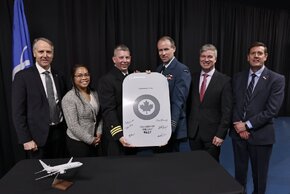
Canadian military refuses to release photo of air force commander signing F-35 fuselage - Yahoo News Canada

A photo of the Royal Canadian Air Force’s top officer signing the fuselage of Canada’s first F-35 has become a political football with the military refusing to release the image for fear of undercutting Prime Minister Mark Carney.

RCAF Lt.-Gen. Jamie Speiser-Blanchet travelled to Lockheed Martin’s Fort Worth, Texas, facility on Feb. 2 for a ceremony to mark a production milestone for Canada’s first F-35. During the event, Speiser-Blanchet signed the fuselage bulkhead to be installed on the jet.

Usually such a ceremony would be worthy of publicity by both Lockheed Martin and the Canadian Forces, but the signing was deemed to be a closed-door event.

Although the RCAF and Department of National Defence have provided the names of those who attended, they are refusing to release a photo of the signing event.

Lockheed Martin Canada also declined to release the image to the Ottawa Citizen, pointing out that the RCAF and DND were handling the distribution of the photo. “The Media Relations Office at the Department of National Defence is co-ordinating directly with RCAF public affairs for any queries regarding this imagery,” Amanda Hauck, the company’s spokesperson, noted in an email.

DND spokesperson Kened Sadiku confirmed the Fort Worth event was a closed-door ceremony and attended by Speiser-Blanchet, Crista-Lynn Ferguson, the director general of fighter capability, and Col. Daniel Constable, director of fighter capability transition. No explanation was provided on why the event was kept so low-key or why the photo was not being released.

Photos have been released of similar F-35 fuselage signing events by officials from other nations purchasing the fighter jets.

But government sources say the military was worried the special ceremony would undercut Carney’s message that Canada’s purchase of F-35s was under review. The Ottawa Citizen is not naming the sources as they were not authorized to discuss the matter publicly.
The Canadian Government is seemingly unwilling to release photos of the head of the RCAF signing the bulkhead for the first RCAF CF-35A, with sources saying they are concerned such media in the public space will undercut the PMO's long overdue fighter review. This reeks of the sort of juvenile political theatre that we saw commonly under Justin Trudeau, and it reflects very poorly on Mark Carney's PMO if this is indeed true. There was no issues releasing photos of the first RCAF P-8 Poseidon parts being signed back in February, so it's not an issue with US aircraft alone.


canada-will-soon-become-the-ni-20260223.jpg


Défense nationale: le Canada refuse d’avoir une flotte mixte d’avions de chasse | Le Devoir

The Royal Canadian Air Force does not want a mixed fleet of fighter jets

It has been a year since Canada began looking for alternatives to its American ally that had become too unpredictable. And among the options on Mark Carney's desk is that of integrating Swedish-made Gripen fighters into Canada's air strike force.

The Royal Canadian Air Force (RCAF), through its most senior officer, Lieutenant-General Jamie Speiser-Blanchet, does not see this possibility in a very positive light. The reason? The RCAF would not have the resources to integrate Gripen at the same time as the first F-35s are delivered.

While waiting for Mark Carney's decision, which she refuses to comment, the RCAF commander prefers to focus all her efforts on the integration of the F-35s. "We are focused on the acquisition [of the F-35s], which started with the decision made in 2022, and announced in 2023. We will begin training on our first Canadian F-35 aircraft, which will be delivered to the U.S. base in Luke, Arizona, next fall. At the moment, we are focusing on the current path," explained the RCAF commander in an interview with Le Devoir.

And the current path is to integrate American F-35s into the Canadian air strike force to replace the aging F-18s, whose life expectancy has been extended to 2032. "Right now, we have a plan for the transition from the F-18 to the F-35. We are reducing F-18 operations while we are increasing F-35 operations. We're really focused on this transition, which is quite complex in terms of differences in technology or security levels."

Adding Gripen aircraft in the middle of this transition would therefore add a degree of complexity that Commander Jamie Speiser-Blanchet considers inappropriate.

Due to the political tensions between Ottawa and Washington since Donald Trump's return to power, one of the fears about the F-35s is related to the possibility of a loss of Canadian sovereignty in relation to the aircraft's updates.

Lieutenant-General Jamie Speiser-Blanchet brushes aside these fears. "No, it's not a fear," she says bluntly when asked by Le Devoir.

According to the senior officer, Canada decided to buy the American F-35 because it is the best aircraft available today. "It's the only fifth-generation fighter jet that is available to Canada, since the others are developed by China and Russia. Our NATO allies, but also Australia and Japan, already have F-35s. It is also for this reason that [the] decision [to acquire them] was taken.

Moreover, unlike the Danish military, for example, the Commander of the RCAF refused to consider the United States a military threat to Canada. "I would distinguish between politics and the military. The United States is a military ally and, therefore, in that sense, it is not a threat that we should worry about."

As for Trump's repeated threats against Canada, the commander prefers not to analyze them in the heat of the moment, even if she says she is aware of the political stakes. "It's very important that I go beyond my emotions and focus on the facts. And that's what I do. I make sure that we make decisions and provide military advice to the government that is truly fact-based and intelligence-based."

A French language interview recently with the head of the RCAF, take the exact quotes with a grain of salt as I translated them using Google. It further supports the fact that this Fighter Review is an entirely political endeavor undertaken by the PMO, as the RCAF has no interest in a mixed fleet and operating any fighter besides the F-35A. It would also seem that the head of the RCAF has not fallen prey to kneejerk emotional reactions and is looking to keep the course with the F-35, continuing to prepare for its arrival with infrastructure upgrades ongoing across the country.
 
(Splitting this post due to character limits.)

Saab sees Canada as 'great' partner to design next-generation fighter jets | CBC News

Swedish company Saab says it's hoping to partner with the federal government and Canadian businesses to develop systems for the next generation of aerial warfare as it pursues deals to supply Ottawa with new aircraft.

The company intends to produce Gripen fighters and GlobalEye surveillance planes on Canadian soil if they are purchased by the Canadian Armed Forces.

Saab and Sweden hope that these ventures will also lead to a collaboration on designing future military systems.

"As we're looking ahead, we'd really like to work with countries and companies who are willing and interested and have the skill set," Peter Nilsson, head of future programs at Saab, said in an interview with Radio-Canada. "Canada would be great."

According to several sources, Sweden and Canada have already started discussions on a possible collaboration on research and development projects. They say the government has not yet made a decision on the matter.

In a statement, the Department of National Defence confirmed that it is "exploring possible future options beyond the current fighter jets."

According to sources familiar with the matter, the leadership of the Royal Canadian Air Force is not in favour of the possible purchase of Gripen fighter jets in the near term. In terms of sixth-generation fighters, their preference is joining GCAP, sources said.
I do find it somewhat amusing that Saab is trying to bring Canada into cooperative agreements with 6th generation manned fighters and CCA's when they have historically had struggles producing even their ongoing 4th generation fighters, have no experience with 5th generation fighters (and their marketing refuses to talk about 5th generation fighters outside of smugly talking down at the entire concept) and seemingly want to jump to 6th generation aircraft going forward? They have no real experience with large unmanned systems, although they claim to have programs ongoing at this point. Yet again, we see the RCAF not interested in Gripen and seemingly eyeing up GCAP in the long term. Saab is very much the laggard of the major European aerospace companies and it seems like we would be used as a funding piggy bank to help push forward their own programs.

I think cooperation for items like GlobalEye production in Canada is worthwhile given its increasing popularity and adoption rates abroad, although I am skeptical of such an aircraft for domestic Canadian use for a variety of reasons. Carney made a campaign promise to adopt a domestic AWACS platform and with US sentiment the way it is currently, E-7 seems incredibly unlikely and the GlobalEye is an easy pick. Perhaps if Saab can pick up the pieces of FCAS they can get a realistic 6th generation program ongoing however, they would very much be the junior partner in such an arrangement and Canada would be a junior, junior partner with the limited benefits associated with such a position.
 

John Fedup

The Bunker Group
The F-35 debacle has several components. [rant on] First, everything is pollical, usually with respect to economics, especially in Canada regarding provincial workshare (think of it as a mini FCAS EU fiasco). The other politic factor was the POS junior who is symptomatic of anti-defence rot in the Canadian electorate largely fermented by the Liberal Party, NDP, and left-wing kumbaya losers. Add in that orange headed @uck-stick IOTUS south of the border, hardly a surprise why we are still using 40 year fighters![rant off]

However, even though the F-35 offers the best bang for the buck along with decent economic benefits from a 3,000 plus production run, the serious per flight hour cost, support and readiness issues, and extremely delayed software releases are valid reasons why this $hitshow continues. Let's not forget the spiralling price increases which are of concern to other clients as well. Fortunately for LM, there are no viable alternatives. IMHO, something with 80-90% capability, even at the same price point, would hurt the F-35 program big time.
 
Top