Royal Australian Air Force [RAAF] News, Discussions and Updates

The point of keeping and converting an aircraft to fly unmanned is not to risk aircrew,taking out systems the manned crew would need and put in some communication remote system so that crew back in Australia could fly remotely is what I am suggesting ,it would be used on high risk operations where is survival is not important but as a one time launch platform , the U.S has only used some of its old f-16,s as targets

You are not turning a F-111 into a UAV, the maintenance requirements are too high. It is literally the worst possible platform (short of a B-1B) that you could use in that regards.

Its also old enough that its control systems and sensors would probably be quite difficult to integrate for remote operation or automation.

Remote operation still requires pilots current in the airframe, where are they coming from? Even a one off flight would require significant maintenance, where are the maintainers coming from? How familiar are they with the platform? What isn't getting maintained so they can go play with antiques?
 
Aircraft such as Australia's old Mirage III are still being flown by Pakistan, our Classic Hornets were apparantly in good condition when when they were retired, the mid-life taipans were stripped and buried somewhere and the Tigers will probably suffer the same fate. Soon Australia will be replacing its C-130J with brand new C -130Js.

I actually dont think those combat aircraft are of any real value to Australia, particularly with the advent of the MQ-28. However preserving the Taipans(too late now) the old C-130Js and even the C-27J could be useful.

Its not just about the platform, its about the ecosystem around them.

Parts, Maintainers, Pilots. There is a significant cost to retain the ability to bring something back into service.

The only one of those examples that could be worth it would be the C-130J's, but they would have a value on the secondary market so I'm guessing that if they are in decent condition they will be sold on.
100%

Case in point - we put a Black Hawk in deep storage in 2003. Done properly, in accordance with the manuals, so preserved better than the aircraft in a boneyard. In 2005 it took eight months to get back to flying. And, from what I understand, it was always a basket case after that.

Now that was a properly preserved, simple airframe in a climate controlled environment with some of the most experienced maintainers in the Department (not all were uniformed) putting it back. Pulling it from a desert? Well, this B-1 took two years of effort. From what I understand, even pulling the semi-stored Adelaide class back into service was (a) hard and (b) enormous amounts of work.

The secondary and tertiary costs of storage are almost always fully ignored, because so few have any idea what it costs to bring them back. Remember too, the storage money will come directly from the current sustainment bill (which is already too short), and the maintainers will come from the workforce putting modern platforms into the fight.
 
Yes. In every major case, the life extension ended up costing more than a replacement, and increased the cost of the replacement. It is not just the ADF, it's a common theme across the West. The Leander MLU is a classic example of something that looked good, but failed miserably in terms of $$ and capability. Now the RN is repeating history with Type 23 replacement - they are built for an 18 year life.... The classic example is for us is the M113 - we have spent the cost of two replacement projects on a fleet that is worse than when we bought it - and that's before you add the cost of LAND 400-3.

Collins is showing this, as is ANZAC. The Hornets came close. Kiowa's avoided the MLU cost, but still should have been replaced in the early 90s. C-130s have avoided this through regular purchases of new, upgraded fleets.

The issue is two-fold - no MLU can match a new build for capability (walk me through the M113AS4's computer aided aiming, its electro-optical sights and it's counter drone capabilities) and the MLU is operating in the wrong half of the bathtub curve. Old things get expensive, and quite frankly, no matter the upgrade, unless you replace everything (which is more expensive than a new build) you still have the old bits there. Also remember, every dollar spent on that old platform is one less for the replacement - Kiowa/Tiger is an excellent example of this where millions were diverted from Tiger to Kiowa at the very start of the program. And that was for a Kiowa, arguably the second most simple platform we have owned (after the bayonet).

20 - 25 years is ideal for a military platform. There will be some exceptions, but pretty much anything expecting to take/give fire is restricted to 20 years. The gap is just too big. People point at the new Apache's as proof we should have got them instead of Tiger - ignoring that the E is two generations beyond the A and, while looking the same, is very different under the skin. Like, 25 years more advanced different. Likewise our new M1s look just like the old ones - expect they are not.

I get the idea of keeping old platforms on the shelf, but these aren't rifles. The require $$ to maintain (our sustainment is already too little for the existing fleet), many $$ to refurb (at the point you will be haemorrhaging $$ in the fight) and you still are facing a modern threat with 2 - 3 generation old materiel. I get the argument - better to have a mediocre F-111 instead of nothing. Except I disagree. If there is a mediocre F-111, it'll get used and we lose two valuable aircrew (who likely have fresh combat experience and in the early days of the war they, like all veterans, are worth more than anything). If there is nothing, the planners will do a different approach - and those aircrew survive to fight back in a new-build F-15F/18J/35D. Reverting to my soap box, would you want to face a PLA-N SAG in Mirage III or Sabre? Because that's what our mech inf are doing. Wouldn't it be better to hold them back, ramp up the production line of AS21, and put them in some new build, modern cars?

Too many people, including my peers, get too sentimental over platforms. 20 years and out. Its what our people deserve, and what our planners need.

Agree on many levels
Platforms that span the test of time over many decades evolve with technology upgrades to keep relevance.
Well designed initial body shape really highlights how good the design was from day one to last this distance of time.
You mentioned some good examples.

If I have one criticism it’s the RAAFs preference for the Hercules J transport going forward.
Yes many advancements over 70 years and I acknowledge the J , is not the original A, however it still has a body shape and cargo capacity not too dissimilar to the original.

Fine for back in the day and fine for some other defence forces, but not the ADF going forward.
It’s just too small for the army that we are building.

There are other options in 2026 to the Herc going forward.

The argument that the we have a mixed transport fleet with the much larger C 17 I get up to a point.
That said is there nothing better than the C130J 30


Cheers S
 

Attachments

  • Screenshot 2026-11-02 at 14.23.31.png
    Screenshot 2026-11-02 at 14.23.31.png
    1 MB · Views: 4
  • Screenshot 2026-11-02 at 14.23.13.png
    Screenshot 2026-11-02 at 14.23.13.png
    1.6 MB · Views: 4
  • Screenshot 2026-11-02 at 14.24.24.png
    Screenshot 2026-11-02 at 14.24.24.png
    1.9 MB · Views: 4
Agree on many levels
Platforms that span the test of time over many decades evolve with technology upgrades to keep relevance.
Well designed initial body shape really highlights how good the design was from day one to last this distance of time.
You mentioned some good examples.

If I have one criticism it’s the RAAFs preference for the Hercules J transport going forward.
Yes many advancements over 70 years and I acknowledge the J , is not the original A, however it still has a body shape and cargo capacity not too dissimilar to the original.

Fine for back in the day and fine for some other defence forces, but not the ADF going forward.
It’s just too small for the army that we are building.

There are other options in 2026 to the Herc going forward.

The argument that the we have a mixed transport fleet with the much larger C 17 I get up to a point.
That said is there nothing better than the C130J 30


Cheers S
Re the size of aircraft going forward ,would not increasing size of aircraft reduce the the ability for use of smaller airfields?
 
Re the size of aircraft going forward ,would not increasing size of aircraft reduce the the ability for use of smaller airfields?

That depends on the design of the aircraft and its lift profile more than the size of the aircraft (to an extent).

A C-17 is still short field capable and can land on prepared but unsealed surfaces.
 
Re the size of aircraft going forward ,would not increasing size of aircraft reduce the the ability for use of smaller airfields?
Fair question
A balancing act of trade offs.
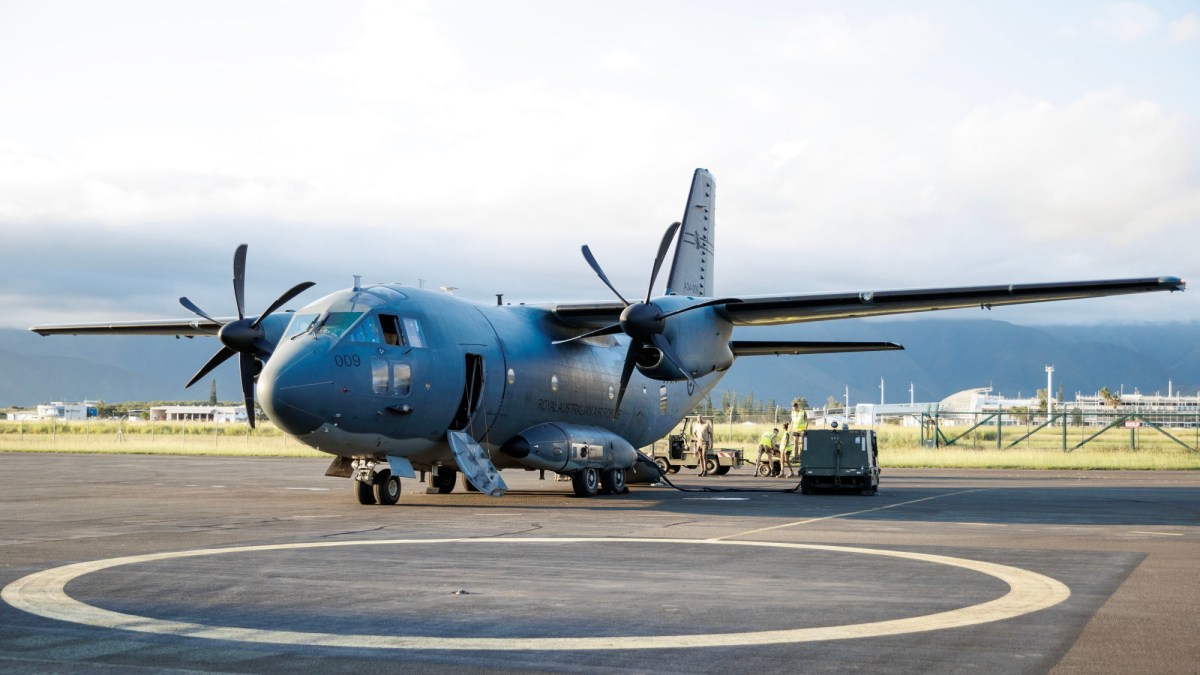
Interestingly the RAAF has just retired the C27 J which could land in more locations than the Herc.!!!
The logistic need has not gone away with the Spartans demise. It will be satisfied in other ways.
Which begs the question what does that look like.
More chinooks , LCMs, LCH , existing platforms of something else.
RAAF
MRTT , C17. , something in the middle and something much smaller.
I believe the C 130 is now to small for the middle tier

Australia is all about distance and flexibility and requires the correct mix of aviation assets to meet the ADFs logistical needs.

Cheers S
 
That depends on the design of the aircraft and its lift profile more than the size of the aircraft (to an extent).

A C-17 is still short field capable and can land on prepared but unsealed surfaces.
If we had the option to purchase many more C17s we could reevaluate the RAAFs logistical fleet mix.

Cheers S
 
I wonder if the A400M would be a better option than C-130J-30, but being larger with more powerful (and probably more complicated) engines operational costs could be problematic?

Does the C-390 have a capability to land at short Austere strips?
 
I am not particularly concerned about the loss of the C-27J. I am more concerned about our heavy lift capability. We now have out sized equipment like HIMARS and Ghost Sharks to haul around the region. HIMARS can fit inside a C--130, but I believe it can carry one system compared to three for the C-17. I think the C-130 does fill an important role but in lieu of additional C-17s we may yet need to consider a larger transport such as the A400, KC-390 or C-2 as well.
 
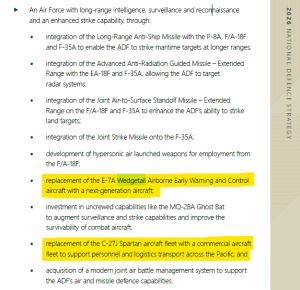
This article does state commercial replacement as well as for the Wedgetail ,is it the writing or are they suggesting the same commercial body for both what is meant by next generation?
 
This article does state commercial replacement as well as for the Wedgetail ,is it the writing or are they suggesting the same commercial body for both what is meant by next generation?
Neither. I don't see it saying anything about replacing both with the same commercial aircraft. As for next generation - I think that's probably deliberately vague.
 
This article does state commercial replacement as well as for the Wedgetail ,is it the writing or are they suggesting the same commercial body for both what is meant by next generation?
All the article states is that the C-27J will be replaced with a commercial solution and in the future the E7 will be replaced with a next generation aircraft. Nowhere does it state the E7 will be replaced with a commercial solution.
 
I think we are splitting hairs on this the E-7 was a commercial aircraft and became a next generation aircraft by means of military enhancements ? if the c-27j replacementwas a commercial aircraft and was not fitted any military equipment that the present c-27j has, that would be commercial and a different discussion, I hope I am wrong on this.
 
Back
Top