I wonder what prompts these people use to get their results (and what ai are they using). My question to Grok:
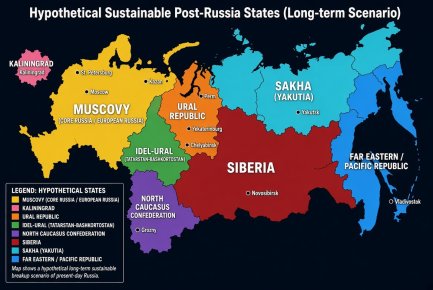
Consider a hypothetical scenario where Russia breaks up into smaller parts. What would be the most realistic sustainable breakdown into “countries”? Draw a map.
The result:
View attachment 55973
Didn't follow up much to preserve the original hypothetical breakdown, only asked about the population of Sakha. The answer was about 1M. Clearly unsustainable, which I asked about. Grok agreed and divided Sakha between Siberia and Far Eastern Republic. Only then I noticed that Sakha was a potential or a hybrid addition in the original write up (yet added to the map anyway). The only other thing I asked it to break down the population by ethnicity in each resulting “country” (copy-paste):
1. Muscovy (Core Russia / European Russia)
- Ethnic Russians: ~85–92%
- Other major groups: Tatars (scattered, especially Volga edges), Ukrainians, Armenians, smaller Finno-Ugric and other minorities.
Heavily Slavic/Russian-majority heartland. Highest Russian share of any large unit.
2. Kaliningrad
- Ethnic Russians: ~80–91% (2021 figures often cited around 78–91% depending on whether non-declared are excluded)
- Ukrainians ~1–1.4%, Belarusians ~1–1.3%, Armenians ~0.8–1%, Lithuanians ~0.4–0.5%, Germans ~0.4%, others small.
Strong Russian majority; post-WWII resettled population.
3. Ural Republic
- Ethnic Russians: ~80–90%
- Tatars and Bashkirs form notable minorities in southern/western parts (especially near Bashkortostan/Chelyabinsk), plus smaller groups.
Industrial Russian-majority region with some Turkic presence.
4. Idel-Ural (Tatarstan–Bashkortostan centered)
- Ethnic Russians: ~35–45%
- Tatars: ~30–40% (dominant in Tatarstan ~52–53%)
- Bashkirs: ~15–25% (strong in Bashkortostan ~30–36%)
- Smaller: Chuvash, Mari, Udmurt, etc. if included.
Most mixed of the larger units; clear Turkic plurality overall when combining the core republics.
5. North Caucasus Confederation
- Ethnic Russians: typically <5–15% overall (much lower in core republics)
- Chechnya: ~96% Chechen, ~1% Russian
- Ingushetia: ~93–96% Ingush, ~1% Russian
- Dagestan: ~3–5% Russian; multi-ethnic (Avars ~30%, Dargins ~16–17%, Kumyks ~15–16%, Lezgins ~13%, plus Laks, Tabasarans, Azeris, etc.)
- Other republics (Kabardino-Balkaria, Karachay-Cherkessia, North Ossetia, etc.): titular groups (Kabardians, Karachays, Ossetians, etc.) form majorities or pluralities, Russians often 15–30% or lower.
Strongly non-Russian; highly diverse internally, especially in Dagestan.
6. Siberia
- Ethnic Russians: ~80–90%+ in most areas
- Notable minorities: Buryats (in Buryatia areas), Ukrainians, Germans, Tatars, indigenous Siberian groups (Evenks, etc.) in smaller shares.
Broadly Russian-majority resource region; indigenous shares higher in some northern/remote districts.
7. Sakha (Yakutia)
- Sakha (Yakuts): ~47–55%
- Ethnic Russians: ~28–38% (share has declined over decades)
- Evenks ~2–3%, Evens ~1.5–2%, smaller groups (Ukrainians, Kyrgyz, Buryats, etc.).
One of the few large units where the titular non-Russian group forms a plurality or near-majority.
8. Far Eastern / Pacific Republic
- Ethnic Russians: ~80–90%
- Smaller shares of Ukrainians, indigenous peoples (e.g., in Magadan/Chukotka/Kamchatka areas), Koreans, Chinese (migrant/urban), Buryats (if border areas included).
Russian-majority with sparse indigenous populations in the far north and east.
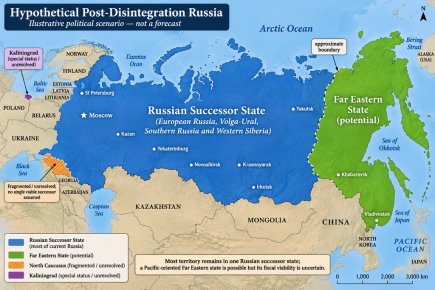
I settled there. Time spent was 3-5 minutes. I then asked ChatGPT the same, except I did not ask it to draw a map right away. It proposed 9 states and a whole bunch of analysis and what it thinks it should do next. I said ok and a few oks after. It led itself to the conclusion that Russia as it is today is the most sustainable outcome that is likely to remain post-Putin and potential “troubles”. I wanted to get some break-up, so I made a few prompts to get me the result I want (some break up it thinks is reasonable) and draw it on the map. It eventually came up with this:
View attachment 55974
I stopped here, with a messed up map, lol, because time spent was already over 15 minutes with CharGPT basically debating with itself. It noted that the breakdown is likely not sustainable and it will basically all turn to Russia again. Kaliningrad is a problem though.
I am actually interested in this now and will try a real conversation or two with ai and see what it can come up with based on the real data, my ideas, etc. If I proceed with this plan, I will post the results.