Royal Canadian Navy Discussions and updates

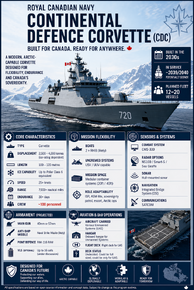
Just have to wonder why a 35mm gun would be shown as that is more along the lines of what many navies equip their OPVs with. Surely a 40mm or 57mm gun would be more in keeping with the corvette designation.
The 35mm Millennium gun is more of a CIWS than a proper main gun, although I would take what you see on these very early concept renders with a substantial grain of salt.
 

Underway

Active Member
Just have to wonder why a 35mm gun would be shown as that is more along the lines of what many navies equip their OPVs with. Surely a 40mm or 57mm gun would be more in keeping with the corvette designation.
Its a placeholder artwork for a powerpoint. They don't normally consult the warfighters to see if it makes sense. What it does show is this is a serious discussion now.

NATO designations separate corvette from frigate by ship size (corvette 60-100m, frigate 76-150m) and OPVs are less than 60m.

Of course the "rules" are not followed by anyone and you call ships whatever you want. I find that the rule of thumb is Destroyers - excel in all warfare domains, Frigates - excel in one domain generally good at others (ASW/ ASuW), Corvettes self defense domains only, OPV limited self defense.
 
Last edited:

Vanquish

Active Member
They will be great to have. I have serious doubts about the numbers though. Even building to the low end seems a stretch. Also dock space, particularly in Esquimalt is in short supply. I have heard rumours of possibly creating another west coast base in Prince Rupert which would actually make a lot of sense. Also I believe the Feds need to consider an even split in naval forces between the west and east coasts. I understand Canada has always leaned harder to our NATO obligations but personally I believe the Indo Pacific should garner just as much attention. I will note there have been a lot of east coast based frigates spending a lot more time in the Pacific of late. This indicates to me a shortage of assets on the west coast.
 
There are plans for both dockyards to build new jetties and infrastructure for future fleet. DND just purchased a large track of land in Eastern Passage for new jetties and a fueling facility for future fleet. As it stands the East Coast will have a larger share of Naval assets.
 

Underway

Active Member
They will be great to have. I have serious doubts about the numbers though. Even building to the low end seems a stretch. Also dock space, particularly in Esquimalt is in short supply. I have heard rumours of possibly creating another west coast base in Prince Rupert which would actually make a lot of sense. Also I believe the Feds need to consider an even split in naval forces between the west and east coasts. I understand Canada has always leaned harder to our NATO obligations but personally I believe the Indo Pacific should garner just as much attention. I will note there have been a lot of east coast based frigates spending a lot more time in the Pacific of late. This indicates to me a shortage of assets on the west coast.
Its basically the same distance to go to SE Asia from the East Coast as it is to go there from the West Coast. Given that the RCN is in no hurry to move assets. There is far more space on the East Coast (especially as they just bought more space as @HaroldBloggins just mentioned)

As far as more East Coast frigates recently, its not a shortage of assets on a coast its part of a deliberate policy, Canada's Asia policy states there will be three ships a year in the Pacific. The Kingston class are the ones doing the NATO deployments assisting with the standing NATO mine countermeasures flotilla (or whatever its called).

So yah, more attention to OP HORIZON (SE Asia)/ OP NEON (Korean peninsula) than OP REASURANCE (NATO) as per gov't direction.

 

Vanquish

Active Member
Its basically the same distance to go to SE Asia from the East Coast as it is to go there from the West Coast. Given that the RCN is in no hurry to move assets. There is far more space on the East Coast (especially as they just bought more space as @HaroldBloggins just mentioned)

As far as more East Coast frigates recently, its not a shortage of assets on a coast its part of a deliberate policy, Canada's Asia policy states there will be three ships a year in the Pacific. The Kingston class are the ones doing the NATO deployments assisting with the standing NATO mine countermeasures flotilla (or whatever its called).

So yah, more attention to OP HORIZON (SE Asia)/ OP NEON (Korean peninsula) than OP REASURANCE (NATO) as per gov't direction.
I appreciate the comment, however I still believe Canada should go with a balanced fleet on both coasts. There is also a significant choke point that the Atlantic fleet must pass through to get to the Pacific, which is fine in peace time.
 

John Fedup

The Bunker Group
I appreciate the comment, however I still believe Canada should go with a balanced fleet on both coasts. There is also a significant choke point that the Atlantic fleet must pass through to get to the Pacific, which is fine in peace time.
Agree about the choke point and the Pacific and to a lesser extent (for now anyway) is be much more important for Canada. Probably an important a consideration regarding the future sub acquisition as well. The east will be the priority for now but in 5-10 years….?
 

SamB

Member
There are because the maintenance facillity is in Esquimalt and we all know how reliable the class has been.
Hope you are well. I grew up in the Pacific. Admittedly, my knowledge of the Atlantic Ocean is limited. May I ask, how interchangeable is Canada's Pacific and Atlantic Ocean naval strategy?
 

Vanquish

Active Member
Hope you are well. I grew up in the Pacific. Admittedly, my knowledge of the Atlantic Ocean is limited. May I ask, how interchangeable is Canada's Pacific and Atlantic Ocean naval strategy?
There are people who could better answer that question such as @Underway. Canada has always been more focused on the Atlantic than the Pacific and I just wish that there could be a better division of assets. Having 2 AOP's on the west coast is fine but the west coast should get an equal split on the rest of the new fleet ships as they become available.
 

SamB

Member
There are people who could better answer that question such as @Underway. Canada has always been more focused on the Atlantic than the Pacific and I just wish that there could be a better division of assets. Having 2 AOP's on the west coast is fine but the west coast should get an equal split on the rest of the new fleet ships as they become available.
Awareness is good enough for me. You may not know, but I want a wolf too. But hey, dreams are free. hehe.
 
There are people who could better answer that question such as @Underway. Canada has always been more focused on the Atlantic than the Pacific and I just wish that there could be a better division of assets. Having 2 AOP's on the west coast is fine but the west coast should get an equal split on the rest of the new fleet ships as they become available.
It is helpful to look at the list of established operations which the RCN regularly undertakes, and it becomes relatively clear why assets have historically been focused around the East Coast. There has been a substantial amount of work done in the Caribbean (OP CARIBBE), Arctic (OP NANOOK), Europe (OP REASSURANCE), Africa (OP PROJECTION) and some more minor missions. Pacific vessels do heavily participate in the Indo-Pacific (OP PROJECTION), some limited work in the eastern pacific (OP CARIBBE) and off Korea (OP NEON) however, Atlantic vessels get pulled off to do this as well.

It is far easier to access the Arctic from the Atlantic, while obviously our substantial NATO commitments in Europe alongside our work more domestically is better served for much of the country by focusing on the Atlantic. Strategically, Atlantic ships are able to cover more provinces and our more expansive EEZ on said coast. This is doubly so given the ease of entering the Canadian Arctic from the east as well. People have mentioned infrastructure as well, which is a key point to take into consideration. It makes little sense to send ships to base where they have sub-par infrastructure.

The current strategy works fine, our access to the Panama Canal allows for the RCN to reinforce coasts at will during peacetime and in the lead up to potential conflicts.
 

John Fedup

The Bunker Group
It is helpful to look at the list of established operations which the RCN regularly undertakes, and it becomes relatively clear why assets have historically been focused around the East Coast. There has been a substantial amount of work done in the Caribbean (OP CARIBBE), Arctic (OP NANOOK), Europe (OP REASSURANCE), Africa (OP PROJECTION) and some more minor missions. Pacific vessels do heavily participate in the Indo-Pacific (OP PROJECTION), some limited work in the eastern pacific (OP CARIBBE) and off Korea (OP NEON) however, Atlantic vessels get pulled off to do this as well.

It is far easier to access the Arctic from the Atlantic, while obviously our substantial NATO commitments in Europe alongside our work more domestically is better served for much of the country by focusing on the Atlantic. Strategically, Atlantic ships are able to cover more provinces and our more expansive EEZ on said coast. This is doubly so given the ease of entering the Canadian Arctic from the east as well. People have mentioned infrastructure as well, which is a key point to take into consideration. It makes little sense to send ships to base where they have sub-par infrastructure.

The current strategy works fine, our access to the Panama Canal allows for the RCN to reinforce coasts at will during peacetime and in the lead up to potential conflicts.
Asia is becoming increasing important for Canada. While NATO requires RCN commitment so do our Pacific friends. Agree the Arctic is best supported by east coast basing. Given US actions lately, how reliable will Panama Canal access be in the future? Probably a combination of more ships and and mission trimming (e.g. Africa) would sort things.
 

Vanquish

Active Member
Asia is becoming increasing important for Canada. While NATO requires RCN commitment so do our Pacific friends. Agree the Arctic is best supported by east coast basing. Given US actions lately, how reliable will Panama Canal access be in the future? Probably a combination of more ships and and mission trimming (e.g. Africa) would sort things.
Agreed John on the Arctic and Africa. As a west coaster the cynicism in me always figured the available seats in the east played an outsize role in fleet deployment. Probably not a fair assumption on my part but it is what it is.
 
Asia is becoming increasing important for Canada. While NATO requires RCN commitment so do our Pacific friends. Agree the Arctic is best supported by east coast basing. Given US actions lately, how reliable will Panama Canal access be in the future? Probably a combination of more ships and and mission trimming (e.g. Africa) would sort things.
Asia is indeed becoming more important for Canada however, we are in a formalized military alliance with NATO and have legitimate/larger scale commitments there than we have in the Pacific. We have fundamentally limited resources and when it comes down to cold hard logic, we have to maintain our relationship with NATO as that is where a great deal of value comes from for Canada. This isn't to put down the Pacific, but our partnerships and involvement in the region is far less developed than that of Europe.

If the reliability of the Panama Canal is being seriously discussed for Canadian military use, we have far more serious issues at stake than simply moving warships from coast to coast. I don't tend to entertain that sort of talk as its fundamentally out of the scope of reality, and would be part of a huge geopolitical breakdown that would have much more important items to be concerned about if so.

Mission trimming is not the way to do things, our Canada's commitment elsewhere besides the Pacific abroad is valuable to both ourselves and our allies. We aren't sending frontline combatants out to many of these theatres like Africa, it is second line non-combatants like the AOPS or MCDV's doing these roles. Different kinds of ships for different regions, undertaking cross-training, counter-narcotics/piracy and humanitarian work abroad is fulfilling and important work to build our military capability and our soft power. Asia is primarily a frigate deployment territory, so there is different resources being used more so than competing directly.

Asia is just one more theatre to work within, not something that should pull us out of our other commitments abroad.
 
Top