Middle East Defence & Security

Feanor

Super Moderator
Staff member

Interesting article claiming that the Russians are providing ISR to Iran. I wonder, why would they claim Russia is providing the location of warships if no warships have been targeted, as they also claim?
There have been claims on Russian sources that Iran had targeted US ships. Confirmation is absent and I don't trust the reporting, but it might be happening.

Edit: Another thought, Russia could provide Iran with satellite imagery of US radars and base facilities enabling some of those strikes.

Fog of war is going to be very thick here I think. Israel and the Gulf states are censoring as much as they can, and all we will really see from Iran is basically propaganda footage. Proper BDA is going to get more and more difficult for the public sector.

But I don't agree with the assessment that Iran is doing poorly at all. Obviously they are going to sustain a huge amount of punishment; this is a war of asymmetric capabilities. But they are also going to inflict huge pain on the global economy, particularly agriculture and energy.
I agree it's hard to tell. But it doesn't look like Iran has managed to disrupt USAF operations, which means the strikes can continue largely unhindered. And this is despite the clearly inadequate air defenses across the region. Again look at what Russian strike waves into Ukraine look like. Iran should be at least attempting similar attacks.

The effects of that campaign will really begin to tell in the next couple of weeks. It also seems clear that they can more or less hit what they target (bases, radars, ships, etc) with few exceptions and don't require huge waves of strikes to do so.
But they often don't do that much damage. And much of what they're targeting isn't well protected. If they hit a major USAF air operations hub with a couple of hundred inbounds they could substantially disrupt its operations. If they hit it with single digit inbounds, the impact becomes far more manageable

The war is unpopular in the US and will only become worse as economic effects tell. Trump will be under increasing pressure to find an off-ramp, which may not really exist.
This isn't a path to victory. It's a hope for survival.

Iran on the other hand will more than likely be able to endure the pounding. Unless you choose to believe IDF/CENTCOM propaganda, there really is no way to know how degraded missile launch capability is; based on visual evidence/air siren alerts, it seems missile launches have been pretty steady over the last few days, with consistent impacts. Iran knows the only path to a favorable outcome is to hunker down and eat bombs while maintaining an attrition strategy against the Gulf economy.

Will be curious how things evolve as interceptor stocks dwindle.
I agree on this part. But there are other things Iran should be doing.
 
I agree it's hard to tell. But it doesn't look like Iran has managed to disrupt USAF operations, which means the strikes can continue largely unhindered. And this is despite the clearly inadequate air defenses across the region. Again look at what Russian strike waves into Ukraine look like. Iran should be at least attempting similar attacks.
I'm curious to what extent they ever really thought they would disrupt USAF operations. Not sure why, but they never bought high end AD from the Russians or the Chinese. Feels like their strategy has been to dig into the mountains. And honestly I can see why. If you have limited resources, why spend them on fighting the best SEAD/DEAD operation in the world? Iran is a very big country, with places to hide.

It would make a lot of sense to weather the storm for a few weeks and not expose too much. Especially if they can attrit UAVs, which are probably the biggest threat overall.


But they often don't do that much damage. And much of what they're targeting isn't well protected. If they hit a major USAF air operations hub with a couple of hundred inbounds they could substantially disrupt its operations. If they hit it with single digit inbounds, the impact becomes far more manageable
I'd say the early warning radars are very significant, and they don't have to do much damage to oil/port facilities to have a big impact. Again, usual FOW caveats apply but my guess would be they are holding back capabilities in order to weather the air war storm a bit as well as waiting for interceptor stocks to dwindle. We didn't see any massed launches at all like we saw against Israel after the embassy bombing, or the 12 day war.


This isn't a path to victory. It's a hope for survival.
Isn't survival equivalent to victory for Iran? If the US gives up on trying to destroy them, they will also need to cut a somewhat Iran-favorable deal to get the Gulf economies back on line.
 

Feanor

Super Moderator
Staff member
I'm curious to what extent they ever really thought they would disrupt USAF operations. Not sure why, but they never bought high end AD from the Russians or the Chinese. Feels like their strategy has been to dig into the mountains. And honestly I can see why. If you have limited resources, why spend them on fighting the best SEAD/DEAD operation in the world? Iran is a very big country, with places to hide.

It would make a lot of sense to weather the storm for a few weeks and not expose too much. Especially if they can attrit UAVs, which are probably the biggest threat overall.
The best way to disrupt USAF operations is by hitting their bases and supporting infrastructure in a massive way. I don't think Iran could realistically build an IADS that the US wouldn't overcome and relatively quickly. I don't know what Iran thought, but I know if I was them, I would certainly try to hit those bases especially early and hard. Before the US learns how to handle the Shahed threat effectively. Instead of a drone hitting a storage facility or a hangar here or there, they should be hitting everything and as close to all at once as they can. It maximizes impact and overloads the other side. With how unimpressive drone defense is now, a few thousand Shaheds could do absolutely catastrophic damage and impose a very high cost. And I suspect it would disrupt USAF operations.

I'd say the early warning radars are very significant, and they don't have to do much damage to oil/port facilities to have a big impact. Again, usual FOW caveats apply but my guess would be they are holding back capabilities in order to weather the air war storm a bit as well as waiting for interceptor stocks to dwindle. We didn't see any massed launches at all like we saw against Israel after the embassy bombing, or the 12 day war.
The strikes on radars are probably, at least militarily, the best choice. Maybe they can target Patriot sites directly? It would only take several dozen Shaheds to take out a Patriot battery. Any jets forced to do drone defense are jets not available for operations against Iran.

Isn't survival equivalent to victory for Iran? If the US gives up on trying to destroy them, they will also need to cut a somewhat Iran-favorable deal to get the Gulf economies back on line.
Maybe. It depends on how thoroughly this campaign can destroy Iranian strike capabilities. A long enough campaign can take out facilities that produce Shaheds, destroy the power grid, etc.
 

swerve

Super Moderator
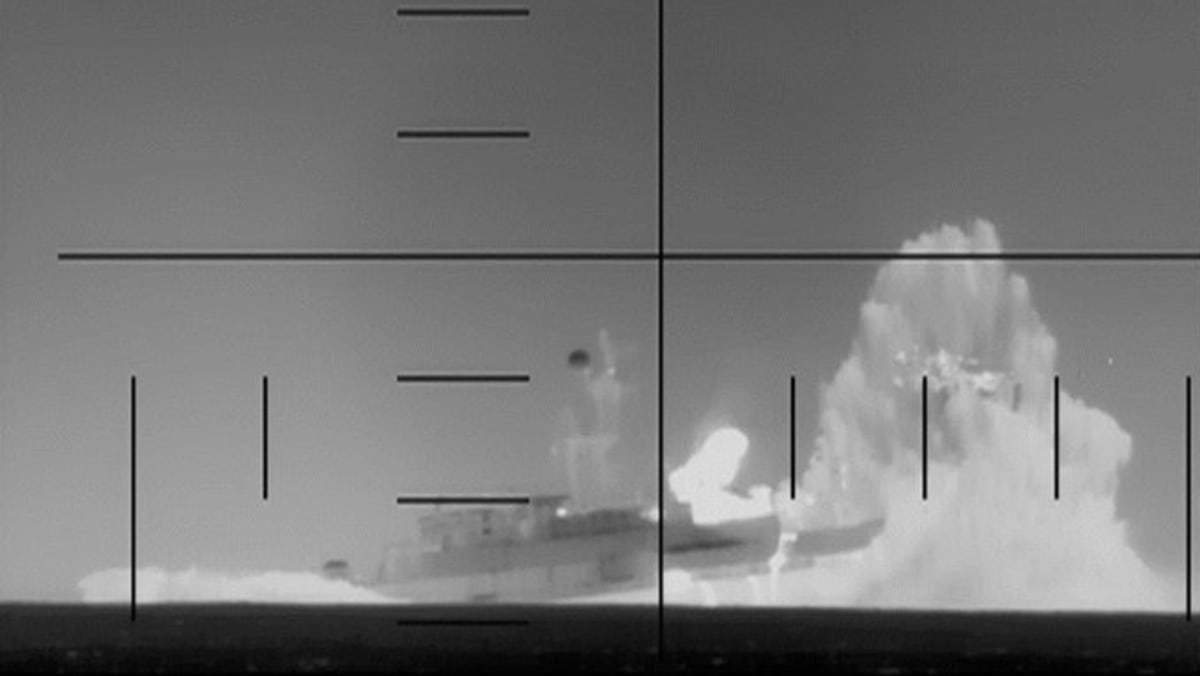
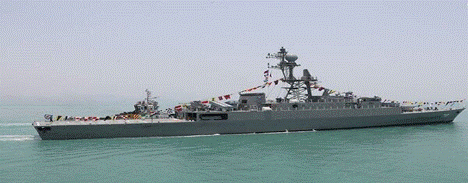
Curious situation with IRIS Dena. She was just in India to attend the International Fleet Review (IFR2026) and MILAN 2026 exercises. With war breaking out, it would have made sense for her to shelter in a port outside of Iran.

And now she is sinking in Sri Lanka's territorial waters.

If she was attacked by US forces, it would be a significant escalation. One, it signals all Iranian military assets overseas are potential targets, and two, it is a grave violation of another nation who had no business in the conflict (which is an unsanctioned military operation by the US and Israel)

Whatever you think of the sinking of a ship which was no threat at all, it wasn't "a grave violation" of any country other than Iran. It was in international waters, about 40 nautical miles off the coast of Sri Lanka. Territorial waters are limited by UNCLOS to 12 nautical miles.
 

koxinga

Well-Known Member
Whatever you think of the sinking of a ship which was no threat at all, it wasn't "a grave violation" of any country other than Iran. It was in international waters, about 40 nautical miles off the coast of Sri Lanka. Territorial waters are limited by UNCLOS to 12 nautical miles.
I erred as the initial reports were unclear and described the action as taking place within Sri Lanka waters.

I have no issues with the action taken by the USN skipper since he was given an order and the US is in active conflict with Iran at the moment. But I still see this as a grave escalation and violation in the larger geopolitical context. Why?

The current attacks on Iran is a unilateral action based on national interests (of the US and Israel) and done with no consultation of allies or the GCC. While it is a reality that we have to deal with, extending military action far outside that theatre is... unnecessarily provocative.

Comparing it with the sinking of ARA General Belgrano is also a case of false equivalence:

1. Argentina had invaded the Falklands, the jus ad bellum for UK action is clear (UK's sovereignty was violated via armed action and continued occupation) - The current US/Israel actions has very weak justifications in a traditional sense and is not endorsed by the international community of UN.

1. While ARA General Belgrano was not in the Total Exclusion Zone (TEZ), even the Argentinians acknowledged it was participating in combat actions and operating within general theatre of operations, hence she is an active participant. The IRIN Dera was two thousands miles away.

If her Captain is determined to bring her to the Gulf of Hormuz which is an active combat zone, by all means do it near there and don't make Sri Lanka clean up the aftermath.
 
Last edited:

KipPotapych

Well-Known Member
As some have been predicting, the US is planning to pull some air defense capabilities from South Korea (I would not exclude the possibility/probability for these being pulled from elsewhere as well). Bloomberg, via the archive:


An article on the munitions used in the first 36 hours of war, cost and replenishment times, etc. Foreign Policy, via the archive:


About Claude’s (AI) role in the US campaign in Iran, planning, target identification, etc. Washington Post, via archive:


US intel did not suggest a pre-emptive strike on Iran, of course:


Trump has serious interest in sending ground troops to Iran:


Saw some reports suggesting that deployment to Kuwait and elsewhere in the ME is imminent. More reports talking about the second coming of Jebus too.

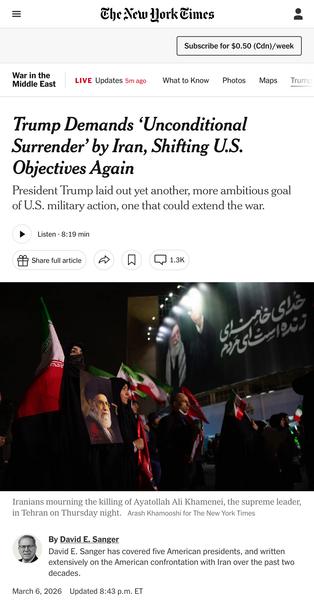
A headline from today:


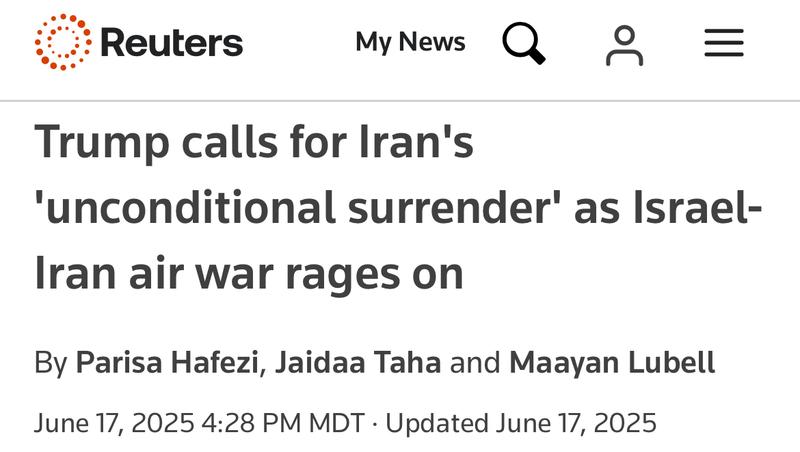
One from a week before the 12-day war was over last June:


Leavitt explains what unconventional surrender actually means:


In other words, it will be Trump who decides if Iran had unconditionally surrendered, everything obliterated, etc. Just like last time around. Zero evidence Iran is even remotely ready not only to surrender, but even for some kind of ceasefire. The logic for Iran should suggest that they need to be able to inflict as much economic pain as possible, on the Arab states, as well as the rest of the world, political costs on the US administration, and so on. That is the only somewhat credible deterrent they have against another round of this (nukes is an obvious choice, but not feasible at this time). On this note, some reports indicate that some of the Arab states have reached out to Iran to reduce the hostilities (not going to happen), while UAE has reportedly frozen Iranian assets in the kingdom.

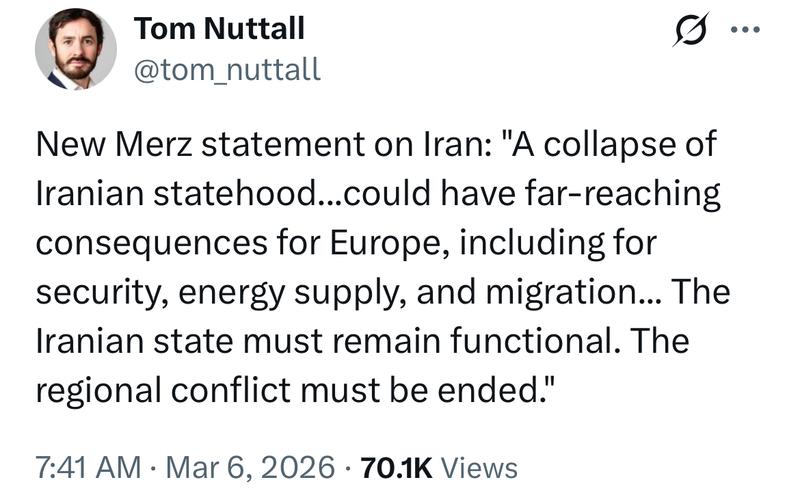
Also (serious) humour: one cannot help but wonder what Merz and other Euros, but Merz expressed it today, think about the “day after” if the plan is to destabilize the country (Israel’s plan is probably to wreck the state altogether) and what that “day after” entails for Europe. Merz threw his full support behind it. Will be interesting to return to this some months and years from now.
Looks like Merz has given it some thought after all.


These people… It is like they just shoot air all the time, depending on where the wind blows. Thinking appears to be secondary.

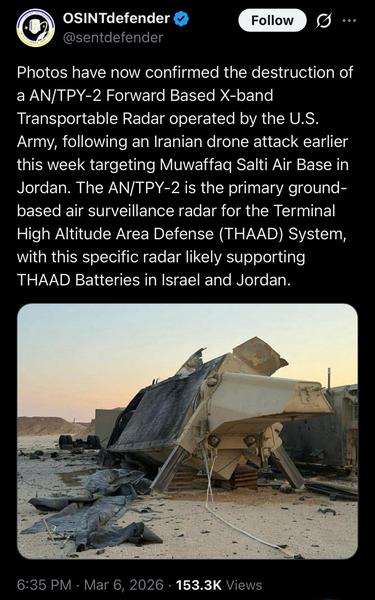
Some analysts suggest, citing satellite imagery, that at least four of AN/TPY-2 were either destroyed or damaged by Iranian strikes. Along with the CNN, NYT investigation, the NBC article I cited the other day, these are all consistent, painting the true picture, perhaps?. Some photos appeared allegedly confirming the distraction of one of these assets (I cannot speak for the validity of the information, of course):


Humour on the subject:


Bessent says that the US might “unsanction”other Russian oil to help with the crisis.


I find it extremely weird that they simply would not tap into strategic reserves for the relief, if that is their intention. Sure, Russian oil, especially the volume already on ships at sea is going to find its clients much faster and put brakes on oil prices going exponential in the very short term… Perhaps, that is the game and they are hedging politically (not working very well). I have little doubt in my mind, if this is going to last for another week or two, we are going to see oil prices well above $100. Sucks for us. Risk for Russia is stronger ruble. On the flip side, they don’t have to print. I do not see, in spite of some suggestions, how this is an inflationary pressure. Realistically, this is a great boost for them, they could not have wished for more, really. While appreciating currency is a risk (see as bad), there is plenty of room the Central Bank has to reduce the pressure via the interest rates given the state of the economy and other indicators. Also, at the end of the day, oil at these prices and somewhat stronger currency is probably a preferable state of events. Reports suggesting otherwise are… call it wishful thinking, propaganda, whatever. It’s bad takes basically.

Hegseth on the reports of Russians supplying Iranians with intel; the most concerning part is probably what Aaron quoted in the post though:


Trump completely dismissed the question by suggesting that it isn’t a serious question and went to the next journo.

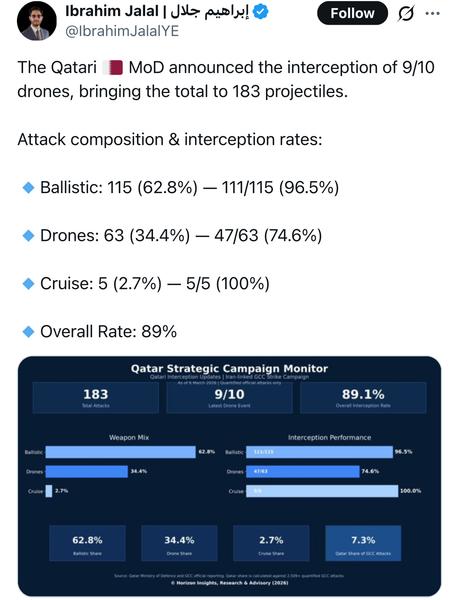
Last thing, Qatari released numbers of inbounds and intercepts so far:


Honest or not (probably is for the most part), I do not see where Ukraine fits in with its expertise and their proposed trade for Patriot interceptors. That ain’t happening, obviously. While many articles suggest that Patriots are widely used to intercept Shaheds, this is clearly not true if one believes the numbers reported in the Foreign Affairs article cited in the beginning of this post.

Also, you should check out the White House X account, they are going full-retard with the war promotion videos. I wonder if MLB, NFL, among others are going to sue Donald for this nonsense.
 

personaldesas

Active Member
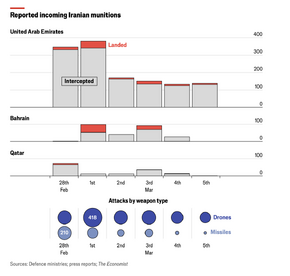
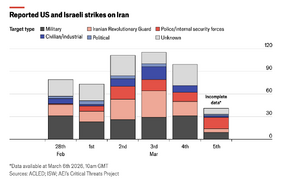
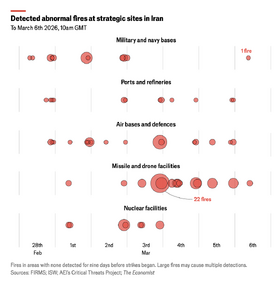
The Economist has a piece arguing that the war has entered a new phase.

Their analysis of strike data suggests two main shifts:

1) US/Israeli targeting has moved from mainly military infrastructure to parts of the regime’s internal control apparatus, police stations, internal security, defence-industry facilities, etc. The idea seems to be weakening the regime’s ability to control the population rather than just its conventional military.

2) Iran’s retaliation appears less effective than at the start of the conflict. Missile launches have decreased and the response relies increasingly on drones. In many Gulf countries (UAE, Bahrain, etc.) the vast majority of incoming missiles and drones have reportedly been intercepted.

Iran still likely has large stockpiles of drones and possibly missiles. One theory is that drones are being used to wear down interceptor stocks before larger missile attacks, or to create the perception that Iran still holds significant reserves.

Overall the campaign looks like a real-world test of whether precision air power and surveillance alone can seriously weaken or even destabilize a regime. Most analysts remain skeptical that air power by itself can produce regime change without ground forces.

Screenshot 2026-03-07 at 12.17.38.png

Screenshot 2026-03-07 at 12.17.56.png

Screenshot 2026-03-07 at 12.18.10.png
 

crest

Active Member
Reports Iran is offering to cease attacks on the Gulf states and perhaps aloe tanker traffic. Depending on not u.s operations in there states, this is imop a significant event if it happens Iran will have effectivly pushed the u.s out of the Gulf states, all other things aside that is a major shift in geostatistical affairs
 

John Fedup

The Bunker Group
Reports Iran is offering to cease attacks on the Gulf states and perhaps aloe tanker traffic. Depending on not u.s operations in there states, this is imop a significant event if it happens Iran will have effectivly pushed the u.s out of the Gulf states, all other things aside that is a major shift in geostatistical affairs
This will not happen anytime soon if ever. The Gulf states are extremely dependent on the US to support their military kit and Iran cannot be trusted.
 

crest

Active Member
This will not happen anytime soon if ever. The Gulf states are extremely dependent on the US to support their military kit and Iran cannot be trusted.
We will have to see there even more dependent on the flow of oil then they are on t u.s military after all it was supposed to make them immune to attack. A factor they may not see quite the same way. Will be very interesting to see how it plaes out for example does the 5th fleet still have a home there?
 

koxinga

Well-Known Member
One week after this conflict started, the only realistic outcome I see is:

1. Bibi will claim that war has removed Iran as an definitive, immediate existential threat, with the complete elimination of their nuclear program and diminished their ballistic missile stockpile
2. Trump will claim similar and add that he has done more than all the past Presidents before moving to Cuba
3. The Iranians will claim that they have endured and survived the Zionist-America war, trying to draw a parallel to the suffering of Iran-Iraq War, quietly licking their wounds and work doubly hard to ensure internal control/more represssion.

Trump is delusional if he insists there is going to unconditional surrender, this is not 1945 with US/Russians troops in ruins of Berlin or two atomic bombs dropped on Japan and on the eve of Operation Downfall.
 

KipPotapych

Well-Known Member
US/Israeli targeting has moved from mainly military infrastructure to parts of the regime’s internal control apparatus, police stations, internal security, defence-industry facilities, etc. The idea seems to be weakening the regime’s ability to control the population rather than just its conventional military.
Today, it seems to me that they moved to targeting critical infrastructure, including refineries, oil/fuel storage, allegedly a desalination plant, airport, etc. Basically facilities directly involved in state functioning. Which seems to be the next rational step in the explicitly stated and implicitly implied goals of the campaign. The question now is whether Iran will be able to meaningfully retaliate by striking similar infrastructure, including that of the Arab states.

Iran’s retaliation appears less effective than at the start of the conflict. Missile launches have decreased and the response relies increasingly on drones. In many Gulf countries (UAE, Bahrain, etc.) the vast majority of incoming missiles and drones have reportedly been intercepted.
What’s interesting to me, though not at all unexpected, is that the intensity and number of volleys was rather underwhelming to begin with.

Iran still likely has large stockpiles of drones and possibly missiles. One theory is that drones are being used to wear down interceptor stocks before larger missile attacks, or to create the perception that Iran still holds significant reserves.
We have been reading about these epic stockpiles of the missiles and even bigger stockpiles of drones in Iran for months and years now. What we have observed, however, really begs to question these assumptions and makes one wonder. On the other hand, I do not believe one can reasonably deny that stockpiles exist (it is the volumes that are questionable), but what we are also observing is that having stockpiles does not translate into actual use - that is, ability to use the assets.

I think the theory that Iran is wearing down air defences with drones so that they can use missiles later does not hold much water. No one is shooting down drones with Patriot or THAAD interceptors (it is also clear from the numbers in the Foreign Affairs article I cited yesterday). It would be most effective to launch combined and concentrated attacks with large numbers of projectiles, which Iran is failing to do. To note, they had done exactly that in the first couple of days (and definitely in the first few waves) during the war last year. What’s probably relevant is that the reported BDA was not sufficiently different then from what we see today; arguably the damage caused in this round so far is more significant. But it is certainly hard to tell at this time (hard to trust anything anyone says, really). I think, it is more likely that the degradation of the Iranian capabilities is real vs some strategy of “restrain now and shoot later”. The latter makes little sense as does firing individual missiles to Israel or elsewhere. This seems to especially hold true for decentralized command that Iran appears to operate under presently (or advertised to do so). If the capabilities existed and could be used, they certainly would be.

On another note, it appears to me that the Iranians fully understood their limitations and inferiority as far as capabilities are concerned; thus, they have chosen, and correctly so, in my opinion, a different strategy, which involves dispersing their strikes into a wider area, which involves the Gulf States, as well as taking the (artificial) control of the Hormuz Strait. It is exactly here, in my opinion, where one cannot help but wonder if this new (proper) strategy and some successful strikes (radars, US bases, etc) is the fruit of working with the Russians (less likely (or unlikely) Chinese or a combination of the two). I highly doubt the Russian ability to provide any real-time targeting data (maybe Feanor or others who know better can correct me on that) because if these capabilities existed in any sufficient manner, Russians would not struggle with it as much on their own end in Ukraine. Sure, Ukraine (and Russia) are probably more adapted to it than anyone else, the allegedly hit radars appear to have been in more or less permanent positions, and so on. But this is where the Russian advisory would be useful and bare fruit, as it may have.

Anyway, there is no winning for Iran here, regardless of the definition of victory, but if the country can absorb the bombardment and the regime can handle the internal affairs, the regime is guaranteed to survive this round in the short to medium term, in my opinion. This is especially true if the US-Israel campaign will continue to include the destruction of critical infrastructure and real functionality of the country/society. These are counterproductive in regard to the regime change. Consequences can also be dire for the region, as well as the entire world, but this will be complained about and dealt with “the day after”, of course.

Overall the campaign looks like a real-world test of whether precision air power and surveillance alone can seriously weaken or even destabilize a regime. Most analysts remain skeptical that air power by itself can produce regime change without ground forces.
What I think is more probable in this scenario is that the “regime change” will basically come with the disintegration of the state, which is the worst case scenario, in my opinion.


This will not happen anytime soon if ever. The Gulf states are extremely dependent on the US to support their military kit and Iran cannot be trusted.
Agreed and definitely so on the former. No one there is giving up the US arms and (questionable) protection as it is not exactly strategically savvy beyond the immediate present. Trump will wrap all this up anyway if the strait remains closed for shipping for another week or two, tops.

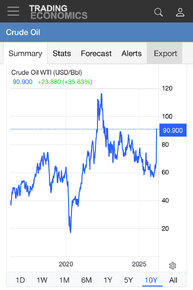
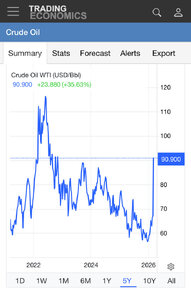
People on the State side complain about a 30-cent price increase per gallon of fuel, while the gas price here went from $109.9 on Friday a week ago to $142.9 per litre today at the same pump. And we haven’t seen nothing yet, as the saying goes.

Generally speaking, the price of barrel of oil increases by 10% when supply drops by 1% due to the demand being largely inelastic. It certainly does not hold true when we are talking about the loss of 20% or so that Hormuz provides, but one really does not want to go into that territory because we would be talking about severe economic consequences in that case.

A couple of charts (the same thing over 10 years and 5 years, respectively):

IMG_4296.jpeg

IMG_4297.jpeg

That 2022 spike was merely a disruption of the supply that never stopped flowing (and speculation). There we are talking about 12–13% of the global production and probably about 9% heading for exports. We are now sitting on 20% of the global export volume completely shut for the most part.
 

koxinga

Well-Known Member
I highly doubt the Russian ability to provide any real-time targeting data
Seems very unlikely. I am sure Iranian targeting teams get their satellite data from various sources, but whatever available Russian satellite assets (which are now sparse and limited) are more likely focusing on real-time needs on Ukraine. Besides, whatever US bases in ME should have been identified and pre-assigned, and any real-time intel required might well be a guy with a cell phone.
 

Feanor

Super Moderator
Staff member
Seems very unlikely. I am sure Iranian targeting teams get their satellite data from various sources, but whatever available Russian satellite assets (which are now sparse and limited) are more likely focusing on real-time needs on Ukraine. Besides, whatever US bases in ME should have been identified and pre-assigned, and any real-time intel required might well be a guy with a cell phone.
Satellites often fly in a certain pattern, meaning they might pass over the Middle East, and then pass over Ukraine. There isn't an option to focus that satellite specifically on Ukraine. I've seen a Russian source claiming that Russia is using one of the new Liana satellites to support Iranian strikes based on it's flight pattern and timing.


uguduwa

New Member
Longer this goes, the more support from the Iranians the US would lose. Especially after yesterday‘s strike on oil depots, I notice that the mood if shifting real time. I guess ultimately that doesn‘t matter because the goal is probably a weakened Iran without a nuclear or missile program that anyone can strike at any time with impunity.
 

crest

Active Member
Seems very unlikely. I am sure Iranian targeting teams get their satellite data from various sources, but whatever available Russian satellite assets (which are now sparse and limited) are more likely focusing on real-time needs on Ukraine. Besides, whatever US bases in ME should have been identified and pre-assigned, and any real-time intel required might well be a guy with a cell phone.
I do believe Iran switched to the Chinese GPS system beideu. Fennor is right about satellite patterns, the information Russia provides may be from satellites or from human intelligence or radio interception. Russia has excellent e.w capabilities aswell as extensive experience and very likely intelligence contacts in the middle east. After all there is a long history covert actions and support in the region so those comnication networks and assets are pre-existing
 
Striking desalination plants across the Gulf and Levant is dangerous escalation for both sides. Water scarcity can become a thing real quick. Iran of course would suffer far worse, since they won't have American logistics supplying them with water.
 

Feanor

Super Moderator
Staff member
Some preliminary data on Iranian strikes confirms a substantial decrease in both drone and ballistic missile launches. The former is in my opinion more significant than the latter, because while the latter can be explained fairly easily by bottle-necks in launchers availability, and likely complex measures taken to ensure the survival of remaining TELs, for drones there isn't a similar obvious explanation. One other note, the lowest day according to this data was day 5, since then launches have stabilized around 30-35 missiles and ~150 drones per day, a 90% reduction in missiles and ~80% reduction in drone launches. I can't speak to the reliability of the numbers, so please take with a healthy dose of salt.


crest

Active Member
Some preliminary data on Iranian strikes confirms a substantial decrease in both drone and ballistic missile launches. The former is in my opinion more significant than the latter, because while the latter can be explained fairly easily by bottle-necks in launchers availability, and likely complex measures taken to ensure the survival of remaining TELs, for drones there isn't a similar obvious explanation. One other note, the lowest day according to this data was day 5, since then launches have stabilized around 30-35 missiles and ~150 drones per day, a 90% reduction in missiles and ~80% reduction in drone launches. I can't speak to the reliability of the numbers, so please take with a healthy dose of salt.

It would be alot more reassuring if the numbers hadn't stabilized to be honest, there is the argument of Iran pacing itself for a long engagement. Time will tell but stabilization opposed to further decrease can at this early stage be seen as intentional as opposed to there actual limit. It also would fit well with Iran's long stated strategy of asemetrical warfare. Again time will tell here but at this point I think there is good reason to judge those numbers on more factors then face value
 

Feanor

Super Moderator
Staff member
It would be alot more reassuring if the numbers hadn't stabilized to be honest, there is the argument of Iran pacing itself for a long engagement. Time will tell but stabilization opposed to further decrease can at this early stage be seen as intentional as opposed to there actual limit. It also would fit well with Iran's long stated strategy of asemetrical warfare. Again time will tell here but at this point I think there is good reason to judge those numbers on more factors then face value
Well it would be the most logical course. If they can't, or think they can't (and therefore don't try) to disrupt the strike campaign against them, then their strategy would have to be to do as much damage to the economy and infrastructure of the region as well as continue to hit military targets where opportunity presents itself. Most of the Middle Eastern states around that area have ties to the US, and are arguably American allies. So in the long run, showing them that following the US into a war like this could cost them dearly might move the needle at least somewhat. And the mounting costs both domestically and internationally would put pressure on the US.
 
Top