Middle East Defence & Security

Feanor

Super Moderator
Staff member

Interesting article claiming that the Russians are providing ISR to Iran. I wonder, why would they claim Russia is providing the location of warships if no warships have been targeted, as they also claim?
There have been claims on Russian sources that Iran had targeted US ships. Confirmation is absent and I don't trust the reporting, but it might be happening.

Edit: Another thought, Russia could provide Iran with satellite imagery of US radars and base facilities enabling some of those strikes.

Fog of war is going to be very thick here I think. Israel and the Gulf states are censoring as much as they can, and all we will really see from Iran is basically propaganda footage. Proper BDA is going to get more and more difficult for the public sector.

But I don't agree with the assessment that Iran is doing poorly at all. Obviously they are going to sustain a huge amount of punishment; this is a war of asymmetric capabilities. But they are also going to inflict huge pain on the global economy, particularly agriculture and energy.
I agree it's hard to tell. But it doesn't look like Iran has managed to disrupt USAF operations, which means the strikes can continue largely unhindered. And this is despite the clearly inadequate air defenses across the region. Again look at what Russian strike waves into Ukraine look like. Iran should be at least attempting similar attacks.

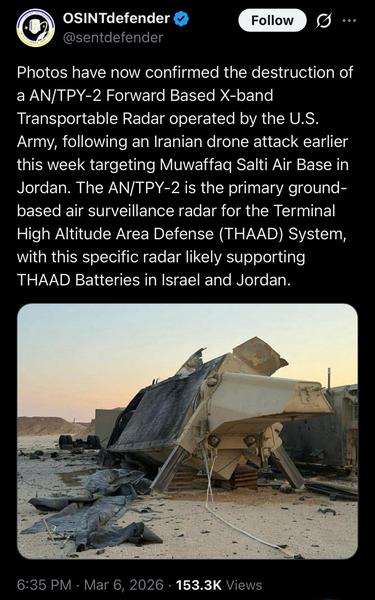
The effects of that campaign will really begin to tell in the next couple of weeks. It also seems clear that they can more or less hit what they target (bases, radars, ships, etc) with few exceptions and don't require huge waves of strikes to do so.
But they often don't do that much damage. And much of what they're targeting isn't well protected. If they hit a major USAF air operations hub with a couple of hundred inbounds they could substantially disrupt its operations. If they hit it with single digit inbounds, the impact becomes far more manageable

The war is unpopular in the US and will only become worse as economic effects tell. Trump will be under increasing pressure to find an off-ramp, which may not really exist.
This isn't a path to victory. It's a hope for survival.

Iran on the other hand will more than likely be able to endure the pounding. Unless you choose to believe IDF/CENTCOM propaganda, there really is no way to know how degraded missile launch capability is; based on visual evidence/air siren alerts, it seems missile launches have been pretty steady over the last few days, with consistent impacts. Iran knows the only path to a favorable outcome is to hunker down and eat bombs while maintaining an attrition strategy against the Gulf economy.

Will be curious how things evolve as interceptor stocks dwindle.
I agree on this part. But there are other things Iran should be doing.
 
I agree it's hard to tell. But it doesn't look like Iran has managed to disrupt USAF operations, which means the strikes can continue largely unhindered. And this is despite the clearly inadequate air defenses across the region. Again look at what Russian strike waves into Ukraine look like. Iran should be at least attempting similar attacks.
I'm curious to what extent they ever really thought they would disrupt USAF operations. Not sure why, but they never bought high end AD from the Russians or the Chinese. Feels like their strategy has been to dig into the mountains. And honestly I can see why. If you have limited resources, why spend them on fighting the best SEAD/DEAD operation in the world? Iran is a very big country, with places to hide.

It would make a lot of sense to weather the storm for a few weeks and not expose too much. Especially if they can attrit UAVs, which are probably the biggest threat overall.


But they often don't do that much damage. And much of what they're targeting isn't well protected. If they hit a major USAF air operations hub with a couple of hundred inbounds they could substantially disrupt its operations. If they hit it with single digit inbounds, the impact becomes far more manageable
I'd say the early warning radars are very significant, and they don't have to do much damage to oil/port facilities to have a big impact. Again, usual FOW caveats apply but my guess would be they are holding back capabilities in order to weather the air war storm a bit as well as waiting for interceptor stocks to dwindle. We didn't see any massed launches at all like we saw against Israel after the embassy bombing, or the 12 day war.


This isn't a path to victory. It's a hope for survival.
Isn't survival equivalent to victory for Iran? If the US gives up on trying to destroy them, they will also need to cut a somewhat Iran-favorable deal to get the Gulf economies back on line.
 

Feanor

Super Moderator
Staff member
I'm curious to what extent they ever really thought they would disrupt USAF operations. Not sure why, but they never bought high end AD from the Russians or the Chinese. Feels like their strategy has been to dig into the mountains. And honestly I can see why. If you have limited resources, why spend them on fighting the best SEAD/DEAD operation in the world? Iran is a very big country, with places to hide.

It would make a lot of sense to weather the storm for a few weeks and not expose too much. Especially if they can attrit UAVs, which are probably the biggest threat overall.
The best way to disrupt USAF operations is by hitting their bases and supporting infrastructure in a massive way. I don't think Iran could realistically build an IADS that the US wouldn't overcome and relatively quickly. I don't know what Iran thought, but I know if I was them, I would certainly try to hit those bases especially early and hard. Before the US learns how to handle the Shahed threat effectively. Instead of a drone hitting a storage facility or a hangar here or there, they should be hitting everything and as close to all at once as they can. It maximizes impact and overloads the other side. With how unimpressive drone defense is now, a few thousand Shaheds could do absolutely catastrophic damage and impose a very high cost. And I suspect it would disrupt USAF operations.

I'd say the early warning radars are very significant, and they don't have to do much damage to oil/port facilities to have a big impact. Again, usual FOW caveats apply but my guess would be they are holding back capabilities in order to weather the air war storm a bit as well as waiting for interceptor stocks to dwindle. We didn't see any massed launches at all like we saw against Israel after the embassy bombing, or the 12 day war.
The strikes on radars are probably, at least militarily, the best choice. Maybe they can target Patriot sites directly? It would only take several dozen Shaheds to take out a Patriot battery. Any jets forced to do drone defense are jets not available for operations against Iran.

Isn't survival equivalent to victory for Iran? If the US gives up on trying to destroy them, they will also need to cut a somewhat Iran-favorable deal to get the Gulf economies back on line.
Maybe. It depends on how thoroughly this campaign can destroy Iranian strike capabilities. A long enough campaign can take out facilities that produce Shaheds, destroy the power grid, etc.
 

swerve

Super Moderator
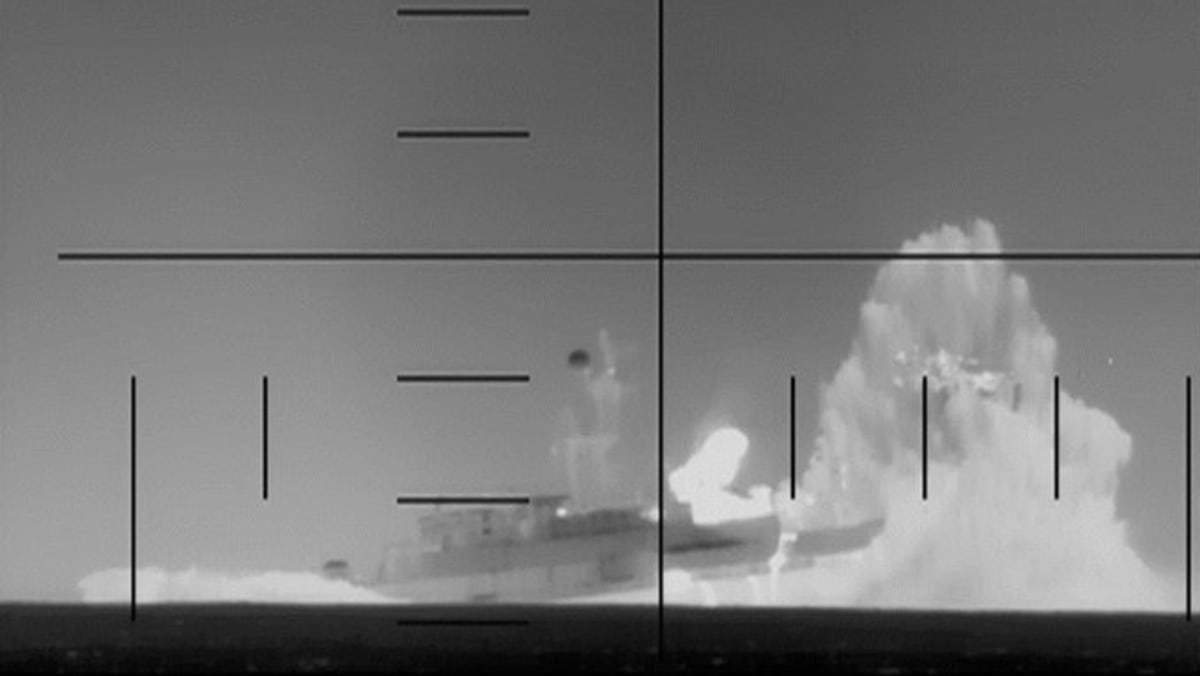
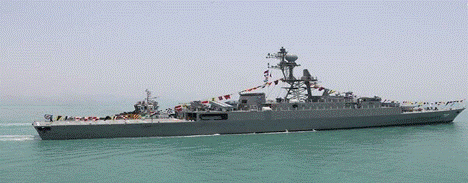
Curious situation with IRIS Dena. She was just in India to attend the International Fleet Review (IFR2026) and MILAN 2026 exercises. With war breaking out, it would have made sense for her to shelter in a port outside of Iran.

And now she is sinking in Sri Lanka's territorial waters.

If she was attacked by US forces, it would be a significant escalation. One, it signals all Iranian military assets overseas are potential targets, and two, it is a grave violation of another nation who had no business in the conflict (which is an unsanctioned military operation by the US and Israel)

Whatever you think of the sinking of a ship which was no threat at all, it wasn't "a grave violation" of any country other than Iran. It was in international waters, about 40 nautical miles off the coast of Sri Lanka. Territorial waters are limited by UNCLOS to 12 nautical miles.
 

koxinga

Well-Known Member
Whatever you think of the sinking of a ship which was no threat at all, it wasn't "a grave violation" of any country other than Iran. It was in international waters, about 40 nautical miles off the coast of Sri Lanka. Territorial waters are limited by UNCLOS to 12 nautical miles.
I erred as the initial reports were unclear and described the action as taking place within Sri Lanka waters.

I have no issues with the action taken by the USN skipper since he was given an order and the US is in active conflict with Iran at the moment. But I still see this as a grave escalation and violation in the larger geopolitical context. Why?

The current attacks on Iran is a unilateral action based on national interests (of the US and Israel) and done with no consultation of allies or the GCC. While it is a reality that we have to deal with, extending military action far outside that theatre is... unnecessarily provocative.

Comparing it with the sinking of ARA General Belgrano is also a case of false equivalence:

1. Argentina had invaded the Falklands, the jus ad bellum for UK action is clear (UK's sovereignty was violated via armed action and continued occupation) - The current US/Israel actions has very weak justifications in a traditional sense and is not endorsed by the international community of UN.

1. While ARA General Belgrano was not in the Total Exclusion Zone (TEZ), even the Argentinians acknowledged it was participating in combat actions and operating within general theatre of operations, hence she is an active participant. The IRIN Dera was two thousands miles away.

If her Captain is determined to bring her to the Gulf of Hormuz which is an active combat zone, by all means do it near there and don't make Sri Lanka clean up the aftermath.
 
Last edited:
Top