Space telescope news

John Fedup

The Bunker Group
The James Webb space telescope is progressing along toward its October 2021 launch date. As the Hubble telescope nears its end the new scope hopefully gets into orbit and successfully sends back images. Resulting images should be even more spectacular than Hubble’s awesome images!

James Webb Space Telescope's golden mirror in final test James Webb Space Telescope's golden mirror in final test
 
I was doing a basic uni physics course for dummies back in 1989 when the Hubble Telescope was being prepared for launch (launched 1990). It was a course that covered everything from cosmology to quantum physics in terms that idiots could understand. Turned out to be one of the best and most interesting courses that I did at university. Anyway the lecturer was an astrophysicist and he waxed lyrical on the Hubble, explaining it in terms that the fulla and fulless off the street could easily understand. So ever since then I have followed it with interest.

The images that the Hubble telescope have recorded have been absolutely stunning in detail. Even the ones they gathered when they found that they had made a horrendous mistake in the lens shaping, resulting in blurring on images. Once they rectified that later on, we got the stunning images that we are so used to seeing. The James Webb Telescope images will make the Hubble images look like Polaroid shots. I wonder how far away and back in time it will allow us to look. How close will we get to look at the big bang and the beginning of this universe time?
 
The James Webb space telescope is progressing along toward its October 2021 launch date. As the Hubble telescope nears its end the new scope hopefully gets into orbit and successfully sends back images. Resulting images should be even more spectacular than Hubble’s awesome images!

James Webb Space Telescope's golden mirror in final test James Webb Space Telescope's golden mirror in final test
I`ve also heard about Ariel space telescope and, it has the same purpose as James Webb Space Telescope to search for planets found beyond our solar system, otherwise known as exoplanets or extrasolar planets.
 
As I understand the Ariel mission is to look for exoplanets in order to analyze atmospheric properties. The Webb scope features a huge mirror and will use IR frequencies to search out the most distant objects in the universe.
 
Probably with such technology like the telescope like Ariel space telescope or the most expensive telescope by NASA James Webb Space Telescope will give us a hint at the possibility of other forms of life that can exist somewhere in another galaxy or atleast define more accurate the planets that can remind Earth. (Both of the telescopes are aimed to look for some new exoplanets or planets that can remind Earth). To find more information about Ariel space telescope check here
 
Looking forward to a successful mirror deployment and first images from the “Webb” on the web.;)
This is the sequence of the deployments of the major components in the first 29 days.


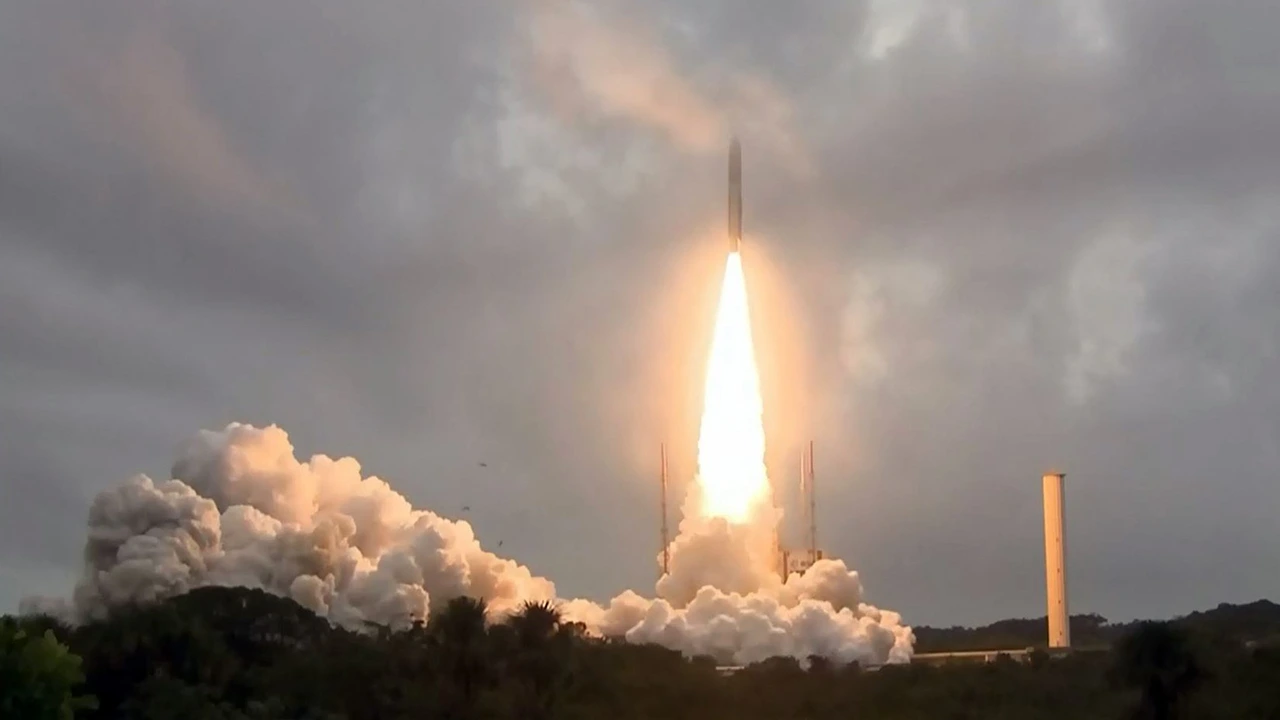
The actual launch.


The James Webb Space Telescope will be ready for the scientific observations after 6 months.
Btw, the observatory’s Fine Guidance Sensor and Near-Infrared Imager and Slitless Spectrograph are from a certain country....
 
Last edited:
This is the sequence of the deployments of the major components in the first 29 days.


The actual launch.


The James Webb Space Telescope will be ready for the scientific observations after 6 months.
Btw, the observatory’s Fine Guidance Sensor and Near-Infrared Imager and Slitless Spectrograph are from a certain country....
Yes, there are a few things that happen here but there should be more.
 
This Nature article describes the difficult journey to get the Webb into space. Assuming it works as expected, the difficulties encountered during the program will likely be forgotten.

 
now for a space telescope with a difference. Princeton University have mounted a super pressure imaging telescope on a very large balloon. The balloon was launched from Wanaka Airport NZ this morning afternoon. appears to be testing and qualify the technology to see if it can offer any cost saving measures in lieu of space flight.

One hopes it does not drift over the Chinese mainland.

It's a cunning Kiwi plan to spy on Tasmania.
 
Back
Top