Not to dispute this was the intent from the very beginning, of course...
Last edited:

Not to dispute this was the intent from the very beginning, of course...
Not exactly. The locks are in fact 24.4m wide, but the typical Seaway freighter (Seawaymax) will have a beam of 23.8 in order to give a bit of room for margin. That does not mean a vessel with a beam of 24m can't transit the locks, however, if extra care is taken, and there are may examples of this happening during the history of the canal. And now, with the new hands-free mooring system that eliminates the mooring cables (in favour of vacuum pads), it's anticipated that the Seawaymax specification will be increased to 24m anyway. The only area I see Heddle Marine being deficient is with respect to the requirement that a yard will be currently building (or will have built recently) a vessel of at least 1000 tonnes displacement. Given these new icebreakers will likely be even larger (probably quite a bit larger, given the currently tasked vessels are all in the 4-6000 ton range, full load), this seem like a reasonable requirement.

Government updated the requirement: Feds amend shipyard search criteria, extend deadline following complaint
 Perhaps Ontario’s premier, Doug Ford, should be pressuring Ottawa for this build for Great Lakes icebreakers. After all, all but one of these lakes border on only one Canadian province, Ontario!

Finally the RCN is getting mexiflotes for use from its new supply ships.
Canada buying ship-to-shore connectors for its Joint Support Ships
I posed this question to a Federal Fleet Services employee but received no response about a month ago. This is a great moment for the RCN and the CAF as a whole as it gives much greater ability to move equipment from sea to shore.
 Apparently MAN has been awarded the engine contract so things are slowly progressing.

Have they started building the AORs yet? If not, it would seem that they are getting a bit ahead of themselves!
Yes, construction started June 2018. You can see the progress update photos at the bottom of the following web page: Joint Support Ships | SeaspanHave they started building the AORs yet? If not, it would seem that they are getting a bit ahead of themselves!

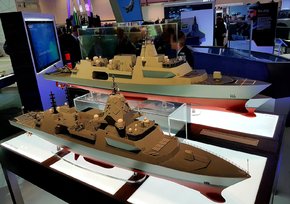
Wow they are going to be quite different ships, it seems like they are different in every possible way around a common hull. Even the same things are in different positions (Harpoons?). Even doors and access hatches seem slightly different.Just want to share this photo i found on twitter taken by someone in DSEI2019, the models of both Canadian and Australian Type 26 alongside each other.
I noticed that as well. I think it could be as simple as the Australian ships are more advanced in the design phase, whereas Canada is still in the Requirements definition phase, so the CSC models are more of a guess as to what the final ship design will look like.Wow they are going to be quite different ships, it seems like they are different in every possible way around a common hull. Even the same things are in different positions (Harpoons?). Even doors and access hatches seem slightly different.

Just want to share this photo i found on twitter taken by someone in DSEI2019, the models of both Canadian and Australian Type 26 alongside each other.