Middle East Defence & Security

rsemmes

Active Member
Two points of view on the resurgence of combat...
El Memorando de Entendimiento no debe interpretarse como una concesión gratuita a Teherán, sino como el reconocimiento de que la guerra ha reducido el margen de maniobra de ambas partes. Como resume en su análisis, "los términos del acuerdo representan una sumisión no a Teherán, sino a la realidad".
Por eso, plantea una pregunta incómoda para los más belicistas: ¿Cuál es la alternativa? ¿Más bombardeos? ¿Más sanciones? ¿Una guerra todavía más larga?. Su respuesta es que ninguna de esas opciones garantiza un resultado mejor y que todas implican asumir costes adicionales para Estados Unidos y sus aliados.

The Memorandum is not a surrender to Tehran, but to reality. (What reminds me of Russia-Ukraine, a peace agreement is not a surrender, but facing reality.) A reality that leads us to a difficult question: What is the option? More bombing, more sanctions, a longer war? None of those options make a better result certain and all of them imply a higher cost. (And again, what is a good option for Ukraine?)

-https://www.theatlantic.com/ideas/2026/07/iran-controls-war-trump/687848/ (Paywall)-
El analista de The Atlantic, Tom Nichols, llega a una conclusión distinta. Sostiene que la Administración estadounidense ha dejado de marcar el ritmo de la guerra y actúa cada vez más en respuesta a las decisiones de Teherán. En su opinión, Washington sobrestimó la fragilidad del régimen iraní, infravaloró su capacidad para mantener la presión sobre Ormuz y terminó reaccionando a una escalada que ya no controla plenamente.
Así, la superioridad militar estadounidense puede seguir produciendo victorias tácticas sin lograr una solución política al conflicto, y ahí reside precisamente el auténtico cambio estratégico. La Casa Blanca ya no bombardea únicamente para responder a un ataque. Bombardea porque el tiempo ha dejado de jugar a su favor y sus misiles ya forman parte de la negociación.

Washington is no longer in control, just reacting to Tehran. This new bombing campaign is part of the negotiation, time is against the US.
 

John Fedup

The Bunker Group
Two points of view on the resurgence of combat...

El Memorando de Entendimiento no debe interpretarse como una concesión gratuita a Teherán, sino como el reconocimiento de que la guerra ha reducido el margen de maniobra de ambas partes. Como resume en su análisis, "los términos del acuerdo representan una sumisión no a Teherán, sino a la realidad".
Por eso, plantea una pregunta incómoda para los más belicistas: ¿Cuál es la alternativa? ¿Más bombardeos? ¿Más sanciones? ¿Una guerra todavía más larga?. Su respuesta es que ninguna de esas opciones garantiza un resultado mejor y que todas implican asumir costes adicionales para Estados Unidos y sus aliados.

The Memorandum is not a surrender to Tehran, but to reality. (What reminds me of Russia-Ukraine, a peace agreement is not a surrender, but facing reality.) A reality that leads us to a difficult question: What is the option? More bombing, more sanctions, a longer war? None of those options make a better result certain and all of them imply a higher cost. (And again, what is a good option for Ukraine?)

-https://www.theatlantic.com/ideas/2026/07/iran-controls-war-trump/687848/ (Paywall)-
El analista de The Atlantic, Tom Nichols, llega a una conclusión distinta. Sostiene que la Administración estadounidense ha dejado de marcar el ritmo de la guerra y actúa cada vez más en respuesta a las decisiones de Teherán. En su opinión, Washington sobrestimó la fragilidad del régimen iraní, infravaloró su capacidad para mantener la presión sobre Ormuz y terminó reaccionando a una escalada que ya no controla plenamente.
Así, la superioridad militar estadounidense puede seguir produciendo victorias tácticas sin lograr una solución política al conflicto, y ahí reside precisamente el auténtico cambio estratégico. La Casa Blanca ya no bombardea únicamente para responder a un ataque. Bombardea porque el tiempo ha dejado de jugar a su favor y sus misiles ya forman parte de la negociación.

Washington is no longer in control, just reacting to Tehran. This new bombing campaign is part of the negotiation, time is against the US.
The only solution is boots on the ground, preferably with allies (like GW 1) to end the ayatollahs and their republican guard albeit Trump piSSing off most of America's allies makes this solution impossible. The other option, equally impossible, is to give the ayatollahs want the want, nukes...from the bomb bay doors of a B-2 along with ballistic missiles.
 

John Fedup

The Bunker Group
Boots on the ground in Iran is science fiction.
Not science fiction, a solution that might have been supported by allies (including ME allies) with any US president other than Trump to end the ayatollah rot in Iran. As for the final outcome, it could be something that normal people absolutely don’t want but would be perfectly acceptable to ayatollahs.
 
A full-scale invasion of IRAN? I think that the war in Iraq and Afghanistan have shown us what would happen after the war was "won" and a full-scale insurgency got some time to get up to steam. Just as Israel is learning again and again, you cant kill yourself to a lasting peace deal. The only way to deal with Iran is a Carrot and stick approach in which both the carrots and sticks are big enough to entice certain behaviors.
 
Last edited:

rsemmes

Active Member
The only solution is boots on the ground, preferably with allies (like GW 1) to end the ayatollahs and their republican guard albeit Trump piSSing off most of America's allies makes this solution impossible. The other option, equally impossible, is to give the ayatollahs want the want, nukes...from the bomb bay doors of a B-2 along with ballistic missiles.
Oh well, if you are just for the US imposing its will through nukes... You should explain that to Greenlanders.

If we go back to a world without American dictators and his obedient servants... How many boots? How many casualties to get there? How long do they have to be there? The same level of corruption that in Iraq or more? Do you want to impose another bloody dictator like the Shah o can Trump rule them as a Viceroy? Why should allies support the expansion of the American Empire? Is US the ruler of the world?
Do you support those who want to end Republican rot in the US too?

It seems that you are quite happy with criminal and illegal invasions, only if done by the US?
 

SolarisKenzo

Well-Known Member
Not science fiction, a solution that might have been supported by allies (including ME allies) with any US president other than Trump to end the ayatollah rot in Iran. As for the final outcome, it could be something that normal people absolutely don’t want but would be perfectly acceptable to ayatollahs.
To think that you can invade a 92 million people country, with its 1 648 195 km^2 mostly covered by mountains and a millenary history as a regional power is not even science fiction, its beyond it.

To be honest I think that even the airstrikes on Iran that started in february are the result of having mad men in power. Totally disconnected from reality.
Look at where the US are now. Did they solve anything? Apart from killing politicians and leaders of sovereign states, violating basically every international law, causing a world-wide energy shortage and destroying the last bits of their reputation while guaranteeing the iranian regime a bright future of government...

Also, I totally see europeans or middle eastern sending troops to invade Iran. 100%. It's not even funny as a joke.
Trump's been crying for the last 4 months because the euros completely trashed him and refused to even let his jets refuel in Europe.
Do you see anyone joining last minute for a suicidal invasion?

Come on, one must be either completely blind or plain stupid to not understand that if the middle east is a complete shit show, devastated by war and full of terrorism, is mostly thanks to the policies of the US and israel after 1948.
 

rsemmes

Active Member
US President Donald Trump declared the return of a naval blockade on Iranian ports on Monday, saying Washington would impose hefty fees on ships transiting the Strait of Hormuz as fighting once again flared over the vital waterway.
On Monday, Trump said the US would demand a 20% tariff on all cargoes shipped through the strait of Hormuz. Until now, the US had said the strait should remain open to all without tolls – as it was before Washington and Israel attacked Iran on 28 February. Any attempt by the US or Iran – which has also proposed tolls – to charge fees would violate global norms on freedom of navigation and would be likely to cause further economic disruption far beyond the region.
And Rubio wants to dismantle the ICC because interfere with US military operations.

Who is the enemy? When are we going to start to support the right to self-defence? To defend International Law?
Up Greenland!
 

Redshift

Active Member
US President Donald Trump declared the return of a naval blockade on Iranian ports on Monday, saying Washington would impose hefty fees on ships transiting the Strait of Hormuz as fighting once again flared over the vital waterway.
On Monday, Trump said the US would demand a 20% tariff on all cargoes shipped through the strait of Hormuz. Until now, the US had said the strait should remain open to all without tolls – as it was before Washington and Israel attacked Iran on 28 February. Any attempt by the US or Iran – which has also proposed tolls – to charge fees would violate global norms on freedom of navigation and would be likely to cause further economic disruption far beyond the region.
And Rubio wants to dismantle the ICC because interfere with US military operations.

Who is the enemy? When are we going to start to support the right to self-defence? To defend International Law?
Up Greenland!
Yes but what about Ukraine????
 

KipPotapych

Well-Known Member
And Rubio wants to dismantle the ICC because interfere with US military operations.
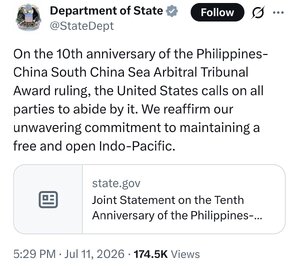
While calling on to abide by something they never subscribed to:

IMG_5877.jpeg


Yes but what about Ukraine????
It’s fucked (pardon my language). Luckily, it somehow made us believe that we need Ukraine more than Ukraine needs us (copyright Stubb most recently, but many others as well), so we still talk about it. Iran has to actually illustrate it because it was attacked by a wrong country (or wrong countries). No?
 

Redshift

Active Member
While calling on to abide by something they never subscribed to:

View attachment 55191


It’s fucked (pardon my language). Luckily, it somehow made us believe that we need Ukraine more than Ukraine needs us (copyright Stubb most recently, but many others as well), so we still talk about it. Iran has to actually illustrate it because it was attacked by a wrong country (or wrong countries). No?
Yes but what about Russia, won't somebody think about poor Russia?
 

Feanor

Super Moderator
Staff member
Yes but what about Russia, won't somebody think about poor Russia?
Russia has contributed their part to the current Middle East, as did the USSR. But in this part of the world they're not even second fiddle at this point.
 
Pretty good article by Iran expert Vali Nasr on the strategic calculus of Iran's decision to restart hostilities

I was very surprised when the initial ceasefire was signed but things are starting to get a little clearer. Trump at least nominally conceded a lot of points a lot quicker than I'd have imagined. But it's beginning to look like that was primarily about buying time. Costs were beginning to mount, not the least of which was interceptor inventory, and there was no good plan to take on Iranian control of the Strait. I'm also beginning to suspect that the MOU itself was primarily intended (from the US side) to create a frozen conflict, with the US gradually prying away control of the Strait via their alternate route. The end result would be a return to normal for the global economy without any kind of further concession to Iran, and Iran would have to restart the war to get anything more, painting them as the global villain. The US may have had no intention at all of delivering on their commitments.

The question is, now what? The Iranians are calling Trump's bluff. They would probably accept a true return to the MOU, but now Trump knows they will break it quickly if they don't trust his level of commitment to the terms. If Trump is anything I suppose he's unpredictable so anything could happen. But I'm wondering if we won't see a level of escalation that even the first round didn't have (boots on the ground) as Trump desperately searches for a way to claw back leverage at the negotiating table. Delaying tactics aren't viable any more.
 

Feanor

Super Moderator
Staff member
Pretty good article by Iran expert Vali Nasr on the strategic calculus of Iran's decision to restart hostilities

I was very surprised when the initial ceasefire was signed but things are starting to get a little clearer. Trump at least nominally conceded a lot of points a lot quicker than I'd have imagined. But it's beginning to look like that was primarily about buying time. Costs were beginning to mount, not the least of which was interceptor inventory, and there was no good plan to take on Iranian control of the Strait. I'm also beginning to suspect that the MOU itself was primarily intended (from the US side) to create a frozen conflict, with the US gradually prying away control of the Strait via their alternate route. The end result would be a return to normal for the global economy without any kind of further concession to Iran, and Iran would have to restart the war to get anything more, painting them as the global villain. The US may have had no intention at all of delivering on their commitments.

The question is, now what? The Iranians are calling Trump's bluff. They would probably accept a true return to the MOU, but now Trump knows they will break it quickly if they don't trust his level of commitment to the terms. If Trump is anything I suppose he's unpredictable so anything could happen. But I'm wondering if we won't see a level of escalation that even the first round didn't have (boots on the ground) as Trump desperately searches for a way to claw back leverage at the negotiating table. Delaying tactics aren't viable any more.
Its looking like the fighting between Yemen and the Saudis is picking up again too.
 

crest

Active Member
Pretty good article by Iran expert Vali Nasr on the strategic calculus of Iran's decision to restart hostilities

I was very surprised when the initial ceasefire was signed but things are starting to get a little clearer. Trump at least nominally conceded a lot of points a lot quicker than I'd have imagined. But it's beginning to look like that was primarily about buying time. Costs were beginning to mount, not the least of which was interceptor inventory, and there was no good plan to take on Iranian control of the Strait. I'm also beginning to suspect that the MOU itself was primarily intended (from the US side) to create a frozen conflict, with the US gradually prying away control of the Strait via their alternate route. The end result would be a return to normal for the global economy without any kind of further concession to Iran, and Iran would have to restart the war to get anything more, painting them as the global villain. The US may have had no intention at all of delivering on their commitments.

The question is, now what? The Iranians are calling Trump's bluff. They would probably accept a true return to the MOU, but now Trump knows they will break it quickly if they don't trust his level of commitment to the terms. If Trump is anything I suppose he's unpredictable so anything could happen. But I'm wondering if we won't see a level of escalation that even the first round didn't have (boots on the ground) as Trump desperately searches for a way to claw back leverage at the negotiating table. Delaying tactics aren't viable any more.
i think the issue of lebanon aswell as trumps diplomatic skills is also high on that list as a factors. iran gains a mesure of soft power in the region aswell as by default hard power as it is supporting the forces acting against israel. i mean soft power with the populations at large no so much with all leadership tho in some areas i think it gains more then is publicly admitied. this i would say even extends to westren countries israel is not populare worldwide right now, nor is the u.s for that matter so a country even a paria like iran well i wont say gians alot here but lets say avoids alot of the condemnation and actions that one would have expected normaly.

the biggest problome i see in making peace is honestly a lack of trust. its hard to see how any leader in iran will be able to sell the idea of a peace with the u.s that dosnt involve either the u.s leaving the region or....and here i dont know what the u.s could offer that would be significant enough to placate the hardliners at least not yet tho this is war and circumstances may of cource change.

the u.s has imop greatly harmed its negoitating ability not position i mean actual ability to negotiate with iran to the degree that i think if the military hasnt taken that factor into account druing there wargaming they are seriously misscalcuating the level of restiance that opposes them.

iran like most countries has domestic powerstrugles unfoutunetly for the u.s there actions have made that less a vunerabilty to be explotied then a problom that needs to be overcome
 
Last edited:
Top